Why HVAC Companies Are Replacing Manual Scheduling in 2026
March 18, 2026
You open your HVAC business Google page, and your heart sinks. A string of one-star reviews criticizes your company for lacking reliable service, which is an essential pillar to build a strong reputation.
The problem is not your service quality or equipment; it is the missed appointments, delayed arrivals, and poor scheduling coordination that hold you back!
Any HVAC company that wants to stay competitive and protect its reputation needs the best-fit software to turn its operations into a growth asset. And automation is the key, and all the tools that were once considered "nice to have" with reservations for larger enterprises are now essential for all!
Why HVAC Companies Are Shifting to HVAC Scheduling Software and Digital Tools?
Modern homeowners are embracing a digital-first era, expecting instant responses and efficient services with just a few clicks.
Digitization empowers contractors to focus on growth strategies and build strong customer relationships rather than battling broken workflows and manual processes. Investing in HVAC business software is one of the smartest decisions companies can make this year to enhance operational efficiency and meet rising customer expectations.
With AI-powered dispatch, real-time mobile app communication, automated invoicing, in-built CRM with customer details, and compliance management, the HVAC software tools help businesses respond faster and operate smarter.
Key Takeaways
- Streamline Operations: It is important to shift from paper-based processes and spreadsheets needing manual entries to fully automated software to streamline business operations, eliminating errors that hurt revenues and customer retention.
- Cloud-Based Features: The HVAC software should be a cloud-based platform offering essential features such as automated lead pipeline management, customer management tools, intelligent dispatch, optimized scheduling, real-time alerts, financial processing, and advanced analytical tools.
- Performance Improvement: The HVAC software is essential for boosting customer satisfaction, improving technician productivity, and increasing profit margins.
See How Modern HVAC Scheduling Software Works
Manual scheduling may work for small teams in the early stages, but as service demand grows, it quickly becomes a bottleneck. Modern HVAC scheduling platforms help contractors streamline dispatching, improve technician coordination, and deliver more reliable service to customers.
Hop on a quick demo with our team of experts and explore the power-packed features of HVACBase Scheduling and Dispatching Software as the right tool for smarter operations.
Paper Calendars, Whiteboards & Text Chains: Still Common in 2026?
A. The Reality of Paper-Based Operations
The whiteboard and stick notes used in team hurdle meetings live in offices, and your teams are active on the field, battling new challenges.
As a result text messages get trapped in text threads, and you often lose important inventory order numbers, customer interactions and preferences, or compliance documents, delaying permits and stalling work at job sites.
You depend on guesswork while HVAC techs tackle traffic, overruns, scheduling errors, and inventory mismatches, and lose out on the opportunity to service new emergency calls.
B. What It Really Costs You
1. Double bookings and scheduling conflicts
Disorganized job scheduling can lead to double bookings, missed appointments, and assigning the wrong technicians due to skill mismatches or unavailability that ultimately fails to deliver a satisfactory customer experience.
2. Missed Follow-Ups with Potential Clients
Missed appointments, late arrivals due to unoptimized routes, and slow customer responses frustrate clients. This hurts conversion rates, increasing the risk of negative reviews, and putting long-term business sustainability at risk.
3. Longer Routes and Delays
Mapping out longer routes and ignoring real-time factors like sudden weather changes or traffic conditions can cause HVAC technicians to arrive late or miss critical lead appointments.
4. Technician Idle Time
HVAC technicians spend idle time circling longer routes to drive between jobs and waiting for inventory parts at job sites, which wastes productive hours and can generate revenue
5. Communication Breakdown
The constant phone calls and text messages fail to keep clients, managers, and techs connected at all times. This falters schedules, breaks the entire business operational flow, looses revenue during peak seasons, and fails to serve emergency callouts.
What Is HVAC Scheduling Software (And Why It’s Booming in 2026)?
If manual scheduling and dispatching are no longer viable, then what exactly is here to replace them in the HVAC industry? The answer is simple: It is the HVAC Scheduling Software. Let us first know what it really means!
HVAC Scheduling Software is a powerful digital tool that helps contractors efficiently plan service calls during busy or slow seasons, as well as for special job requirements. It ensures the right technician is assigned to the right job, reducing burnout and workflow pressure, while providing real-time updates, automated follow-ups, and offline functionality to support fast-moving, remote field operations.
The need for these tools is growing rapidly. The U.S. HVAC industry is forecasted to grow at a compound annual growth rate of 6.9%. Yet field HVAC business owners are grappling with a shortage of more than 11,000 skilled HVAC techs.
The imbalance of inadequate staff members and a high volume of jobs creates immense pressure on scheduling, dispatch, and daily operations. Several hours and efforts are wasted on admin activities, directly impacting profit margins.
To streamline operations and maintain productivity, many HVAC companies are now adopting HVAC Field Service Software that connects scheduling, dispatch, and job management across desktop platforms and mobile apps for technicians on the go.
What are the Core Features of HVAC Software that Modern HVAC Teams Rely On?
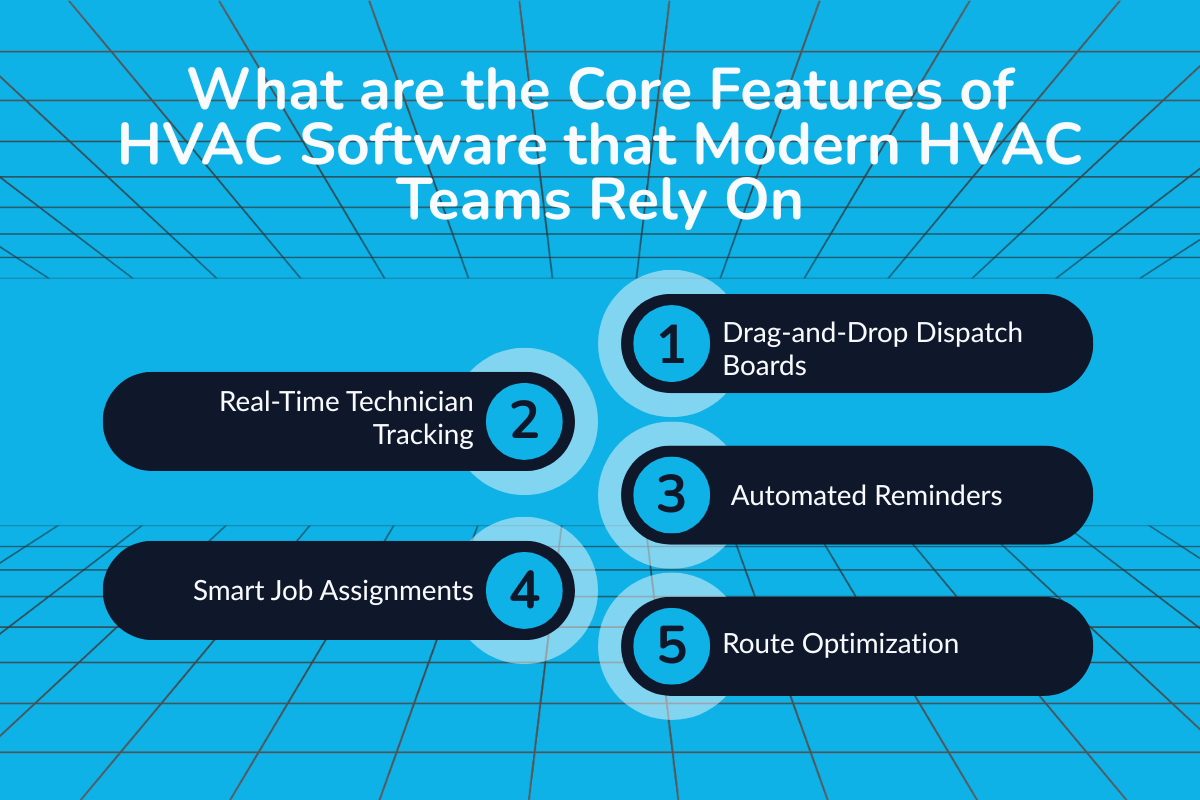
1. Drag-and-Drop Dispatch Boards
A standout feature in modern HVAC platforms is the drag-and-drop dispatch board, which allows dispatchers to visually manage daily technician schedules.
For teams handling dozens of service calls daily, the dispatch board effectively becomes the command center for field operations.
2. Real-Time Technician Tracking
Real-time technician tracking gives dispatchers complete visibility into where technicians are located and which jobs they are currently working on.
GPS-enabled tracking allows teams to assign nearby service calls, reroute technicians during emergencies, and provide customers with accurate arrival updates.
For HVAC companies operating across large service areas, this feature significantly reduces travel inefficiencies and improves on-time service delivery.
3. Automated Reminders
Automated reminders play a critical role in improving the customer experience while reducing administrative workload. HVAC scheduling platforms automatically send appointment confirmations, service reminders, and technician arrival notifications through SMS or email.
4. Smart Job Assignments
Smart job assignment tools allow HVAC companies to automatically match jobs with the most suitable technicians. So instead of relying on manual dispatch decisions, the software considers technician skills, certifications, workload, and geographic proximity when assigning service calls.
5. Route Optimization
Route optimization allows HVAC businesses to complete more service calls without increasing technician work hours. The software calculates the most efficient travel routes between jobs based on distance, traffic conditions, and service priorities.
By minimizing unnecessary travel, HVAC companies can convert more technician time into billable service work while also reducing fuel costs.
5 Signs Your HVAC Service Business Has Outgrown Manual Scheduling
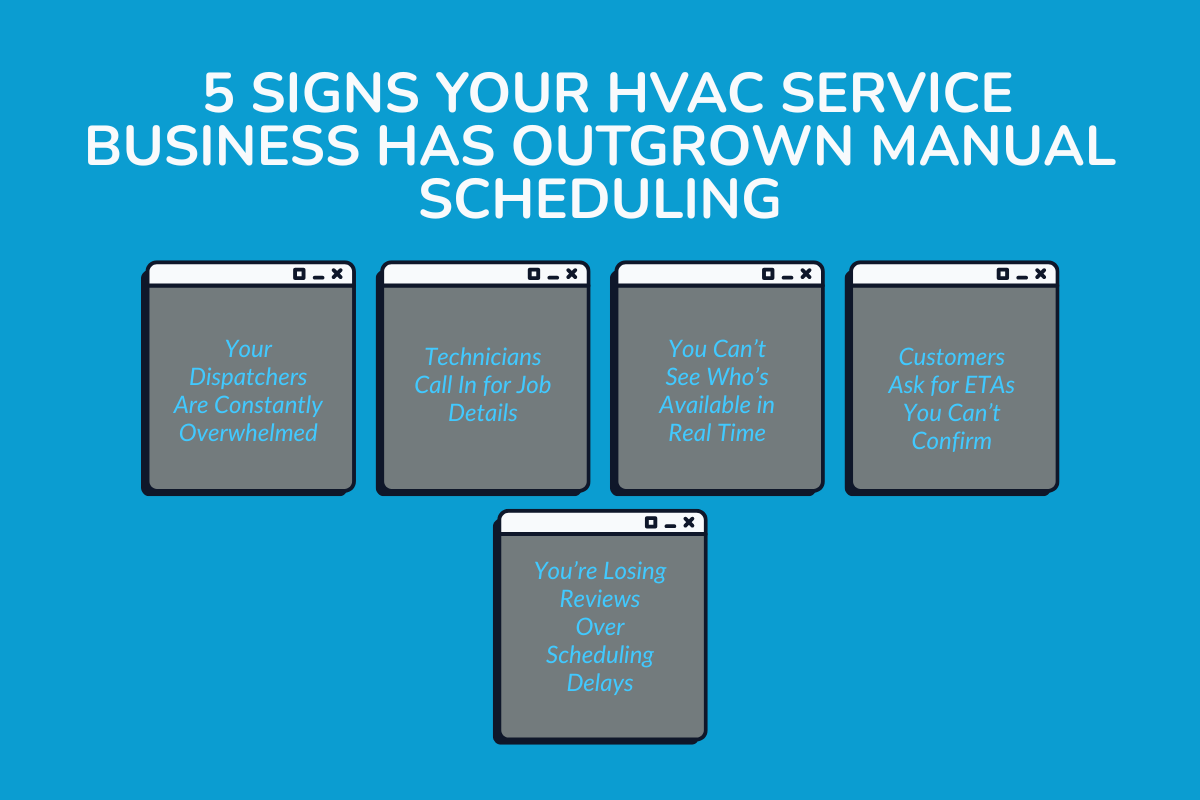
1. Your Dispatchers Are Constantly Overwhelmed
If you see these signs, then you definitely need better dispatch management:
- When you have multiple missed calls and messy schedules that lead to overlap.
- HVAC techs circle longer routes, covering minimal distance but experiencing maximum fuel burnout.
- HVAC techs feel out of place and confused with multiple job details, which drops overall business performance.
- Customer communications are inconsistent, leading to frustrated clients and negative reviews.
2. Technicians Call In for Job Details
If your office staff spends the entire day answering calls from technicians looking for job details, it creates a serious operational bottleneck.
If you notice these situations happening regularly, your scheduling system may be outdated:
- Technicians frequently calling the office to confirm job instructions or service details.
- Field teams requesting equipment history, maintenance records, or customer information during service visits.
- Office staff spending large portions of the day resolving technician queries instead of managing schedules.
- Valuable technician time being lost on administrative back-and-forth instead of completing service calls.
3. You Can’t See Who’s Available in Real Time
Without real-time visibility into technician schedules, assigning jobs becomes slow and uncertain. If your scheduling process looks like this, your team may be relying too heavily on manual coordination:
- Managers guessing which technician might be available for a new job request.
- Multiple calls or messages required to confirm technician availability.
- Delays in assigning emergency service calls.
- Online booking requests waiting too long before being confirmed.
4. Customers Ask for ETAs You Can’t Confirm
Customers often want accurate arrival times, especially for urgent repairs. Without proper visibility into technician locations and job progress, providing reliable ETAs becomes difficult.
Common signs include:
- Customers frequently calling to ask when the technician will arrive.
- Dispatchers estimating arrival times based on guesswork instead of real data.
- Technicians arriving later than expected due to traffic or earlier job delays.
- Customer frustration increasing when ETAs constantly change.
5. You’re Losing Reviews Over Scheduling Delays
Scheduling problems don’t just affect operations — they directly impact customer satisfaction and online reviews.
If these issues occur regularly, scheduling inefficiencies may be damaging your reputation:
- Jobs running late because technicians are overbooked.
- Service appointments delayed due to poor route planning.
- Customers waiting longer than expected for technicians to arrive.
- Negative reviews mentioning missed appointments or late service.
Manual vs Modern HVAC Operations: The Real Difference
The benefits of HVAC software usually outweigh the manual process. Let's have a quick look at the comparison:
Side-by-Side Comparison
| Task | Manual Scheduling and dispatching | HVAC Software for dispatch and scheduling |
|---|---|---|
| Job booking | Relies heavily on paper calendars, paper maps, whiteboards, and spreadsheets, prone to outdated information and errors. | Drag and drop a digital calendar with automated appointment settings |
| Dispatch | Relies heavily on phone calls and text updates | Auto-assigned scheduling and dispatch of techs based on availability, location, skill set, and shortest routes |
| Reminders | Manual call, e-mails, and SMS | Automated SMS, e-mails, and in-app notifications |
| Visibility | No visibility of daily job progress, weekly, or monthly updates is manually inputted by all team members. | A live dashboard that showcases job progress and performance as daily metrics |
| Reporting | Manual data entry filled-out paper forms, checklists, and work orders. | Mobile app with digital completion of daily work orders and forms. |
Why Younger HVAC Owners Are Leading the Tech Shift?
A new generation of HVAC business owners is changing how field service companies operate. Many younger operators grew up with digital tools and expect the same level of efficiency in their businesses.
1. Digital-Native Business Operators
The millennials and Gen Z are driving significant technological transformation in the HVAC industry, moving away from paper-based to digital-driven operations with AI-powered scheduling, customer services, and invoice systems.
With tools like these, teams can handle more service calls without increasing administrative workload. Industry trends reflect this shift as well. Around 98% of the small businesses in the US have embraced AI tools in operational activities.
Connect to the AI tool in HVAC business software to scale faster and serve customers better! A free demo can show you the real value of digitisation to increase customer satisfaction and save time and money on repeatable admin tasks.
2. Scaling Beyond 5–10 Trucks
HVAC companies operate smoothly with manual processes when they only have a few technicians. But once a business grows beyond five or ten trucks, scheduling and coordination quickly become more complex.
Dispatchers have to manage multiple technicians, emergency calls, route planning, and changing job priorities throughout the day. Without software support, this often leads to scheduling conflicts, slower response times, and overwhelmed office staff.
Younger HVAC owners recognize this early and implement scheduling and dispatch software before operational complexity starts slowing the business down.
3. Data-Driven Decision Making
Another reason younger HVAC owners adopt technology faster is their reliance on data to guide business decisions.
Modern HVAC platforms provide dashboards that track technician productivity, job completion times, service demand patterns, and customer history. This visibility helps owners understand what’s working and where operational inefficiencies exist.
Over time, these insights help HVAC businesses scale more confidently because operational decisions are backed by real performance data.
What are the Common Objections to HVAC Scheduling Software (And the Reality)?
1. “We’re Too Small for Software.”
Even a small HVAC business can benefit from scheduling and dispatching to save time, reduce errors, increase customer satisfaction, and support scalability without heavy overhead investment!
2. “It’s Expensive.”
Initially, HVAC software may seem like a significant investment, but the ROI is typically realized within just a few months. It brings the following benefits:
- Reduced missed appointments
- Improves technician productivity and minimizes idle billable hours
- Boosts first-time fix rates
- Increases conversion rates
- Enhances customer lifetime value
- Drives more referral business
3. “My Team Won’t Adapt.”
Some HVAC owners worry that technicians may resist switching from paper-based workflows to digital tools. However, many technicians today are already comfortable using mobile apps in their daily lives.
Modern HVAC software is designed with mobile-first interfaces, allowing technicians to easily access job details, customer history, and service notes directly from their phones.
With intuitive apps and minimal training requirements, most teams adapt quickly. In fact, many technicians prefer digital workflows because they eliminate paperwork, reduce confusion, and make it easier to manage their daily schedules.
How to Choose the Right HVAC Scheduling Software?
Choosing the right HVAC scheduling and dispatch software is about selecting a system that improves daily operations, supports technician productivity, and helps your business scale efficiently.
Before committing to a platform, HVAC owners should evaluate both the core features of the software and the long-term value it can bring to their operations. Below is a practical checklist to help you identify the right solution.
A. Must-Have Features
The best HVAC scheduling platforms combine dispatch management, technician coordination, and customer communication into one system. These features help businesses reduce operational friction and deliver faster service.
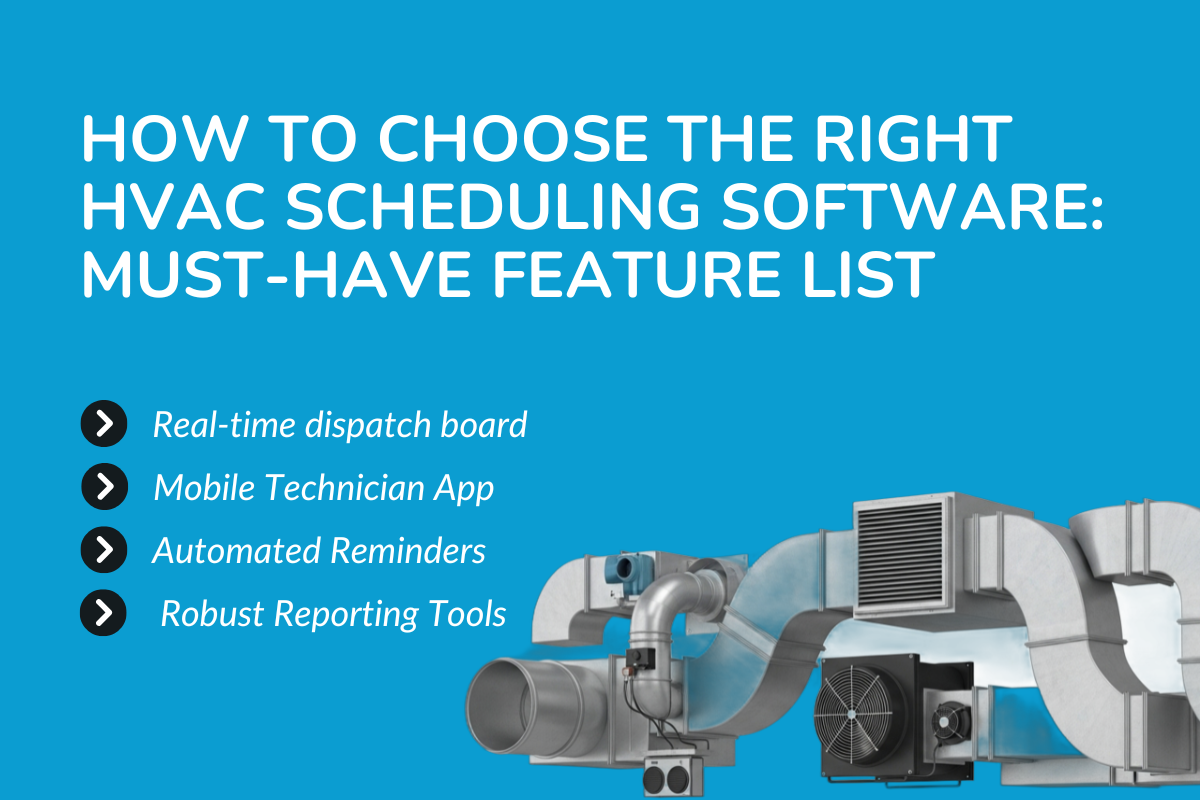
1. Real-time dispatch board
A real-time dispatch board gives managers complete visibility into technician schedules and job progress throughout the day.
- Smart HVAC tech assignment: An intelligent dispatching system automatically assigns jobs based on HVAC technician skills, location, current traffic, weather conditions, job priority, and availability.
- Live visibility: Real-time GPS tracking enables managers to quickly reschedule HVAC techs using a drag-and-drop scheduler to accommodate emergency service calls or adjust routes around road obstacles.
2. Mobile Technician App
The HVAC mobile app must be user-friendly and easy to use for all team members including the non-tech-savvy members.
- On-the-Go Access: Technicians can access important information such as customer history, job details, scheduled jobs, upcoming service calls, and optimised route directions using the mobile app.
- Offline Mode: The software must have offline functionality that syncs automatically once connectivity is regained, as techs often work in remote areas with weak or no signals.
- Real-time Updates: HVAC techs must use a mobile app on the go to instantly update job status, customer interactions, and completed tasks on the go, without the need for daily office visits.
3. Automated Reminders
Automated reminders keep all stakeholders updated, reduce miscommunication, and boost customer satisfaction, increasing the likelihood of repeat business and referrals.
- Proactive Alerts: IoT sensors send alerts for low inventory, overdue payments, and nearby emergency jobs, while cost tracking flags budget overruns, helping take appropriate action promptly. This prioritizes quality for all service calls and unlocks revenue streams to keep cash flow positive.
- Automated Alerts: The HVAC mobile app must provide instant proposals with e-signature approval and on-the-spot invoice generation, enabling quick payments and automated notifications to keep both the team and clients informed.
4. Robust Reporting Tools
Robust dashboards tracking key performance metrics and business goals are essential for proactive strategic decisions, helping optimize business operations and improve profit margins.
- Optimization of Resources & Staff: Dashboards must reveal resources, jobs, and staff performance to identify roadblocks in first-time fix rates, mold coaching strategies for better tech performance, and optimize inventory utilization to maximize resource usage.
- Boost Revenue & Renewals: Key metrics, such as recurring project metrics, would help identify bottlenecks and refine marketing strategies to improve service renewal rates, driving higher recurring revenue.
B.Questions to Ask Vendors
You should get clear answers to these fundamental questions before making the final decision.
> Does the software integrate with accounting tools for invoice creation?
Yes, it should include an HVAC invoicing feature that allows you to create, send, and process invoices instantly with seamless integration with accounting tools such as QuickBooks Online. It helps to process payments faster, improve accuracy, and bring healthier cash flow management.
> Does the software allow easy scalability?
The software should scale as the company grows. It must allow you to add more users, projects, and locations effortlessly, enabling you to manage increased job volumes without operational disruptions.
> Is training included with the purchase of the HVAC software?
Every software requires proper training and onboarding support to ensure smooth adoption. A reliable HVAC software solution should provide structured onboarding and staff training to help your team maximize its full potential.
Where HVACBase Software Fits into the Modern Workflow?
The HVAC Management software has powerful features that make it perfect for business growth, as it helps streamline operations.
1. A Platform Designed for Modern HVAC Teams
The platform brings together several core business functions in one place, including scheduling, dispatching, customer management, inventory tracking, lead management, and financial reporting.
This allows office teams and field technicians to work from the same system rather than juggling spreadsheets, paperwork, and multiple software tools.
2. Built for Real-Time Dispatch Visibility
HVAC software solutions have AI-powered capabilities specially designed for contractors to streamline dispatching by providing real-time visibility into operations, such as job status, technician location, and route conditions, to optimize and reschedule routes for maximum productivity.
3. Mobile-First For Technicians
The HVAC software supports both Android and iOS devices, allowing techs to access customer information and service history to curate personalized service and interactions with every customer, boosting first-time fix rates and increasing positive referrals to grow revenue streams.
4. Streamlining Operations To Enhance Customer Communication
The automated HVAC digital tool allows online booking of services, and real-time trackers can identify customer locations to assign the most suitable techs based on location and skill set.
Two-way communication and automated reminders for service agreements and renewals provide prompt responses and attention to customers, keeping them actively engaged in the sales process.
5. HVAC Accounting Software to Smooth Financial Process
HVAC invoicing software has integration to accounting software, such as QuickBooks integration, to generate basic financial reports, track costs, overdue payments, and help in payroll management.
It helps to create and send invoices on the spot with an instant portal for payment processing from debit/credit card payments, mobile, and ACH portals to get paid faster for healthier cash flow.
HVAC apps can also create professional estimates and proposals with in-built e-signatures for instant deal closure without delays.
Conclusion
For many HVAC businesses, scheduling used to be a back-office responsibility handled with whiteboards, phone calls, and spreadsheets. But as service demand grows and customer expectations rise, scheduling has become a core part of operational performance.
When appointments are coordinated efficiently, technicians spend more time completing billable work instead of navigating delays, dispatchers regain control over daily operations, and customers experience reliable service they can trust. Small improvements in scheduling quickly translate into better reviews, stronger technician productivity, and healthier margins.
That’s why more HVAC companies are replacing manual coordination with digital scheduling systems that connect dispatchers, technicians, and customers in real time.
Stop Delaying Actions. Take Action Today!
Book a quick demo to see how HVAC scheduling software can simplify operations and help your business scale more efficiently.
Frequently Asked Questions (FAQs)
1. Is HVAC Scheduling and Dispatching Software only Suitable for Large Enterprises?
No. HVAC scheduling and dispatching software is useful for businesses of all sizes, including small and mid-sized contractors. Even companies with just a few technicians benefit from features like automated scheduling, route optimization, and real-time job tracking.
2. How Long Does HVAC Service Software Take to Implement?
The basic set-up for an HVAC service software with onboarding and staff training can be completed within a month. Most contractors can see a positive ROI to the hvac business within 3 months of usage.
3. Will My Technicians Require Extensive Training to Use the HVAC Business Software?
Most HVAC business software comes with a highly intuitive interface and requires only a few days of training. With minimal learning time, teams can quickly adapt and use the software to its full potential.
4. How much does HVAC Software Cost?
The cost for HVAC field service management software typically starts at $60 per month for each user and largely depends on the specific brand subscription plans, business size, features, and the number of users.
Have questions or need personalized advice?
Talk to an Expert Today and let our construction specialists guide you to success.
Related Posts