HVAC Calculator vs Manual Load Calculation: What’s More Reliable?
April 25, 2026
Two identical houses in a hot and humid climate installed AC units that differed by just 2 tons, with two contrasting outcomes:
House 1: Perfect humidity control, low energy bills, and a happy client.
House 2: A clammy environment, 8-minute short-cycling, and immediate complaint callbacks.
Every seasoned HVAC pro knows that this 2-ton gap is not minor. It is the difference between comfort and system failure.
Verdict: House 1 was sized using an advanced HVAC calculator built on accurate load calculations using ACCA standards, while House 2 relied on manual load calculations.
Which method would you prefer?
This blog breaks down why an HVAC calculator is essential, as HVAC design is not just about determining load capacity but designing the entire system correctly.
Choosing Between HVAC Calculators and Manual Load Calculations
HVAC unit calculations require much more than just square footage and BTUs. Factors like insulation quality, room size, number of windows and occupants, solar heat gain, local climate zones, and ceiling height all play a critical role in determining the right load. These variables directly impact how efficiently an HVAC system performs.
On the contrary, the basic manual calculators rely on rule-of-thumb methods to deliver quick and rough estimates, compromising on accuracy, which leads to incorrect sizing and load capacity, leading to higher energy bills, inconsistent comfort, and frustrated clients.
The right choice here is simple: A proper HVAC load calculator estimates with precision, efficiency, and long-term performance, reigning supremacy over manual calculations.
Key Takeaways
- Incorrect HVAC sizing drives up energy costs, reduces comfort, and creates long-term inefficiencies.
- Manual calculations are prone to errors and inconsistencies, often leading to improper HVAC installation and system performance failures.
- HVAC load calculators are built on ACCA-compliant standards, automate and validate calculations, helping contractors improve accuracy, streamline workflows, and complete more projects profitably.
- To simplify your decision, the blog sets out the best HVAC design software based on key features, usability, and pricing tailored for seasoned HVAC professionals.
Short on time? Try our HVAC Load Calculator now to see how your estimates stack up against the pros.
Why System Sizing Errors Are the HVAC Industry's Most Expensive and Least Discussed Issue?
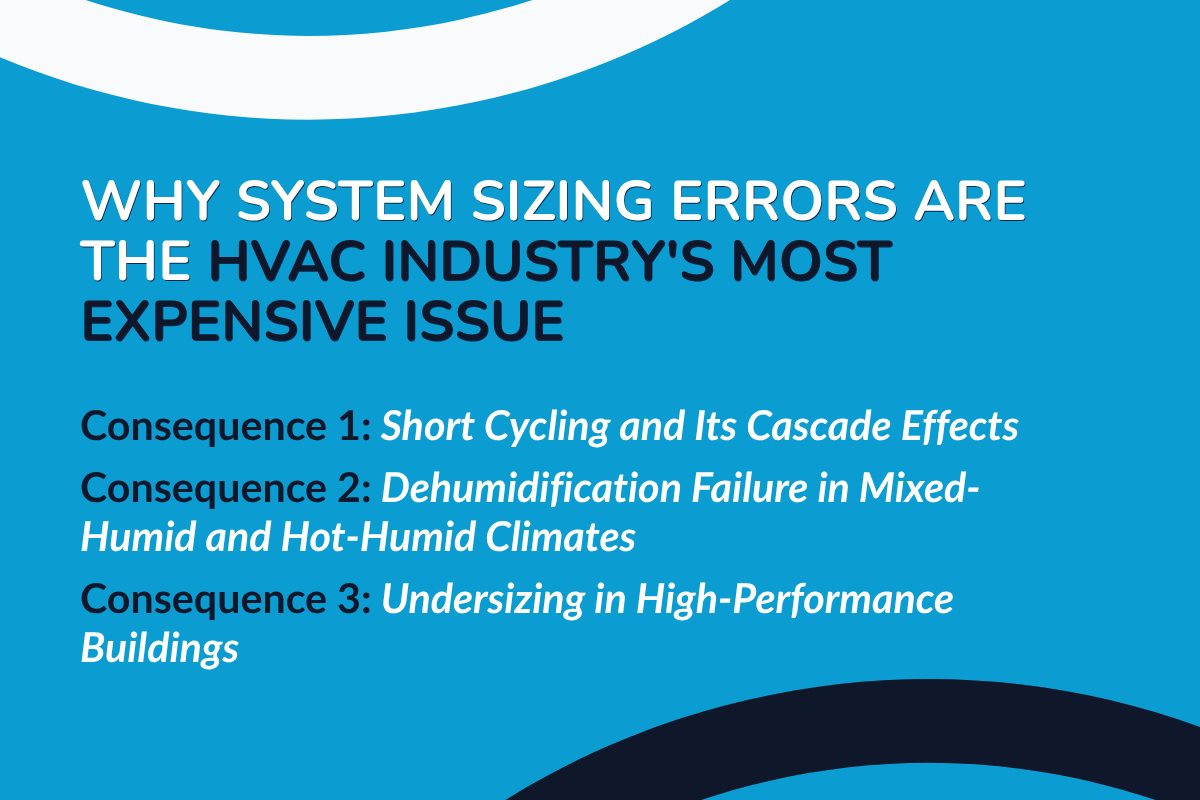
If you make these HVAC sizing errors, you will likely receive complaint callbacks due to three major consequences:
Consequence 1: Short Cycling and Its Cascade Effects
Oversized systems heat or cool spaces rapidly, forcing the thermostats to shut down prematurely, triggering higher energy bills, poor humidity control, and less comfort to residents.
Over time, this leads to premature system failure and costly early replacements that erode customer trust and contractor reputation.
Consequence 2: Dehumidification Failure in Mixed-Humid and Hot-Humid Climates
Improperly calculated or oversized systems' latent loads fail to remove sufficient moisture in mixed-humid and hot-humid climates. This results in excess indoor humidity, potential coil corrosion, microbial growth risks, and a persistently clammy indoor environment.
Consequence 3: Undersizing in High-Performance Buildings
Undersizing of HVAC units causes constant runtime, higher energy consumption, and failure to maintain the optimal temperature desired indoors.
In tightly sealed, high-performance buildings where occupants expect precise climate control, an undersized system will consistently fall short of design setpoints during peak load conditions, making the shortfall immediately and painfully obvious.
This not only generates callbacks but can also disqualify the installation from meeting energy code compliance thresholds, creating potential legal and warranty complications for the contractor.
What Is An HVAC Calculator (And The Assumptions Related to It)
An HVAC design and load calculation software is a digital tool used by professionals to estimate heating and cooling capacity measured in BTU for buildings.
1. The Calculation Behind Every Online HVAC Sizing Tool
Most online HVAC calculators take into consideration the square footage area, insulation levels, ceiling heights, sunlight, number of windows, number of occupants, and extra device wattage.
2. The Three HVAC Load Calculator Types and Their Actual Accuracy Range
Let us explore the three main types of HVAC load calculators to see which ones actually hold accuracy over guesswork.
| Calculator Type | Required Inputs | Accuracy vs Manual J Calculation | Appropriate Usage |
|---|---|---|---|
| Rule-of-thumb Calculator | Square footage and basic climatic zone | ±20-40%. | Budget estimates only |
| Multi-variable online | Square footage, insulation levels, number of windows, occupancy, and climate conditions | ±10–15% standard | Quick Residential estimates |
| Professional load software | Full building envelope components | ±5–10% with accuracy for inputs | Equipment selection and obtaining permit compliance |
| Manual J (full calculation) | Complete building survey data | Highest accuracy | All permitted installations and compliance permit protection. |
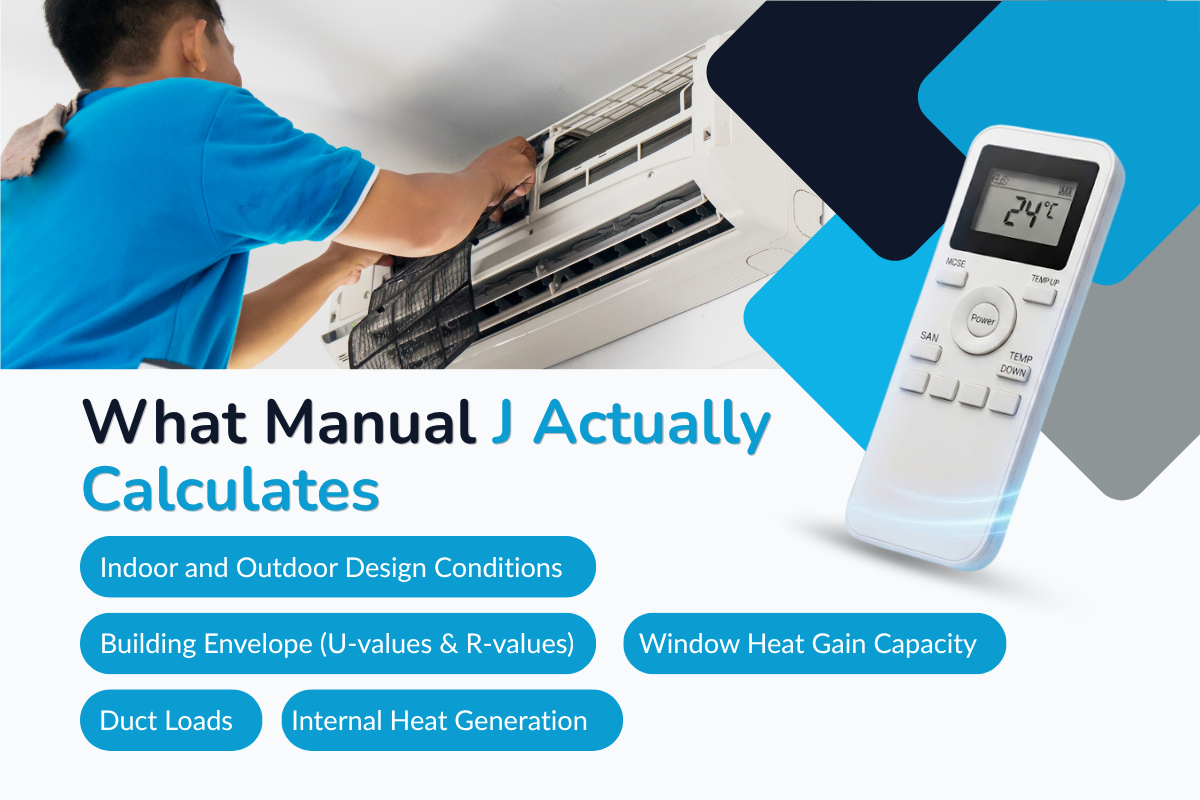
What Manual J Actually Calculates And Why the Methodology Difference Matters?
The Decision Matrix: How it is Applied by Project Type in HVAC Projects
Efficiency, comfort, and savings should not be a hit-or-miss. With the right process, you get it right every time. Let us see which system works best for each HVAC project type!
| Project Type | Calculator Acceptable? | Manual J Required? | Recommended Method to calculate HVAC load |
|---|---|---|---|
| New Residential Construction | No (Must use software) | Yes (Required by energy codes, e.g., IECC) | ACCA-approved HVAC Software (Room-by-Room). |
| Replacement of HVAC units | No (Rule-of-thumb is dangerous) | Yes (Recommended to prevent over-sizing) | Full Manual J & D to properly resize, as home energy efficiency often changes. |
| Light Commercial (<5 tons) | No (Must use Manual N) | Yes (Required) | ACCA Manual N (Light Commercial) rather than Manual J. |
| Climate zones 1A/2A (Hot-Humid) | No (Too imprecise) | Yes (Critical for latent load) | Manual J (sensible/latent load), Manual S (dehumidification), Manual D. |
| Variable-speed/Inverter Equipment | No (Too imprecise) | Yes (Highly sensitive) | Specialized software to ensure an exact, precise load match. |
| High-performance/Tight spaces | No (Will oversize) | Yes (Critical) | Use Manual J with blower door data to account for air leakage and prevent oversizing. |
| Multi-family residential | No | Yes (Required) | ACCA Manual J (8th Edition - Full) or Manual N. Larger multi-family projects may require ASHRAE load calculation methods instead |
You must know the key factors for determining the perfect HVAC installation solutions for any project. A load profile is the secret weapon behind every successful system.
The Efficiency Argument: Why Manual J Does Not Have to Be the Time Sink Contractors Think It Is
Manual J is often perceived as an exhausting and time-consuming process required to meet ACCA-approved regulations. In reality, the challenge is not the Manual J calculation but the way the process is implemented.
The real efficiency gap lies in outdated workflows. Let us break down the common myth that Manual J is a drain on time and cost and explore what it actually looks like when done right:
What Manual J Actually Takes in Time and Cost When Done Properly
Let us take two identical HVAC project scenarios and compare outcomes based on execution method.
Scenario 1: Standard 2,000–2,800 sq. ft. Residential Project using Drawings:
Manual: An experienced team member at an HVAC company completed the Manual J calculation in 45 to 90 minutes.
With Software: The same calculation was completed within 40 minutes, cutting overall time by more than half while improving consistency and accuracy.
Scanrio 2: A standard 2000-2800 sq. ft. Residential Project without Drawings
Manual: The field measurement and calculations had to be performed by technicians, which took at least 2 hours to complete.
With Software: Using LiDAR scanning and real-time sync, what once took hours can now be completed in about 1 hour without drawings.
Final Verdict: Manual J is the foundation, and you need to get it right, and speed is the biggest win for the job in the industry. If you meet both prerequisites, you can scale down complaint callbacks after every project.
The Software Stack That Makes Manual J Viable for Small HVAC Contractors
Technology should be your powerful ally, not an added burden that works against you. So, choose the tool that supports you by exploring the top 6 tools with in-built Manual J capabilities for faster, accurate, and code-compliant outputs that reduce risks and errors.
1. HVACBase

A digital automation tool for HVAC professionals featuring a built-in BTU calculator that delivers accurate load calculations aligned with ACCA Manual J & D standards.
Key Features:
- Accurate Calculations Using ACCA Standards: Performs Manual J & D–compliant calculations to determine correct equipment size and load capacity, factoring in square footage, insulation, sun exposure, local climate zones, building orientation, and other external factors.
- Built-in BTU Calculator: Uses a built-in BTU calculator to generate accurate values based on proper duct design to guarantee balanced airflow and reduce energy wastage.
- Interactive Design Tools: Offers real-time updates on HVAC load capacity, ductwork, and equipment sizing, which are fully customizable and editable by professionals.
- White-Label Proposals: Generates professionally branded proposals using built-in, editable templates downloadable in PDF format for instant client sharing.
- Cross-Platform Access: Supports both desktop and mobile apps, enabling designs to be viewed, edited, and shared anytime and anywhere.
- CRM Integration: Pulls out required customer data directly into templates to create fast and personalized proposals.
Ease of Usage: Minimal learning curve for teams.
Pricing: To get the most accurate pricing for your specific project needs, connect to Customer Support for personalized quotes and a detailed breakdown of available software modules.
2. CoolCalc

A cloud-based HVAC design platform that uses LiDAR screening to create instant 3D models for the entire house and delivers recommended BTU calculations aligned with ACCA Manual J, S & D standards.
Key Features:
- ACCA-Approved Manual J, S & D Calculations: Performs industry-standard calculations to determine accurate equipment size, heating and cooling requirements, and efficient duct system design.
- LiDAR Scanning & Flexible Inputs: Supports multiple input methods from uploading blueprints to using LiDAR scans for floors or entire house plans, enabling automated geometric capture with 3D model visualization.
- Collaborative Project Sharing: Allows teams to share and update projects on a centralized platform, keeping all HVAC designs aligned and coordinated across stakeholders.
Ease of Usage: Built for beginners with an intuitive and easy-to-use interface.
Pricing: It offers per-project, monthly, or yearly plans.
Per-Project Plan: $45 per project offering Manual J, S, and D calculation with LiDAR App.
| Pro Plan billed per user/monthly | Pro Plus billed per user/monthly | |
|---|---|---|
| Monthly | $59 | $249 |
| Yearly | $50 | $200 |
| Subscription Features | Unlimited Manual J, D, and S Reports and LiDAR Scanning. | Pro Plan features, along with Custom Brand reports, CRM integration, and Full API Access. |
3. ServiceTitan

It is a mobile-based field service software for home service providers such as HVAC companies, with a free online HVAC Load Calculator to determine the recommended BTUs for residential homes.
Key Features:
- Manual J Integration: Uses ACCA Manual J principles to determine accurate thermal output and ensure precise heating and cooling requirements for every space.
- Online Free HVAC Load Calculator: Simplifies data entry of key factors to quickly calculate and determine recommended equipment capacity, delivering accurate BTU outputs within seconds.
Ease of Usage: Easy-to-use interface, but may need some training to master the in-depth features.
Pricing: Choose from three subscription plans, Starter, Essential, and The Works, each offering per-technician pricing tailored to different business goals and team sizes. Connect with the sales team to find the best fit for your needs.
4. Elite Software
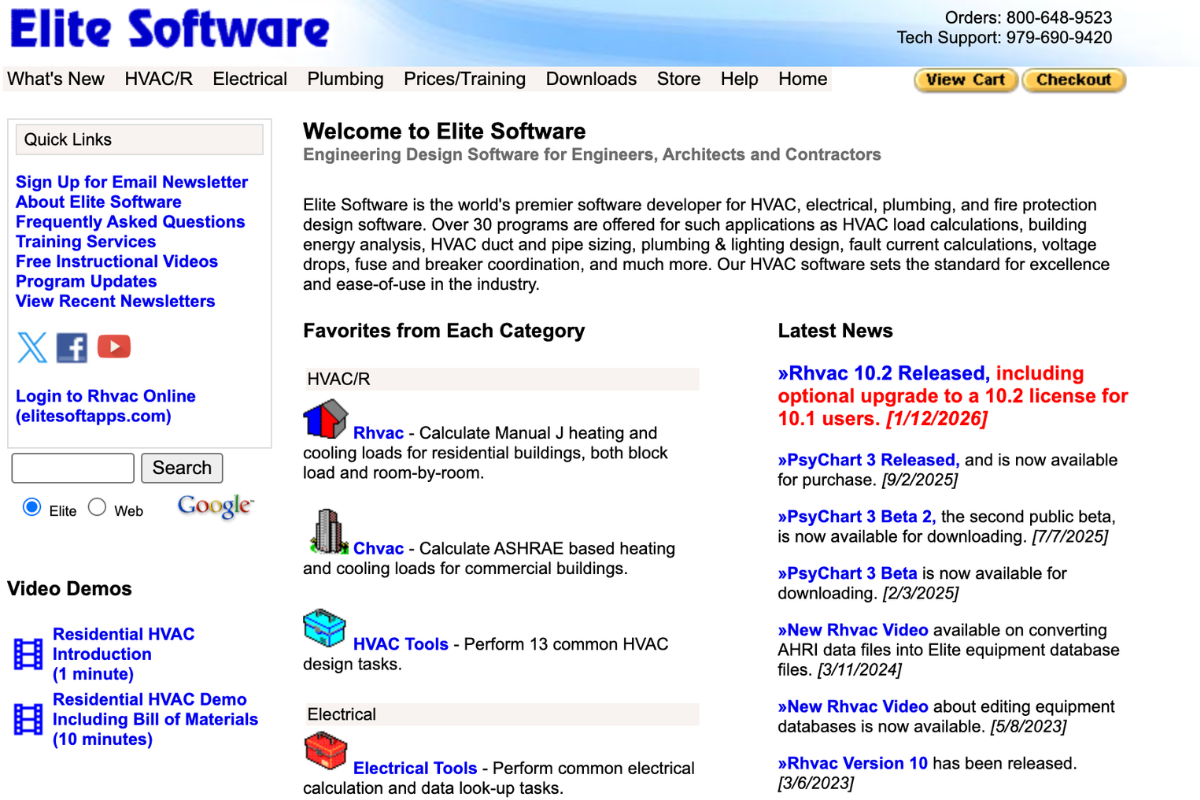
It is a legacy HVAC design tool built for desktop use with offline capability, supporting both residential and commercial projects, and aligned with ACCA standards for accurate calculation outputs.
Key Features:
- HVAC Load Calculator (Manual J Compliance): Accurately determines heating and cooling requirements for every room and zone using ACCA-approved Manual J calculations, ensuring precise system sizing and energy efficiency.
- Duct Design (Manual D Integration): Supports duct sizing and airflow optimization through Manual D calculations to maintain proper air distribution.
- Integrated Drawing Board: Allows users to create or upload floor plans, automatically extracting spatial data for the generation of load calculations.
- Equipment Selection (AHRI & GAMA Integration): Uses AHRI and GAMA databases to obtain standardized-compliant heating and cooling equipment based on calculated load requirements.
- Detailed Analytical Reports: Generates visual reports on business performance with downloadable reports for data-driven decision-making.
Ease of Usage: Intuitive dashboards are ideal for non-tech-savvy users as well.
Pricing: It is tailored to your specific operations, so you’ll need to request a custom quote based on your firm's size and project complexity. Contact the Customer Support Team for a customized quote based on your needs.
5. IESVE

This is paragraph text. Click it or hit the Manage Text button to change the font, color, size, format, and more. To set up site-wide paragraph and title styles, go to Site Theme.
Wrightsoft is a professional HVAC design and sales software suite used by contractors and engineers to perform precise load calculations and system designs.
It is the industry standard for ACCA-approved Manual J (load), Manual S (equipment selection), and Manual D (duct sizing) calculations.
Key Features:
- Manual J/S/D Tool: ACCA-approved modules for load calculations, equipment selection, and duct design, ensuring accurate, code-compliant HVAC system planning.
- Floor Modeling: Radiant floor heating design that takes into consideration heat transfer and room-wise thermal requirements for efficient heating performance.
- CAD Compatible: Seamless integration with built-in drawing tools and CAD, allowing users to import floor plans and perform calculations directly from design files.
Ease of Usage: Steep learning curve to be trained on the usage of the software.
Pricing: Wrightsoft uses a modular pricing model where you pay for the specific capabilities you need. To ensure you get a package that fits your specific workflow, you should connect to Customer Support for personalized quotes.
The Code Compliance Reality in 2026: What HVAC Contractors Need to Know About Manual J Requirements
Building codes now require ACCA compliance for new HVAC installations and major replacements, rather than relying solely on basic load calculations. Skipping these standards can lead to permit delays, failed inspections, and costly rework.
A. Which States Currently Require Manual J and What That Means in Practice
Manual J is the industry-standard method for calculating residential HVAC loads, ensuring systems are accurately sized for optimal comfort, energy efficiency, and code compliance.
Today, building codes increasingly mandate Manual J calculations for new installations and major replacements, making it a non-negotiable part of compliant HVAC design.
As of 2026, Manual J requirements largely follow the adoption of the International Energy Conservation Code (IECC) across the United States:
- States with IECC 2021 or 2024 adoption: Manual J is required for all permitted residential HVAC installations. These states account for nearly 55% of new residential construction permits, and submitting plans without Manual J often results in rejected applications or incomplete documentation.
- States with IECC 2018 or earlier adoption: Manual J may still be required through state or local amendments. Contractors must verify requirements at the jurisdiction level before proceeding.
- States without statewide code adoption: Requirements vary by county or municipality, with many local jurisdictions independently enforcing IECC-aligned standards.
Energy code enforcement is becoming more rigorous. Permit applications that do not include Manual J calculations in required jurisdictions are increasingly rejected, creating delays, compliance risks, and potential revenue loss for contractors.
B. The Liability Exposure Beyond Code Compliance
Compliance is not just about meeting norms but maintaining safety for tenants and employees. Ignoring compliance tests invites safety hazards, hefty penalties, and unexpected downtime.
Let us see the consequences when you have no code-compliance literacy:
- Equipment Sizing Errors = Costly Contractor Liability: Sizing mistakes fall on the contractors, not the manufacturers. One wrong calculation can lead to heavy liability claims and unexpected expenses. Manual J calculations act as the safety net.
- Warranty Failures Hit Hard: Most HVAC manufacturers offer extended warranties only when installations follow ACCA standards. Skipping them poses a direct risk of losing this major benefit.
Real-World Accuracy Comparison: What the Research and Field Data Actually Show
A. What Happens When You Run Both Methods on the Same Building
Here's a quick comparison of using the calculator or the Manual J process. Let us compare the methods with real numbers through case studies:
1. Standard Case: 2100 Single-Family Rach with Mixed Climate (Climatic Zone 4A)
The free HVAC load calculator for air conditioning overestimates the cooling capacity to 4.2 tons, while software using the Manual J calculation process estimates it at 3.3 tons.
Manual J takes into account critical real-world factors such as insulation levels, air leakage, occupancy, and climate data.
In contrast, a standard calculator does not account for personalized details such as how many windows a home has, their orientation, sun exposure, or the number of exterior doors, which significantly impact heat gain and overall load calculations.
Air conditioning systems typically come in standard sizes like 3.0, 3.5, and 4.0 tons. If you rely solely on a general calculator, you are more likely to oversize the equipment, leading to inefficiencies and higher operating costs.
2. Problem Case: 2,100 Single-Family Homes in Hot and Humid Gulf Zone (Climate Zone 2A)
To set up an air conditioner for the humid weather, the HVAC Calculator indicated 3.0 tons, and Manual J is 3.8 tons with a high latent load to manage humidity, using units with supplemental dehumidification.
The calculator underestimated the required load capacity, resulting in a system that would underperform, increasing energy costs and reducing overall efficiency in tackling peak humidity.
3. High-Performance Case: 2,100 Single Family Homes with Cold-Humid temperature (Climate Zone 5A)
The standard calculator indicated a capacity of 2.8 tons, while the Manual J result was 1.5 tons. This means the calculator significantly overestimated the load and equipment, especially for a tight construction condition. Oversizing leads to poor humidity control, short cycling, and reduced overall system efficiency.
Final Takeaway:
We learned two simple things from these case studies:
- Proper load calculation using Manual J, D, and S ensures the HVAC equipment fits just right.
- They are neither oversized nor undersized, which brings better energy usage, efficiency, comfort, and lower operational costs.
The Proper Load Calculation is more than just numbers, but sets the solid foundation for an efficient HVAC System.
B. The Specific Conditions Where Calculator Accuracy Collapses
HVAC Calculators are not wrong, but the failure to capture real-world conditions brings errors. Let us explore the different building conditions where the calculators fall short in achieving accuracy:
| Building Condition | Calculator Accuracy | Error Direction | Real-World Impact | Recommended Solution |
|---|---|---|---|---|
| Standard Residential (Group D) | ±15–20% (rule-of-thumb: 30–40 BTU/sq ft) | Slightly Oversized | Higher energy use, reduced equipment lifespan | Use Manual J for accurate load sizing |
| Hot-Humid Climate (Zones 1A/2A) | ±20–35% error | Undersized (latent load ignored) | Poor dehumidification, musty air, short cycling | Manual J with latent load + proper sizing |
| Tight Construction (ACH50 < 2.0) | ±30–50% deviation | Oversized | Humidity issues, uneven comfort, poor air quality | Manual J + S + D for precise design |
| High Window-to-Wall Ratio (>30%) | ~30% underestimation | Undersized (solar gain ignored) | Higher cooling load, occupant discomfort | Manual J accounting for solar heat gain |
| Mixed Residential + Commercial Use | ±35–60% error | Undersized | System overload, longer runtimes, higher costs | Manual J + S for internal heat gains |
The ultimate resolution for all building conditions lies in the application of Manual J, S, and D calculations to ensure accurate HVAC equipment sizing, load capacity, and efficient ductwork design.
HVAC installations are not just plug-and-play solutions; they demand careful assessment of various factors to achieve efficient and reliable performance.
So why not get the right HVAC load calculation software that fixes your workflow with speed, clarity, and transparency, taking into account all common factors that impact HVAC installations?
Conclusion
In the HVAC industry, success lies in meeting the unique needs of each building. Most HVAC failures are not due to faulty equipment, but rather incorrect sizing and improper load capacity calculations.
While manual methods and HVAC calculators align with ACCA standards, buildings with complex layouts using manual methods are more prone to errors, often leading to oversized or undersized equipment.
Additionally, improper sizing results in higher utility bills, energy waste, and early system failure. Roofing Calculators helps get it right by maintaining accuracy in Manual J, S, and D calculations, ensuring the system is perfectly matched to the building’s requirements.
Is your reputation worth a 'rule of thumb' guess?
Oversized systems lead to humidity issues, short-cycling, and unhappy clients. Transition your team to a platform that automates the complex math of ASHRAE and Manual J standards without the overhead of expert-level training.
Book a personalised demo and see how our software handles everything from multi-zone residential layouts to complex commercial envelopes, ensuring every system you install is right-sized for peak performance.
Frequently Asked Questions (FAQs)
1. How accurate is manual J compared to actual measured building loads?
Manual J HVAC calculations are generally considered highly accurate, as they take into account external factors such as insulation levels, window types, occupancy, and local climate data. They also include a safety buffer, which can be around 10% to 40% higher than actual measured building loads, leading to slightly overestimated results.
Contrary to this, actual measured building loads show the exact HVAC requirement without added capacity. Manual J accuracy is reliable but slightly conservative due to its safety buffer, while measured loads represent the building’s true and exact demand.
2. Is Manual J required by law for HVAC system installations?
The International Residential Code and International Energy Conservation Code have mandated the Manual J calculations for new HVAC installations and significant renovations. These codes need accurate values for HVAC units to maximize safety and energy efficiency.
3. What should homeowners ask their HVAC contractor about sizing calculations?
Homeowners should ask HVAC contractors if they have used Manual J instead of relying on rule-of-thumb sizing, and confirm that essential inputs like insulation, windows, air leakage, and local climate data are included for an efficient system. They should also request the exact BTU load to ensure energy efficiency, proper temperature regulation, and to prevent excessive wear and tear from frequent system usage.
4. Why do different HVAC business contractors offer varied quotes for the same house?
HVAC contractors offer different quotes for the same house because they use different approaches. Some rely on the Manual J residential calculation while others focus on rule-of-thumb sizing for rough estimates, which brings cost differences. Quotes also vary due to equipment capacity, brand selection, and efficiency rating.
5. How much does a manual J calculation cost as a standalone service?
The average charges to conduct the Manual J calculation for an HVAC equipment installation range from $150 to $800, varying based on the size of the property and complexity.
6. What is the difference between Manual J, Manual S, and Manual D?
ACCA Manual J, S, and D are industry-standard protocols used to design and install residential HVAC systems.
Manual J determines the heating and cooling loads capacity to determine the appropriate size of HVAC equipment for homes by using detailed real-world data such as insulation levels, window specifications, air leakage, and local climate conditions.
Manual S is helpful in selecting the right size of the HVAC equipment to ensure it matches the heating and cooling loads calculated by Manual J.
Manual D determines the size and layout for the ductwork of residential buildings to get the correct amount of heating and cooling to each room based on the Manual J load capacity.
Have questions or need personalized advice?
Talk to an Expert Today and let our construction specialists guide you to success.
Related Posts