Top HVAC Software Tools for Multi-Tech Teams
March 24, 2026
You have built a solid HVAC business with skilled HVAC technicians operating at multiple locations to manage a steady stream of jobs.
But instead of planning your next growth strategy, you are stuck troubleshooting IT issues, making double-entry to accounts to rectify errors, managing inventory to reduce wastage, fixing scheduling conflicts, and chasing delayed payments.
Here, you are not only losing time but also losing customers and revenue to competitors. With regulatory shifts and rising expectations for prompt responses, traditional systems simply can’t keep up with multi-tech teams.
The resolution lies in the smarter HVAC software that automates admin tasks, streamlines operations, and lets you focus on strategies and not repetitive work.
Best HVAC Software for Growing Teams Operating at Multiple Locations
Without the apt HVAC business software solutions, you will always tend to miss critical service calls, project costs will never extract maximum profits, and customer lifetime value will be buried under the ineffectiveness of siloed systems.
The blog will take you through the top HVAC management solutions that will help you boost customer satisfaction and meet every set business goal.
The top options are compared based on their integration, scalability, pros and cons, and pricing factors to help you find the one that fits your needs.
Key Takeaways
- Automation is essential to manage a growing team to smooth progress with more efficient operations.
- The best multi-tech HVAC software has smart scheduling, real-time visibility, performance analytics, and seamless communication to keep operations smooth.
- The top five tools for the HVAC business with multi-tech tools are HVACBase, ServiceTitan, HousecallPro, Jobber, and BuildOps, that empowers HVAC contractors to deliver exceptional services.
The Real Solution lies in HVAC Software built to scale!
If you do not want to stall your progress, explore the all-in-one HVACBase software that accelerates speed, accuracy, and flexibility, so that you can enter the field with confidence and complete every job with excellence.
The Real Problem Isn’t More Technicians— It is Less Control on HVAC Business Operations
Even if you are equipped with the most skilled and experienced HVAC professionals and use the best-quality equipment, an inefficient workflow will quietly leak opportunities and money.
Let us unplug the operational weaknesses that suppress your progress:
1. When 5 Techs Become 15, the Spreadsheets Collapse
When your team grows from 5 to 15 techs, your management style should not just evolve but be replaced. Color-coded spreadsheets, whiteboards, and notepads cannot carry you through a demanding workweek.
Spreadsheets fail due to human errors when inserting formulas, leading to inaccurate load calculations and bidding mistakes. They quietly shrink your margins over time.
2. Field vs Office Disconnect
Your best techs close the deal, but office managers are yet to create proposals, generate invoices, and are busy chasing updates for yesterday's leads through text updates.
Customer satisfaction drops, and inefficiency comes to the surface, failing to capture revenues. You need a system where office staff and HVAC techs are on the same page, speaking the same language.
3. No Unified Operational View
When field and office staff are not connected, simple updates turn into constant follow-up chases. Technicians lose track of schedule changes, financial tracking lags, budgets overrun, and the entire operation slows down due to zero visibility into daily activities.
The foundation of a successful construction business is the intelligence that software brings through complete visibility at every project stage.
Let's take a look at an example:
A commercial HVAC company in Florida added 6 new techs within a year to handle growing projects across multiple locations.
The balance sheet revealed a growth of $400,000 through a new stream of projects. The catch is here! Scheduling is still manual, inventory management is faulty, accounting on spreadsheets needs double entry due to errors, updates are delayed, workload pressure explodes, and the admin cost rises by 10,000.
So, in reality, the company scaled, but the profits stalled due to extra admin charges. The right HVAC software built to automate administrative workload can be a powerful growth lever!
What a True Multi-Tech HVAC Software Command Center Should Include?
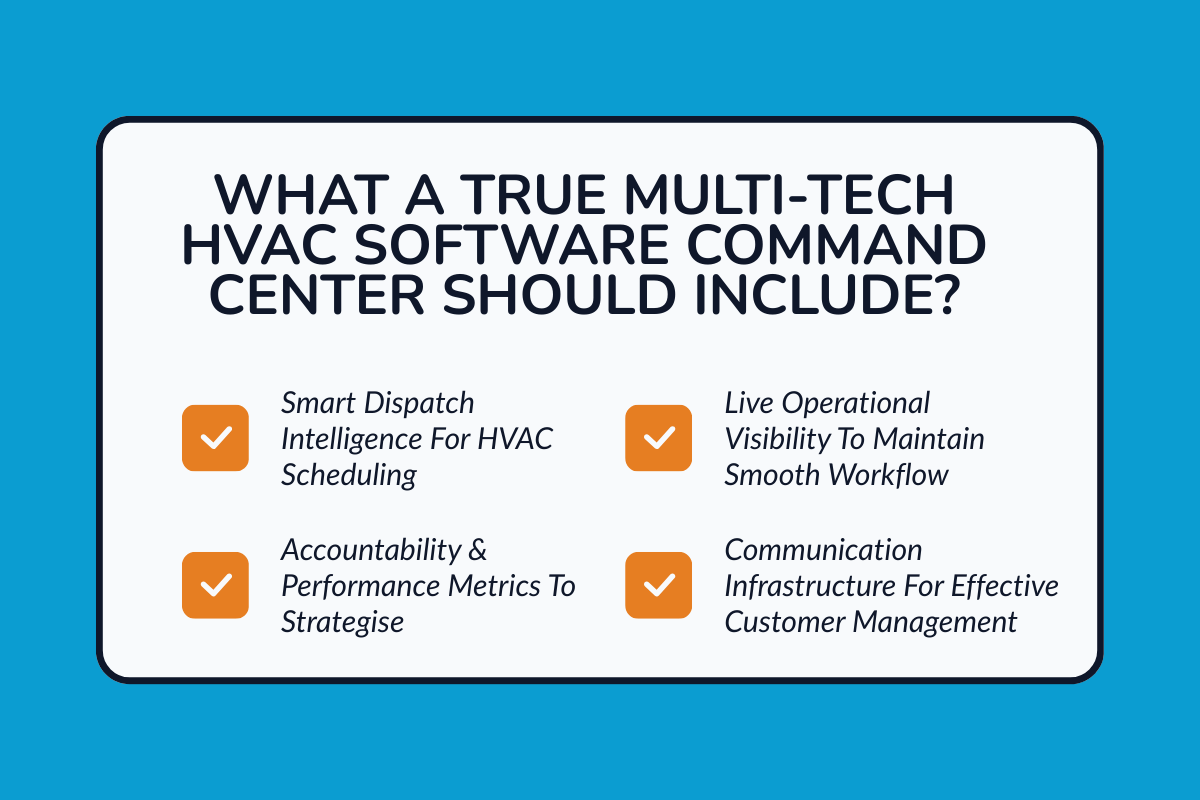
The best software must be built for HVAC professionals, and should also have the following features:
1. Smart Dispatch Intelligence For HVAC Scheduling
The digital tool must have a drag-and-drop scheduling feature that lets managers assign jobs to HVAC techs based on availability, skills, and location, with real-time updates to keep both the team and field techs on the same page.
The software also leverages real-time conditions and GPS tracking to cover large territories efficiently, optimizing routes to minimize travel time and maximize productivity on every workday.
2. Live Operational Visibility To Maintain Smooth Workflow
The platform needs to provide real-time visibility into job detail updates, technician performance, inventory status, and customer information without constantly chasing for updates.
It helps coordinate better and reassign schedules during emergencies without missing any leads or delaying set schedules and project timelines.
3. Accountability & Performance Metrics To Strategise
As the business grows, you need to know what is working and where the hiccups in your business lie. The software must have in-built reporting tools to track operational efficiency, business performance, revenues, and tech productivity through visual dashboards to aid in strategic decision-making.
4. Communication Infrastructure for Effective Customer Management
Communication is the critical driver of success for any business. Tools like automated appointment reminders, technician arrival alerts, and service status notifications help keep customers informed while reducing missed appointments and scheduling confusion.
A mobile CRM should also allow technicians to update job details directly from the field. This includes uploading photos, attaching documents, and adding notes or messages that instantly sync with the central system.
HVAC industry needs a unique workflow, and you must know the must-have features of HVAC business software and identify the best digital assistant with key features to help your team work smoothly, streamline sales, and drive sustainable growth.
Top HVAC Business Software Tools for Multi-Tech Teams
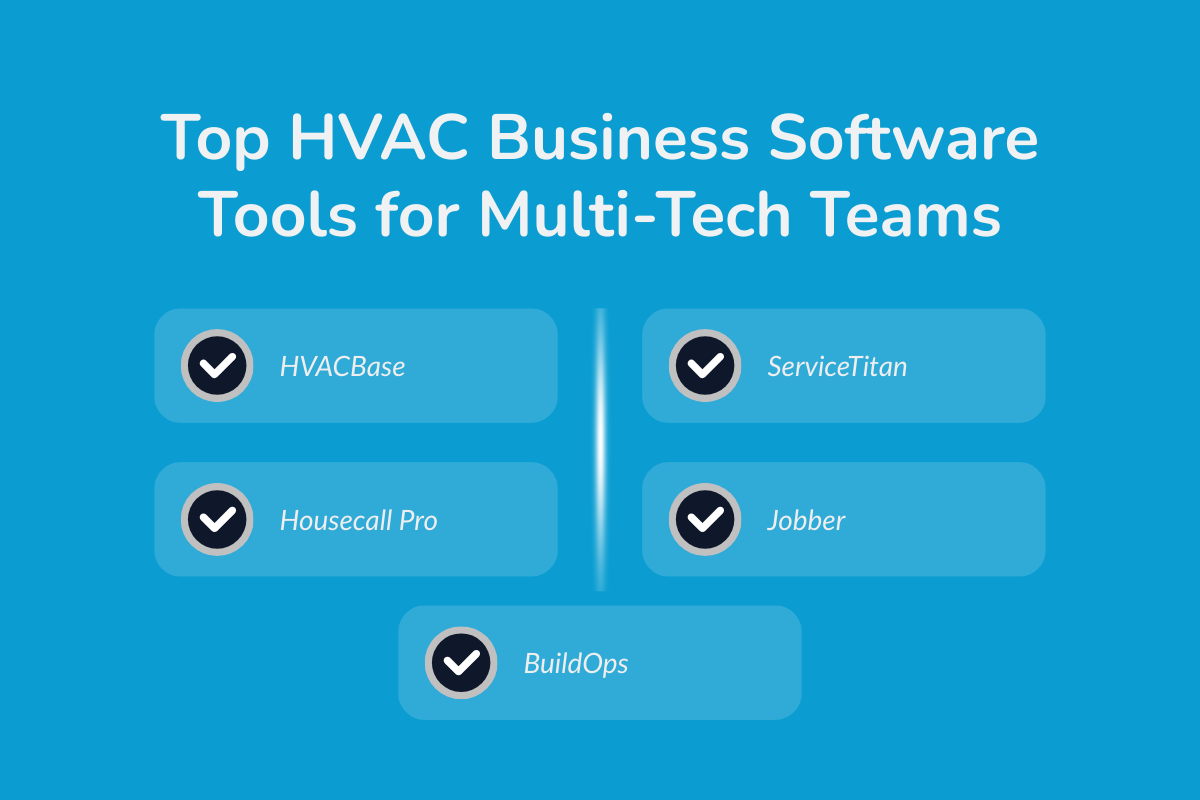
Smart buyers need clarity to decide the best tool that actually fits their workflow and growth goals. Let us explore the top five options:
1. HVACBase
It is an all-in-one cloud-based mobile-first HVAC CRM ideal for small to medium-sized firms to handle Schelduling, Leads, Sales, Inventory, and Customer Management.
HVACBase integrates with accounting tools such as QuickBooks and Xero, allowing businesses to manage invoicing, payments, and financial tracking alongside operational workflows.
Features:
- User-Friendly Mobile App: Supports both iOS and Android mobile devices with a highly intuitive interface, making it easy to use, even for non-tech users.
- HVAC-Specific Workflow: Built specifically for HVAC jobs, aligning with the unique workflow requirements of installation, repair, and maintenance for heating and ventilation systems to offer better customer service.
- Integration with Accounting Software: Enables accurate quotes based on live pricing, precise job costing, and instant invoice creation with online payment processing, helping speed up cash flow and reduce billing lag to boost job profitability.
- Inventory Management: Live tracking of materials and tools with automated reordering to minimize wastage and prevent stockouts.
- Regional Compliance: Built to align with region-specific regulations and rules, ensuring workflows remain compliant and helping prevent penalties and fines.
- Offline Functionality: Mobile app works in offline mode for field reps operating in low or no-connectivity zones, and automatically syncs with the central system once the connection is restored.
- Compliance Adherence: Ensures alignment with ACCA approvals and supports Manual J, S, and D calculations to maintain compliance with industry standards and reduce the risk of equipment failure.
- Scalability: Built to support multi-tech field service teams with flexible API configuration, allowing you to add more users, projects, and locations without additional complexity.
Integration: Seamlessly sync with tools like QuickBooks integration and Xero for invoicing, accounting, and financial tracking.
Pricing: Explore the subscription plans available and choose the one that best fits your needs. Click here to get a quick demo and a mini tour with pricing details.
2. ServiceTitan
It is a software built for large enterprises dealing with home and commercial projects to streamline their workflow by automating scheduling, invoice creation, inventory management, and reporting.
Features:
- All-in-One Platform: A comprehensive suite of tools in one unified system for CRM, scheduling, invoice processing, inventory management, marketing, and communication, eliminating the need to juggle multiple platforms.
- Highly Customizable: Configurable as per workflow requirements, allowing it to seamlessly fit unique business processes and make operations smoother.
- Continuous Tech Updates: Regularly updated based on recent user feedback and evolving market needs, ensuring it stays aligned with the latest HVAC industry workflows and compliance requirements.
- Real-Time Sync with Offline Support: Enables live updates on technicians, job site progress, and a customer portal for seamless engagement with offline functionality that syncs automatically once connectivity is restored.
- Automated Review Requests & Notifications: Sends automated review requests and real-time notifications to technicians, office staff, and customers to keep everyone informed and engaged.
Integration: It has integration with accounting software like QuickBooks Online, which automatically syncs transactions in real-time.
Pricing: ServiceTitan does not publicly list its pricing on its website. The platform typically offers custom pricing based on business size, number of technicians, and selected features.
3. Housecall Pro
It is a cloud-based mobile-first field service management software designed for home service professionals in the HVAC industry to automate operations for scheduling, dispatch, cost-tracking, and financial processing.
Features:
- User-Friendly Interface: Easy to learn and navigate, even for non-tech-savvy users, ensuring quick adoption with minimal learning curve.
- Mobile App Support: Empowers field technicians to create instant proposals and invoices, collect payments, and capture signatures that accelerates job closure.
- Customer Satisfaction: Maintained through a centralized customer portal for monitoring interactions, plus automated text and email reminders for service agreement renewals and upcoming appointments.
- Highly Responsive Customer Support: Delivers prompt and supportive service that elevates your operations, resolving queries and hiccups with software usage in the shortest possible time.
- Easy & Quick Scheduling: Calendar view with drag-and-drop functionality lets you assign job site bookings to the most suitable HVAC technicians effortlessly.
Integration: Seamless integration to third-party tools like Zapier and QuickBooks Online to monitor cash flow and maintain good financial health.
Pricing:
- Basic Plan: (1 user) at $59-$79 monthly
- Essentials:(up to 5 users) at $149-$189 monthly
- Max: (up to 8 users) at $299 to $329 monthly
It has the Add-on at $80 per month for recurring subscription plans and a 14-day free trial.
4. Jobber
Jobber is a cloud-based field service management software. It is ideal for larger HVAC companies and enterprises, streamlining operations by automating quoting, scheduling, and payment processing.
Features:
- Mobile App & Easy to Use: Highly intuitive interface supporting all mobile devices, allowing field teams to track jobs and receive real-time updates.
- Unified Platform: Enables completion of the entire job cycle from quotation to payment processing using a single app.
- AI Support: Leverages AI automation for follow-ups and reporting dashboards to stay organized and maintain accuracy.
Integration: It easily connects to QuickBooks and Zapier without any complex coding, making workflow automation simple and seamless.
Pricing:
It has a tiered pricing plan as follows, priced per user:
- Core: Offers basic features like scheduling, quoting, and invoice processing at $29/month.
- Connect: Adds more advanced features such as automated follow-ups, financial tracking, and QuickBooks integration at $99/month.
- Grow: The top-tier plan at $149/month includes all advanced features like financial operations, job tracking, CRM, and fully customized workflows.
5. BuildOps
About: BuildOps is an enterprise-grade field service management platform designed primarily for commercial contractors, including HVAC, electrical, and plumbing companies managing complex projects and large technician teams.
Features:
- Unified Platform: Consolidates all workflow operations into a single app for scheduling, dispatch, invoicing, and CRM, specially customized for HVAC workflows.
- Strong Customer Support: Provides responsive customer care and dedicated customer management services.
- Efficient Mobile App: Allows technicians to manage work orders and provide real-time updates on the go, keeping all stakeholders in sync.
- Comprehensive Reporting Tools: Tracks key business metrics like sales performance, team productivity, payroll, and profitability in a single dashboard.
Integration: Seamlessly connects to QuickBooks to simplify financial management processes.
Pricing: The pricing is not publicly disclosed and varies based on factors such as the number of users, selected features, and any additional add-ons.
Comparison Table: Which HVAC Management Software Actually Scales With Multi-Tech Complexity?
| Feature / Platform | HVACBase | ServiceTitan | Housecall Pro | Jobber | BuildOps |
|---|---|---|---|---|---|
| Best Fit for | Small to mid-size HVAC firms looking to scale operations | CRM-first enterprise platform for medium–large service businesses | Startups and small service companies | SMEs focused on customer communication and financial workflows | Enterprise contractors managing complex commercial projects |
| Dispatch & Scheduling | ✓ Strong | ✓ Advanced | ✓Moderate | ✓ Moderate | ✓ Strong |
| Real-Time Field Visibility | ✓ Yes | ✓ Yes | Basic | Basic | ✓ Yes |
| Performance & Productivity Metrics | ✓ Advanced | ✓ Advanced | Moderate | Basic | ✓Advanced |
| Service Agreement & Contract Tracking | ✓ Yes | ✓ Advanced | Limited | Limited | ✓ Yes |
| Route Optimization | ✓ Built-in | ✓ Built-in | Basic | Basic | ✓ Built-in |
| Reporting & Business Intelligence | ✓ Intuitive dashboards | ✓Enterprise-grade reporting | Basic analytics | Basic reporting | ✓Advanced analytics |
| Mobile Technician Experience | ✓ Strong | ✓ Robust | ✓ Very User-Friendly | ✓ Good | ✓ Strong |
The 4 Scaling Stages of Commercial HVAC Teams (And What Software You Need at Each Stage)
Stage 1 – Reactive Team (1–5 Techs)
This is the first stage of growth, where the HVAC business owners work in close collaboration with a small team of up to five members.
A simple CRM is necessary to perform basic functions such as:
- Centralized communication portal to streamline team collaboration
- Automated scheduling based on real-time conditions to optimize technician routes for timely job completion
- Inventory management to track, control, and efficiently utilize resources, reducing wastage
- Accounting tools integration to create invoices quickly and manage payments, billing, and financial records
Stage 2 – Growing Team (5–15 Techs)
As you scale in size beyond 10 members, you have more projects and people to manage in the HVAC business.
- Professional proposal generation that creates client-ready proposals efficiently
- Accurate quoting with automated calculations to reduce errors and ensure consistency across projects
- Inventory tracking with automated ordering to streamline supply management
- Central portal to store and update customer and job details in real-time for better project management
Stage 3 – Structured Operations (15–30 Techs)
The company has matured into a mid-sized firm with multiple team members, projects, and locations to manage at the same time!
- Real-time location tracking of HVAC techs with instant updates and alerts on the go
- Intuitive mobile app with offline functionality for field technicians
- Performance analytics dashboards for the entire business performance
- Auto-optimized scheduling and dispatch based on technician availability, skills, and job sites
- Real-time messaging portal to keep teams and clients fully in sync
- Automated reminders for upcoming appointments and service agreement renewals
- Instant invoice creation and payment processing via debit/credit card payments, ACH, or digital wallets
- Integration with third-party tools like QuickBooks Online for accurate and real-time job costing for quote generation
Stage 4 – Multi-Location Operations (30+ Techs)
This stage represents large-scale operations, where HVAC contractors must manage large teams across multiple locations while handling several projects simultaneously.
It's never too late to get stronger, wiser, and better!
No matter which stage of the HVAC growth timeline you stand, a small step in the right direction will help you leap bounds further and prevent your business from stumbling due to growth hiccups.
Why HVACBase Fits Growing Multi-Tech Teams Without Enterprise Overhead?
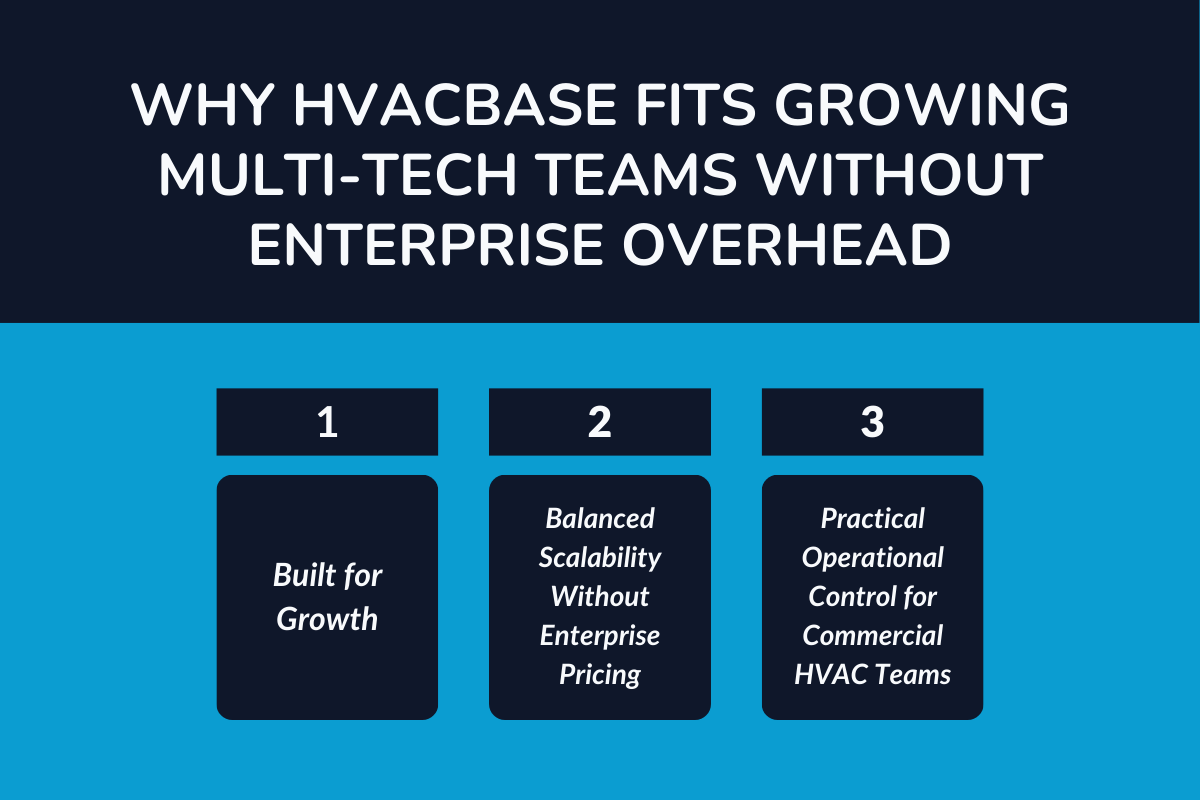
HVACBase software is designed to help businesses stay organized and build repeatable systems for sustainable and smooth growth. Let us see the features that make it an ideal fit for teams operating at multiple locations!
1. Built for Growth
As business operations grow, it becomes necessary to schedule field techs for multiple jobs through optimized routes to enhance customer satisfaction and maintain high-quality service.
HVAC service software automatically tracks technicians, creates optimized schedules based on current conditions, reveals productivity analytics, triggers real-time alerts, and offers a communication portal to help streamline overall business operations.
2. Balanced Scalability Without Enterprise Pricing
HVAC software is built for small to medium-sized firms, but it supports growing teams as well. You can add more users and projects and customize workflows without breaking the bank or dealing with unnecessary complexity from bloated features.
3. Practical Operational Control for Commercial HVAC Teams
As your business grows, you need visible results on what is working and what the major friction points are in your operations, business performance, cash flow, tech productivity, and lead conversions.
The software uses AI-enabled systems to identify bottlenecks and devise targeted strategies with just a few clicks.
Takeaway: HVACBase Software is reasonably priced and offers enterprise-level excellence to the business to gain efficiency, productivity, profitibility and the highest customer satisfaction.
Final Takeaway: Growth Without Visibility Is Risk
Growing an HVAC business is not only about hiring more technicians or expanding into new locations. The real challenge is maintaining operational control as complexity increases.
When schedules are managed manually, updates are scattered across calls and messages, and financial tracking relies on spreadsheets, growth quickly turns into operational chaos.
The HVAC software platforms discussed in this guide—HVACBase, ServiceTitan, Housecall Pro, Jobber, and BuildOps—address these challenges by bringing scheduling, dispatching, reporting, and customer communication into one centralized system.
The key is choosing a platform that matches your current stage of growth while still supporting the next phase of expansion.
For many growing HVAC businesses, the goal is to achieve operational control without the complexity and cost of enterprise-level software.
Ready to Run Your HVAC Operations Like a Command Center?
If your team is managing multiple technicians, juggling schedules, and chasing updates across spreadsheets and messages, it may be time to upgrade your operational system.
HVACBase gives growing HVAC companies a mobile-first platform to manage scheduling, leads, inventory, customer communication, and financial workflows from one place.
See how it works in real time. Book a Quick Demo of HVACBase today and discover how a centralized HVAC command center can help your team work faster, stay organized, and scale with confidence.
Frequently Asked Questions (FAQs)
1. What size HVAC companies require an advanced HVAC software?
Advanced HVAC software solutions are required by companies managing 10+ technicians, high job volumes, or simultaneous projects across multiple locations to optimise operations by automating scheduling, project tracking, and workflows. Meanwhile, the teams can focus on strategy and client management.
2. Is enterprise HVAC Software necessary for small or mid-sized teams?
Enterprise HVAC software is not a necessity, but small and mid-sized teams can gain several benefits of HVAC software by streamlining operations and supporting scalability as job volumes and project complexity increase.
3. What Is the biggest mistake HVAC companies make when choosing the ideal software?
The biggest mistake HVAC contractors make when selecting the best-fit HVAC service software is failing to define their specific business requirements, which often leads them to choose software with unnecessary features that increase overall costs.
Have questions or need personalized advice?
Talk to an Expert Today and let our construction specialists guide you to success.
Related Posts