HVAC SEO vs Paid Ads Where Growing Contractors Should Invest
April 14, 2026
If you’ve already read blog after blog on HVAC SEO vs Google Ads and still feel unsure, that makes sense because most of the advice out there is biased toward the service being sold.
In this blog, we are taking a different approach. Instead of pushing one channel, we are going to give you a practical way to decide which investment makes more sense for your business, based on timeline, budget, and market conditions. And help you decide which one wins for your business, right now, in your market.
HVAC SEO or Google Ads? A Practical Guide for Growing Contractors
HVAC SEO or Google Ads? The right answer depends on how fast you need leads, how competitive your market is, and what your business can afford to invest.
Google Ads can generate demand quickly, while SEO takes longer but compounds over time and can reduce cost per lead.
This guide breaks down what each channel actually costs, when each one makes sense, and how growing contractors can decide where their next marketing dollar should go.
Key Takeaways
- SEO and Google Ads do different jobs: ads drive faster leads, SEO builds lower-cost growth over time.
- The real question is not which channel is better, but where your next marketing dollar should go.
- Most contractors mix up three decisions: where to start, how much to spend, and how to measure results.
- SEO takes longer to work, but it compounds and can become the lower-CPL channel. Google Ads are strongest for urgent demand, new markets, and time-sensitive promotions.
- The best HVAC contractors usually use ads and SEO together in phases, not as an either-or choice.
- More leads do not help if your team cannot answer, book, and follow up properly. This is where software like HVACBase can help.
This Is How You Turn More HVAC Leads Into Booked Jobs
Traffic and leads only matter if they convert. This is where
HVACBase helps you manage follow-up, scheduling, and pipeline visibility so your marketing spend turns into actual revenue.
Book your quick demo today.
The Real Reason HVAC Contractors Stay Confused About Marketing Channels
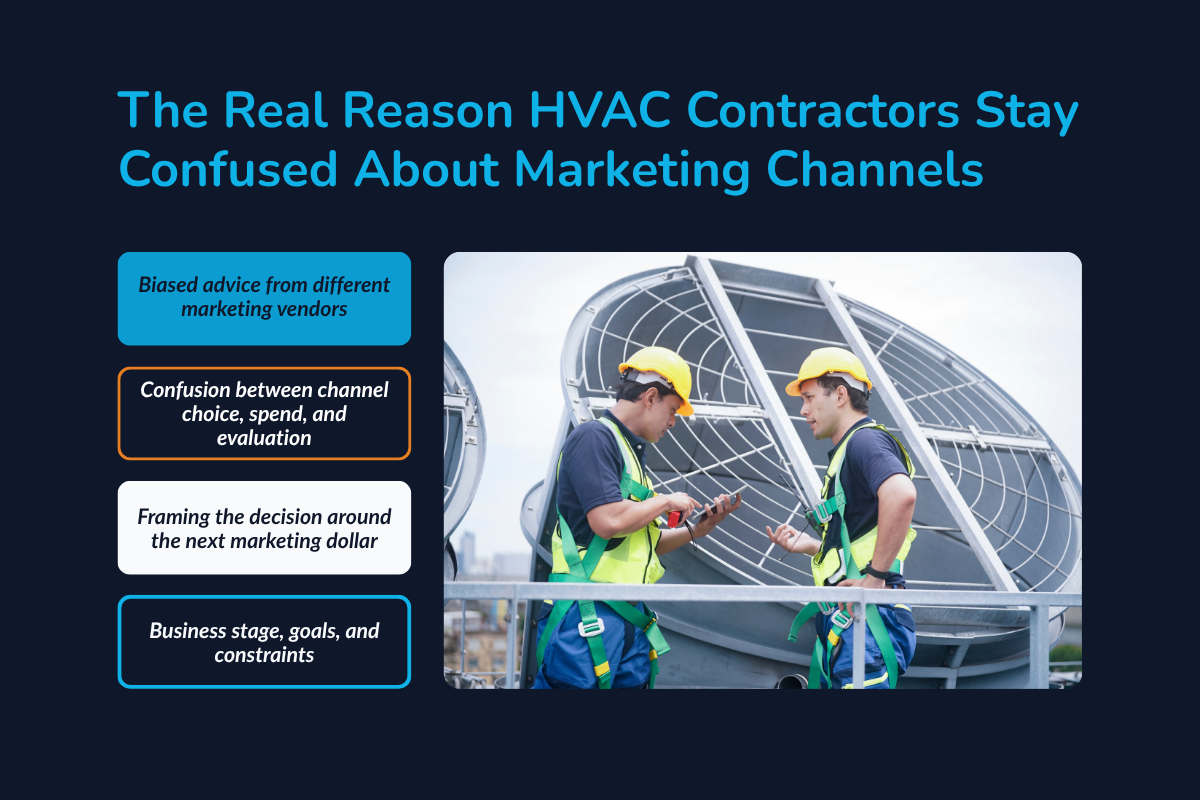
The real reason is biased digital marketing advice because Google wants you to run ads, SEO agencies want you to treat SEO as the most important, review platforms push reputation management, and other channels like social media marketing are often presented as if they solve the same problem.
It's true that none of this internet marketing advice is wrong, but each source is biased, so where do you go?
You ask yourself: Where should the next marketing dollar go, given your company’s current stage, goals, and constraints?
The win for your business is in realising what will help you the most right now. These are the key questions to ask:
- Which channel to start with:
This is a sequencing decision because neither SEO nor paid ads is inherently better in every situation. So, the right starting point depends on how quickly your business needs leads, how strong your current organic presence is, and how competitive the market is. - How much to spend:
To run a successful campaign, make budget decisions based on channel economics. You might think SEO didn't work, or Google Ads weren't worth it, but it could be because of a low budget, you weren't able to generate enough data, traction, or lead volume. - How to evaluate whether it is working:
Track cost per lead, keyword performance, lead-to-booked-job rate, and lead quality, to know whether SEO or paid ads are actually producing profitable growth.
What HVAC SEO Actually Costs, Produces, and Requires?
Most discussions of HVAC SEO treat search engine optimisation as a monolithic thing; you either do SEO or you do not. The reality is that HVAC local search visibility comes from three distinct layers that operate on different timelines, require different inputs, and produce different types of leads.
A contractor who is investing in one or two layers while missing the third is operating with a significant blind spot.
The Three Layers of HVAC SEO: And Which One Most Contractors Are Missing
1. Google Business Profile (The Fastest Layer)
Google says local ranking depends on relevance, distance, and prominence, which means a complete, accurate, well-managed Google Business Profile with strong online reviews can materially improve local visibility. Google now also uses AI summaries in some local listings, which makes profile and review quality even more important.
2. Local Organic SEO (The Compounding Layer)
This layer includes service pages, city pages, technical site health, internal linking, and authority building.
It usually takes longer than GBP optimization, but it creates the organic equity that compounds over time. Unlike paid ads, strong local search engine rankings can continue producing leads without requiring you to pay for every click.
3. Content SEO (The Lead Volume Multiplier)
Most HVAC companies focus only on bottom-funnel terms like “AC repair near me” or “furnace repair [city].” But homeowners also search broader informational queries throughout the year, including maintenance questions, troubleshooting issues, and system comparisons.
Broader HVAC search demand exists well beyond emergency commercial-intent terms, which is why content SEO can expand visibility and create lower-cost traffic over time.
The blind spot for many contractors is that they invest in Google Business Profile work and a few service pages, but never build the content layer that expands traffic and supports long-term organic growth.
The Honest HVAC SEO Timeline: What Happens in Each Phase
SEO usually does not produce meaningful lead flow in the first 30 to 60 days. The early work is foundational, and the visible return tends to lag behind the effort.
- Months 1–2: Foundation: This phase includes technical cleanup, GBP optimization, citation fixes, keyword mapping, site improvements, and content planning. In most cases, no meaningful SEO leads yet.
- Months 3–5: First Signals: In this phase, long-tail rankings begin to appear, local visibility improves for secondary phrases, and traffic starts moving before lead volume does.
- Months 6–9: Inflection Point: Here, more service pages rank, GBP visibility improves, and content begins attracting broader traffic. Lead flow may still be uneven, but SEO starts to justify itself economically.
- Months 10–18: Primary Channel Potential: For established HVAC businesses in viable markets, SEO can begin competing directly with paid acquisition on cost per lead.
- Month 18+: Compounding Stage: Here, new content ranks faster, core pages benefit from accumulated authority, and SEO can become the lowest-CPL channel in the mix.
What Legitimate HVAC SEO Actually Costs in 2026
This is where many contractors get misled because there is a big difference between lightweight local listing management and serious HVAC SEO services built to improve rankings in a competitive market, just as there is between generic tools and the best HVAC software options for growing businesses.
Public pricing references for HVAC and local SEO show a broad monthly range that often starts around the low four figures and extends into several thousand dollars per month, depending on competition, scope, content volume, and number of locations. (WebFX)
- Under $1,000/month: Usually limited local SEO work, such as profile management, citations, and light reporting. Not enough for a competitive HVAC SEO program.
- $1,000–$2,000/month: A realistic starting range for smaller markets or lower-competition campaigns. Can support foundational local SEO, GBP work, technical upkeep, and some content.
- $1,500–$5,000/month: This range should be expected for a real SEO program, including technical maintenance, service page improvements, content creation, authority building, and reporting.
- Above $5,000/month: Usually justified only in major metros, multi-location campaigns, or aggressive competitive markets.
Tip: Very cheap HVAC SEO is usually not full SEO. In many cases, it is just citations, light GBP work, or templated deliverables.
What Google Ads for HVAC Actually Costs in the HVAC Market?
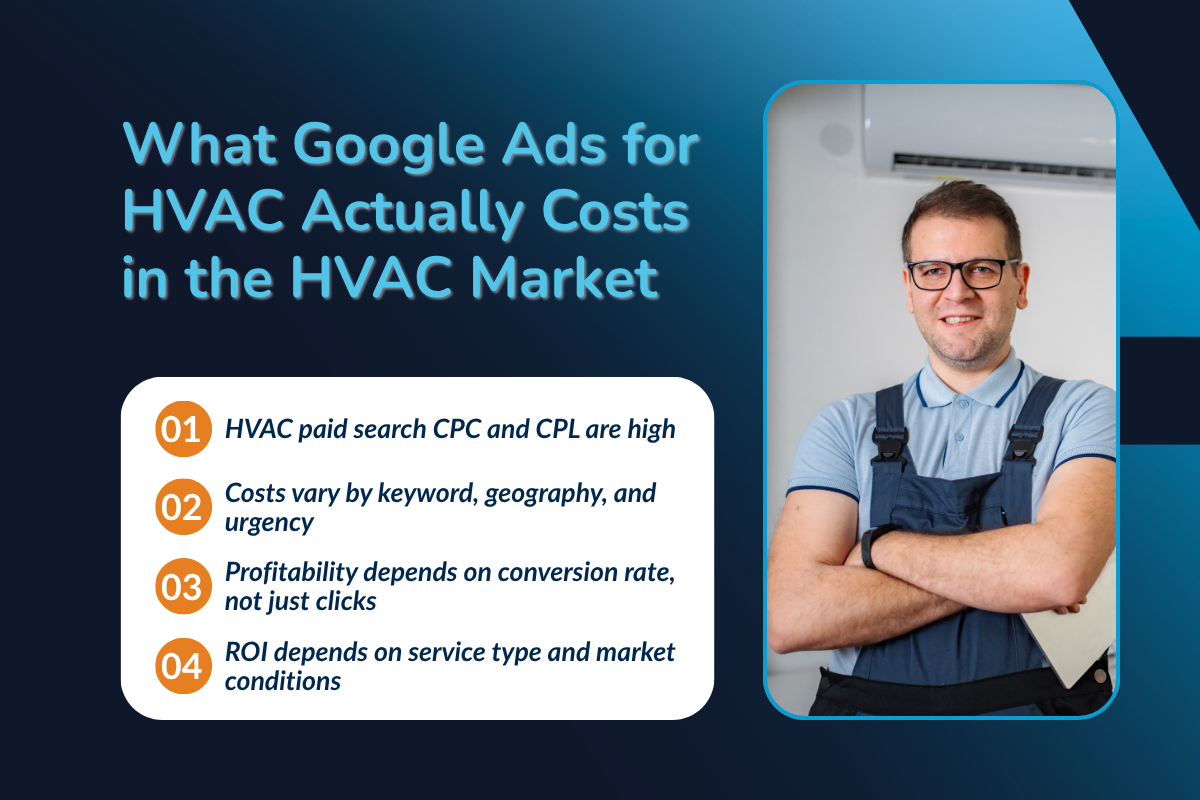
Most HVAC companies either rely too heavily on paid ads or invest in SEO too late. But the highest-performing businesses don’t choose one channel. They use both in phases, adjusting spend based on growth stage, lead demand, and ROI visibility.
What follows is a pattern we have seen in contractors scaling to $3M–$8M in revenue through disciplined marketing execution.
4-Phase HVAC Marketing Strategy Top HVAC Contractors Use in 2026
Phase 1 (Months 1–6): Paid Ads + SEO Foundation
Invest $3K–$5K/month into paid ads to generate immediate lead volume (20–35 leads) and keep 2–3 technicians scheduled. At the same time, build your SEO foundation, Google Business Profile optimization, technical fixes, initial content, and citations. Expect little to no organic leads during this phase.
Phase 2 (Months 7–12): Early SEO Growth + Ads Maintained
Increase total budget slightly to $3.5K–$5.5K/month. SEO begins generating 8–18 organic leads while paid ads continue driving consistent volume. Total leads reach 30–55/month. Start tracking cost per lead (CPL) by channel and begin pausing paid keywords where organic rankings improve.
Phase 3 (Months 13–24): SEO Becomes Primary + Ads Become Tactical
Organic SEO generates 25–50 leads/month. Paid ads shift to tactical use, emergency services, peak demand, and high-ticket campaigns. Paid spend drops by 30–50%. Total investment stabilizes around $3K–$4.5K/month, with 45–75 total leads at a lower blended CPL.
Phase 4 (24+ Months): Compounding SEO + Strategic Paid Ads
SEO becomes the primary, lowest-cost acquisition channel. Paid ads are used selectively for high-ROI campaigns only. Total marketing spend may decrease compared to earlier phases, while lead volume continues to grow. This is the long-term advantage of compounding organic visibility.
The HVAC Seasonal Overlay: How to Adjust Both Channels by Quarter
The HVAC business is more seasonally variable than almost any other home services vertical, and a marketing strategy that does not account for seasonal demand variation is leaving significant efficiency on the table in both channels.
Q2 (April–June): Pre-Peak Setup
Focus on SEO content for cooling services (allow 6–8 weeks to rank before peak season). Run paid ads at moderate levels. Update Google Business Profile with AC tune-ups, efficiency content, and seasonal messaging.
Q3 (July–August): Peak Demand Capture
Maximize paid ad spend for emergency and repair keywords (highest intent). Organic rankings built in earlier months deliver strong returns. Maintain visibility across both channels, as this is not the time to reduce spend.
Q4 (September–November): Budget Reallocation
Reduce paid spend on repair keywords and shift budget toward installation and replacement campaigns. Invest in heating-related SEO content to prepare for winter demand.
Q1 (December–March): Heating Season Execution
Increase paid ads for emergency heating services in colder markets. Organic heating content should perform strongly during this period. In slower or warmer markets, reduce paid spend and focus on building SEO for the upcoming cooling season.
The Five Numbers (Metric) Every HVAC Business Should Be Tracking Monthly
Without clear metrics, it becomes impossible to know which channel is profitable, where leads are leaking, and what to scale next.
These are the five metrics that give you a complete picture of how your HVAC SEO and paid ads are performing:
- Cost Per Lead (CPL) by Channel: Track CPL monthly for paid ads and SEO. SEO CPL should fall over time, while paid CPL usually changes with competition and seasonality. This shows how efficiently each channel generates leads.
- Lead-to-Booked-Job Rate by Channel: Track the percentage of leads that turn into booked jobs for paid and organic separately. This helps you compare lead quality and see your true cost per customer.
- Average Job Value by Lead Source: Measure average revenue from organic vs paid leads. SEO leads often convert into higher-ticket jobs, while paid leads may skew toward smaller repairs. This changes ROI.
- Review Velocity: Track how many new Google reviews you generate each month. Review growth supports local visibility and trust, while a slowdown can signal future lead decline.
- Organic Traffic Trend by Landing Page: Track monthly traffic to key service pages like AC repair, furnace repair, and installation. This shows which parts of your SEO strategy are working and which pages need improvement.
Beyond the Ranking: Owning the Full Customer Journey with HVACBase
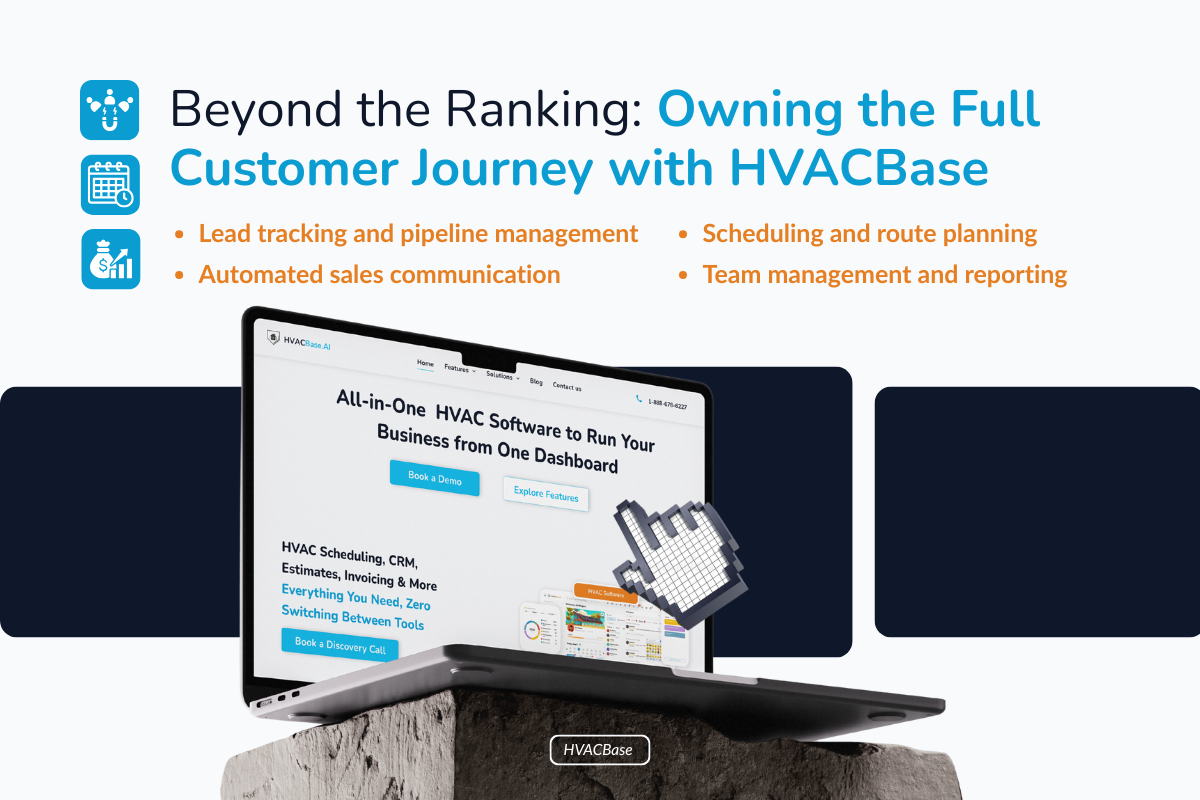
Ranking higher on Google, whether you use Google Ads or seo, is only the first step. The next question becomes, "What happens after the lead comes in?"
HVACBase is built to help you manage the entire journey, from the first inquiry to a completed job, so your marketing investment actually converts into revenue.
- Lead Tracking & Pipeline Management: Capture leads from web forms, ads, and outreach, track their sources, move them through the pipeline, and assign follow-up tasks so no opportunity is missed.
- Scheduling & Route Planning: Schedule appointments, assign jobs, optimize routes, and track progress in real time with HVAC scheduling software that automates dispatching and routes.
- Automated Sales Communication: Automate texts, emails, quote reminders, appointment confirmations, and service alerts so follow-up does not depend on manual effort, and pair it with HVAC proposal software to create quotes and estimates that close faster.
- Team Management: Assign jobs by availability and role, manage workflows, and maintain visibility across the team as volume grows using all-in-one HVAC business management software.
- Sales Analytics & Reporting: Track job performance, team efficiency, and sales activity to understand how operations are performing as you scale with HVAC business software that centralizes revenue and job tracking.
Converting HVAC Leads Matters More Than Generating Them
Using HVAC sales CRM software to track leads and deals through every stage ensures that the demand you create with SEO and paid ads turns into booked revenue instead of slipping through the cracks.
HVAC SEO and paid ads bring in leads, but growth comes from what happens after, how those leads are managed, followed up, and converted into jobs with HVAC sales software built to track leads, build proposals, and close more deals.
This is where HVACBase helps you connect that entire journey in one place, so your marketing efforts don’t stop at generating leads and translate into actual revenue, especially for companies leaning on residential HVAC software to manage calls, quotes, and maintenance agreements.
Conclusion
Should you choose HVAC SEO or Google Ads? The answer is you don't have a choice. If you want a high-performing HVAC business, then instead of choosing a channel, you need to build a system and use your capital based on outcomes.
Paid Ads will give you demand now, while SEO reduces the cost of that demand later on. The better question you can ask is, “Which channel gets me to my next stage of growth faster, given my constraints?”
To become a contractor who scales past $3M, you need to stop relying on one channel and transition from paid-first to SEO-dominant, while tracking cost per lead, lead quality, and booking rate by channel.
This is how marketing stops being an expense you question and starts helping you scale.
Stop Guessing Where Your Marketing Budget Should Go
If you are already spending on marketing but don’t have visibility into which channel is actually producing profitable jobs, where leads are leaking, and what to scale next?
Book a demo with HVACBase, and we’ll break down your current setup, show you your real cost per lead by channel, and map exactly where your next marketing investment should go.
Frequently Asked Questions About HVAC SEO and Google Ads
Is HVAC SEO worth it for a small contractor in 2026?
Yes, if you can wait 6–9 months for results. HVAC SEO builds long-term visibility and can lower cost per lead over time, especially when paired with strong Google Business Profile optimization.
How much should an HVAC company spend on Google Ads per month?
Most contractors need around $2,000–$5,000 per month to generate consistent lead volume. The right budget depends on your market, cost per click, and how many leads you need.
Can an HVAC company do its own SEO without hiring an agency?
Yes, but only at the basic level. A contractor can manage GBP, reviews, and simple content, but competitive HVAC SEO usually requires technical SEO, content, and authority building.
What is a good cost per lead for HVAC Google Ads?
A typical HVAC Google Ads CPL often ranges from $35 to $150, depending on market competition, keyword type, and landing page quality. Emergency and high-intent keywords usually cost more.
How do I know if my HVAC SEO company is actually doing anything?
Look for measurable outputs: new content, ranking growth, better visibility, increasing traffic, and more qualified leads. If reporting is vague and nothing changes after 4–6 months, that is a red flag.
Should an HVAC contractor run SEO and Google Ads at the same time?
Usually yes. Google Ads generates leads faster, while SEO builds lower-cost growth over time. Running both helps maintain lead flow while organic visibility compounds.
Have questions or need personalized advice?
Talk to an Expert Today and let our construction specialists guide you to success.
Related Posts