HVAC Business Software That Helps You Track Revenue, Jobs & Tech Performance
December 4, 2025
Your technicians are out in the field handling service calls, your inbox is full of invoices stuck in emails, and at the end of the day, you’re left with a dozen open browser tabs and zero clarity on how your HVAC business actually performed today.
That’s the real pain: most HVAC companies juggle spreadsheets, separate apps for job scheduling, invoicing, CRM, and inventory. It becomes a chaotic stack of tools. And what happens? Missed revenue, poor tech-performance visibility, and slower decision-making.
Sounds familiar? Good news: you’re about to get your free guide: Building efficiency into every job.
How HVAC Business Software Helps You Track Revenue, Jobs & Tech Performance in One Place
The right HVAC service software can completely change how you run your day. Connecting people, numbers, and performance in one view. Today’s HVAC businesses succeed when HVAC contractors and teams see the full picture, from job progress to revenue flow and technician performance, not just what’s on the schedule.
In this guide, you’ll explore how visibility drives smarter growth for HVAC businesses. You’ll learn what good HVAC management software like HVACBase really does beyond basic scheduling, how it helps you track revenue in real time, measure team performance, and see how leading companies use technology to deliver exceptional service and help your HVAC business grow.
Finally, we’ll break down how to choose the best HVAC business management software that fits your goals and helps you scale confidently. Let’s flip the switch.
Key Takeaways
- HVAC business software brings clarity to your operations, helping you see revenue, job progress, and technician performance in one place.
- Many contractors face limited visibility because data sits in different tools; unified dashboards fix that by connecting them all.
- Modern HVAC platforms turn everyday management into clear, data-backed decisions that improve efficiency and profitability.
- A single system simplifies job tracking, team analytics, and revenue insights, making it easier to stay on top of your business.
- The right software becomes more than a tool; it acts as a growth partner, giving HVAC businesses control, confidence, and room to scale.
Curious how modern tools simplify revenue tracking?
For contractors looking to avoid spreadsheets and manual updates, HVACBase offers a clean way to visualize job profitability. Explore more.
Why Visibility Matters in Every HVAC Service Business
Visibility helps HVAC professionals make smarter, faster decisions. With unified dispatch software and customer relationship management tools, job details, customer information, and technician updates stay connected, boosting efficiency and business growth.
But when visibility is missing, scattered systems cause delays, confusion, and lost opportunities, slowing your HVAC business without you even realizing it. Let’s explore how.
1. The Real Cost of Operating Blind
When revenue, service calls, job progress, customer history, and tech performance are spread across disconnected tools, decisions become guesswork.
- Invoices may get raised late → cash flow gets hit
- Techs may finish a job, but the data stays in their van or on a piece of paper → no central log
- Scheduling conflicts, double-bookings, missed follow-ups → customer satisfaction suffers
When you don’t know what’s happening, you can’t manage it.
How Lack of Insight Impacts Growth
Operational gaps eventually become growth barriers. Without clear visibility into revenue trends, technician performance, or customer history, decision-making turns reactive instead of strategic.
- Harder to forecast revenue or spot profit leaks
- No data-backed way to reward or coach technicians
- Missed chances to build stronger service agreements or upsell loyal customers
- Weakened brand trust due to inconsistent communication and service quality
Visibility isn’t just about seeing what’s happening; it’s about building a business that grows with confidence and control.
Industry Insight (Data-Driven Point)
According to a recent report, the global HVAC field service management software market is valued at over USD 3.21 billion in 2024, and is projected to grow at a CAGR of about 13.8% to reach USD 9.07 billion by 2033.
Another report shows cloud-based HVAC service management software accounted for around 58% of deployments in 2024 and is growing fast.
What does that mean for you? It means the market is choosing software, and companies that hang back risk being left behind.
What HVAC Companies Miss When Data Is Scattered
1. Fragmented Tools = Fragmented Insight: Spreadsheets for job tracking, separate apps for invoicing, paper forms for service calls = chaos.
2. Hidden Revenue Leaks: Jobs get finished → tech leaves site → invoice gets delayed → payment gets delayed → cash flow suffers.
3. No Clarity on Technician Performance: Without clear metrics like first-time fix rate or average job duration, you can’t reward high performance or identify weak spots.
4. Customer Satisfaction Drops: Missed follow-ups, late responses, no mobile access for customers → leads to a poor experience even if your technical work is great.
Solution: HVAC Business Software
The answer isn’t more spreadsheets or more apps; it’s one unified platform that handles job scheduling, dispatching, invoicing, customer management, inventory, technician performance, and analytics all in one place.
That’s where a modern “business operations” tool built for HVAC comes in. Let's Explore how?
What HVAC Business Software Really Does (Beyond Just Job Scheduling)
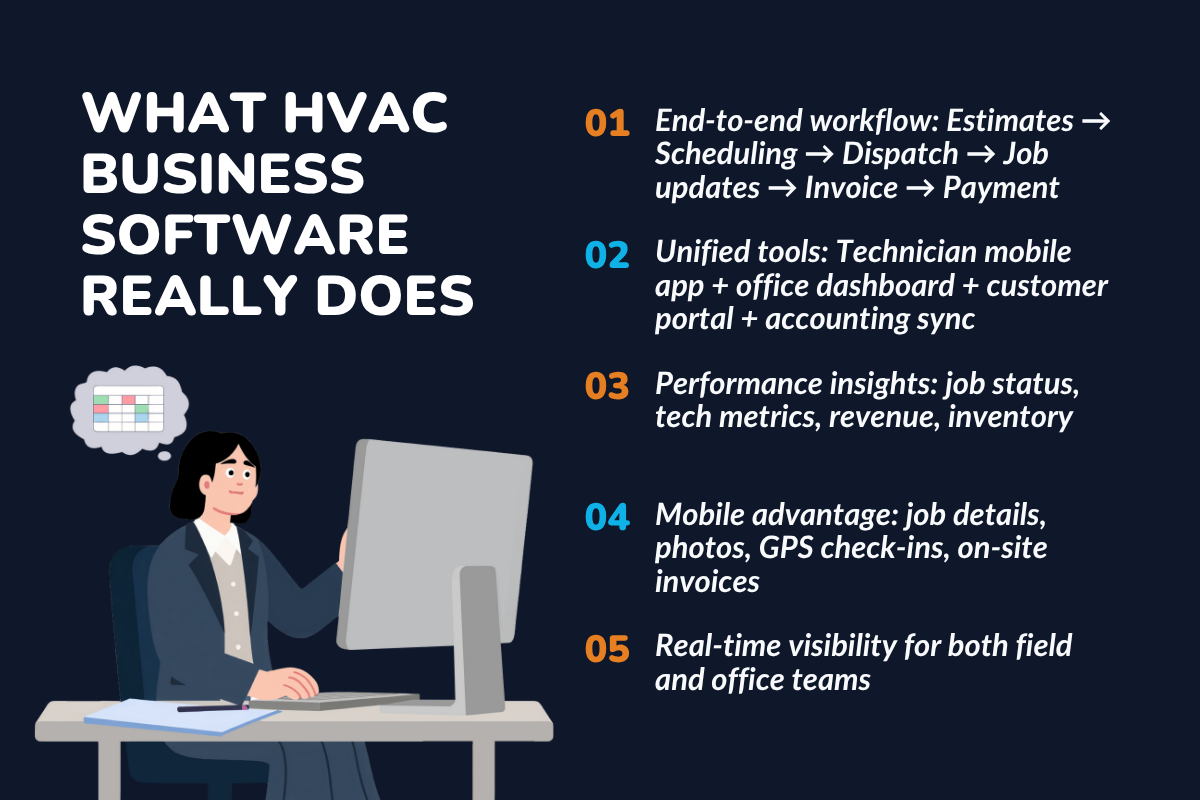
1. From Estimates to Invoices, Everything Under One Roof
Let's say you get a service call, then you have to:
- Schedule the tech
- Dispatch them with job details and customer info
- Technician arrives, updates status, captures photos, logs parts used
- Job completes → generate invoice, send to customer, track payment
- Update customer history, service agreement details, and inventory used
- Analyze how the tech performed compared to previous jobs
Here’s how that looks with an integrated HVAC business software: a mobile app for technicians, a central office dashboard for dispatch and scheduling, a customer portal for transparency, and accounting integrations for faster invoicing, all syncing seamlessly in real time.
2. Performance Dashboards That Tell You What’s Working (and What’s Not)
Instead of relying on gut instinct or fragmented reports, you have:
- Real-time dashboards showing job statuses, unpaid invoices, and parts inventory
- Tech performance metrics: jobs per day, first-time fix %, average duration
- Revenue by job type, by customer, by tech
- Customer satisfaction scores, repeat rates
With that data, you can actually manage your business instead of reacting to it.
3. Mobile Access for On-the-Go Teams
Your technicians are in the field, and they need access on mobile:
- Job details, customer history, parts availability
- GPS check-ins, photo capture, digital signatures
- Invoice generation and payment processing on-site
Meanwhile, the office team can see everything in real time and make dispatch decisions intelligently.
How Can Smart Revenue Tracking Drive Your HVAC Business Growth?
Smart revenue tracking isn’t just about numbers; it’s about understanding every moving part of your HVAC systems. The right HVAC accounting software helps you monitor every payment, job, and service call in one place.
1. See Real-Time Revenue by Job Type, Client, or Team
Knowing your revenue is one thing; knowing where it’s coming from is another.
With the right software, you can:
- Compare maintenance services vs installations vs emergency repair jobs
- See which customers are your top revenue sources
- Identify which technicians are generating the most profitable jobs
This kind of visibility lets you double down on what’s working.
2. Automate Billing and Reduce Payment Delays
- Generate professional estimates and invoices the moment the job completes
- Set up payment processing so you can accept credit cards, Online Pay, etc., on-site
- Automate reminders for overdue payments
- Integrate with accounting software like QuickBooks Online so financials stay synced
Delayed invoicing = delayed payment. And automation kills that lag.
Forecast Cash Flow With Confidence
When you know: scheduled jobs + pending invoices + technician capacity = you can forecast cash flow.
Better cash flow forecasting means:
- knowing when you can invest in equipment or new techs
- avoiding surprise shortfalls
- making strategic decisions instead of guessing
Also read: HVAC Marketing and SEO: Finding Local Commercial/Residential Leads
How Can Effortless Job Tracking Keep Your HVAC Projects on Schedule?
With HVAC field service software, job tracking becomes seamless, helping HVAC pros manage schedules, technician routes, and customer information in real time.
Efficient dispatch software and communication tools keep clients informed, ensure reliable service, and boost overall HVAC operations. By streamlining workflows and improving visibility, HVAC businesses can handle more customers, create invoices faster, and drive consistent growth.
1. Visual Job Timelines and Progress Tracking
Wouldn’t it be great to open your dashboard and see a timeline of each job: scheduled, dispatched, tech arrived, on site, job completed, invoice sent?
That’s the level of visibility you get. Dispatchers don’t have to call techs every 10 minutes. You just see status updates in one place.
2. Real-Time Technician Updates
Mobile apps mean you get:
- GPS check-ins so you know tech arrived
- Photos of the job site and parts used (especially useful for warranties or disputes)
- Digital signatures from customers
- Customer feedback immediately after job completion
It’s transparency and accountability, built in.
3. Eliminate Missed Appointments and Double Bookings
Scheduling conflicts are one of the biggest frustrations in service businesses. The right software gives you:
- A live calendar with tech availability, job location map view
- Automatic warnings if a tech is overbooked or being booked for two jobs at once
- Route optimisation so techs spend less time in transit and more time on jobs
Less idle time = more revenue.
How Can You Measure Technician Performance Without Micromanaging?
You can track technician performance through smart dashboards instead of constant check-ins. Integrated customer management tools and HVAC scheduling give you real-time visibility into jobs, customer calls, and productivity.
The online portal helps HVAC techs update progress, accept payments, and keep customers informed, driving growth and reliability across your entire business.
1. Key Metrics That Matter: Efficiency, First-Time Fix Rate, and Customer Satisfaction
You’ve heard of KPIs. But in the HVAC world, these metrics matter:
- First-Time Fix Rate: Tracks how often technicians complete jobs successfully without needing a return visit.
- Average Job Duration: Measures how efficiently each job is completed, helping identify workflow improvements.
- Revenue per Technician: Shows how much value each team member contributes to overall business performance.
- Customer Satisfaction Score: Captures client feedback after every job, reflecting service quality and reliability.
Tracking these metrics objectively means you can reward performance, train consciously, and improve retention.
2. Leaderboards and Goal Tracking for Healthy Competition
- Which tech had the most first-time fixes last month?
- Which team has the highest customer satisfaction?
- Which job types are hitting the highest margin?
Healthy competition can boost morale and performance.
Insights for Smarter Training and Upskilling
When performance data shows a pattern, say one technician consistently has longer job durations, you can identify training needs rather than just pointing the blame. Use real data to help them improve. That’s leadership, not micromanagement.
How Top HVAC Companies Use Software to Grow Smarter, Not Harder
1. Data-Driven Decisions That Boost Margins
Top companies don’t guess, they analyse:
- Which types of jobs have the highest margins (service agreements vs one-time repairs)
- Which clients are repeating and which are dropping off
- Which technicians are most profitable
Then they allocate techs to high-profit jobs, ramp up service agreement selling, and reduce wasted travel time.
2. Efficiency That Frees Up Time for Expansion
Automation gives you time back: less time doing admin → more time scaling, exploring new markets, investing in marketing. You don’t need to add admins when you grow; just better software and processes.
3. From Reactive to Proactive Management
Instead of "Oh no, a job went wrong", you have alerts:
- Tech is delayed
- Invoice overdue
- The customer hasn't booked a service in 12 months
You become the business that runs itself rather than fires off from one crisis to the next.
Choosing the Best HVAC Business Software for Your Company
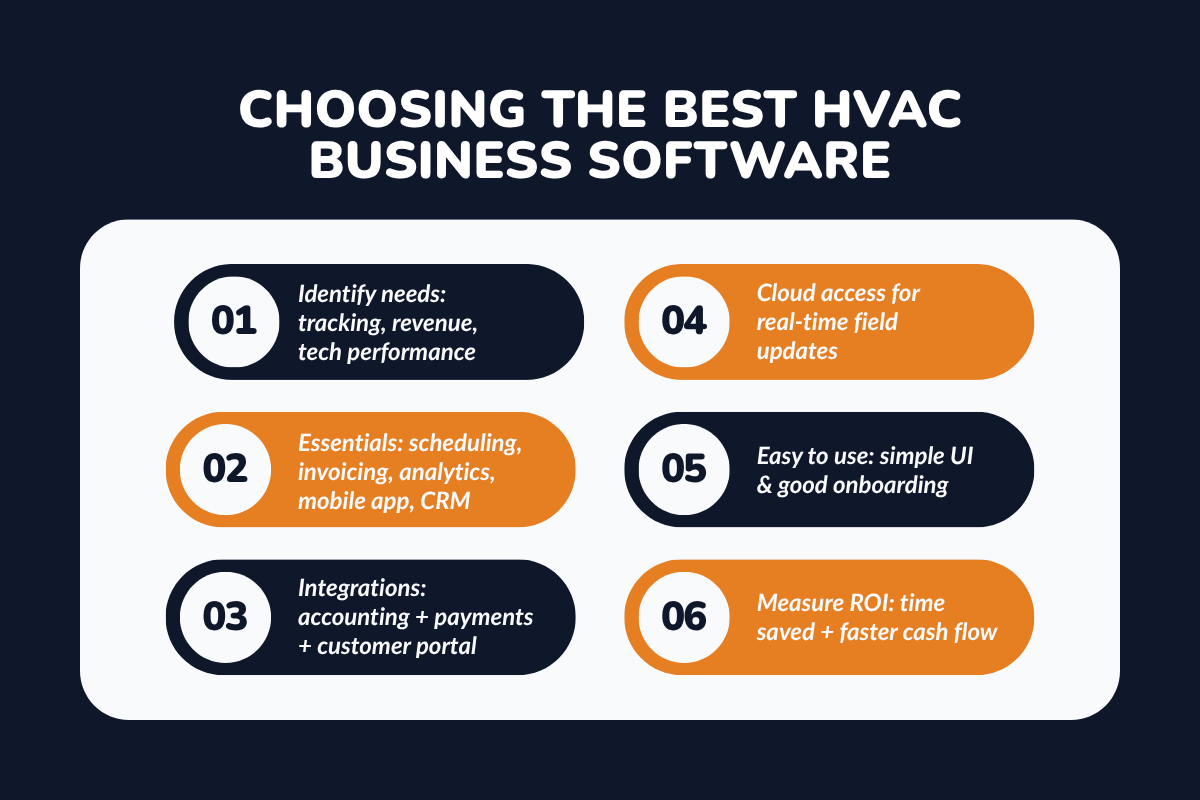
Here's a step-by-step selection checklist:
1. Define Your Business Needs
Are you focusing on job tracking? Technician analytics? Invoicing? Customer management? Know your biggest pain points. Contractors often say:
> “We lack visibility into revenue streams, job progress, and technician performance.”
> “Data is spread across tools, reporting is slow and unreliable.”
> Sound familiar? Then you know what your tool must fix.
2. Must-Have Features
- Job scheduling & dispatch: This feature helps office staff assign the right technician to the right job at the right time. It shows availability, location, skills, and workload, then automatically maps efficient routes.
- Invoicing & payment tracking (on-site payments, card terminals, online Pay, etc): This allows technicians to generate invoices directly after completing a job and collect payments on-site using card terminals, mobile payments, ACH, or online Pay links.
- Revenue analytics (by job, technician, client): This tool breaks down where your money comes from. You can see which jobs are profitable, which technicians generate the most revenue, and which clients bring long-term value.
- Technician performance dashboards (first-time fix rate, profit per tech): These dashboards show how each technician is performing, using metrics like first-time fix rate, average job time, upsells, customer satisfaction, and profit per tech.
- Mobile app for field updates: Technicians can access job details, update job status, upload photos, record parts used, collect signatures, and send invoices—all from their phone or tablet.
- Customer satisfaction/CRM tools (history of visits, service agreements): The built-in CRM stores complete customer history: past visits, installed equipment, warranties, service agreements, quotes, and communication notes.
- Inventory management (parts used, reorder alerts): This tracks every part used in the field and updates stock levels in real time. It alerts you when inventory is running low, helps prevent stockouts, and keeps purchasing organized.
3. Integration Matters
Your HVAC software should integrate with your accounting software (QuickBooks Online / Desktop), CRM, payment processing, and customer portal. No more switching between apps.
4. Cloud-Based Advantage
Cloud solutions give your field teams mobile access, real-time data, and remote visibility. Reports show that adoption of cloud-based HVAC service management software is growing rapidly.
5. User Experience & Support
If your field technicians find the app clunky, they’ll resist using it. If dispatchers struggle to learn it, you’ll have low adoption. Ensure your software provider offers good onboarding, mobile access, and a simple UI.
6. Evaluate ROI
Every minute saved in admin work or every day’s faster invoice cycle directly adds to your profit margin. Estimate how much time you’ll save and how much revenue you’ll recover from missed invoices or tech inefficiencies.
Take a detailed look at: Must-Have Features of HVAC Business Software
Conclusion: Turn Your HVAC Software Into a Growth Partner
Growth isn’t about adding more tools; it’s about using the right one wisely.
The right HVAC software, like HVACBase, doesn’t just organize your business; it reveals where you can be faster, smarter, and more reliable.
When operations run effortlessly, your team performs better, your customers notice, and your business naturally expands. Maybe it’s time to stop managing work and start mastering it.
About HVACBase
Built by HVAC pros for HVAC technicians and pros, HVACBase isn’t just another management tool in the HVAC industry. It’s your all-in-one command center for your HVAC business operations. From scheduling and dispatching to invoicing and customer care, it brings everything together so you can focus on what really matters: getting the job done right, every time.
Say goodbye to messy spreadsheets and missed appointments. If you’re ready to stop juggling tools and start growing with confidence, it’s time to make the switch. Try HVACBase, the smarter way to run your HVAC business.
FAQs
Do I need to migrate all my data from spreadsheets?
Yes, you’ll want to bring customer history, parts inventory, and past invoices into the software, but the best HVAC software provider offers migration support.
Does it integrate with QuickBooks?
Yes, HVACBase offers integration with QuickBooks Online/Desktop (and payment processing) so your accounting stays in sync.
How soon will I see ROI?
Many users report faster invoicing, with HVAC invoicing software, fewer missed jobs, and more time for business development, often within a few months of full adoption.
Can my technicians use it on mobile?
Absolutely, mobile apps for dispatch with HVAC dispatch software, job updates, photos, and digital signatures are core to the platform.
Have questions or need personalized advice?
Talk to an Expert Today and let our construction specialists guide you to success.
Related Posts