HVAC Software for Service Contractors: Automating Dispatch, Billing & Customer Management
December 4, 2025
Every HVAC contractor has been in this scenario at least once: the phone rings before sunrise, a tech calls in sick, and a customer wants to know why their invoice still hasn’t arrived.
By noon, the schedule has shifted twice, and you end up buried in yesterday’s paperwork. That constant shuffle is where most service businesses lose time and money.
Modern HVAC software is built to stop exactly that by connecting your field team, office, and customers in one place, turning the daily struggle into a smoother, faster routine.
How HVAC Software Helps Contractors Automate Dispatch, Billing & Customer Management
HVAC software for service contractors automates dispatching, billing, and customer management with features like real-time scheduling, mobile access for technicians, automated invoicing, and a centralized customer database.
In the sections ahead, we’ll break down how today’s all-in-one HVAC platforms simplify the way contractors run their businesses, automating everything from technician dispatch and scheduling to invoicing and customer communication.
Key Takeaways
- HVAC software connects dispatch, billing, and customer management in one place.
- Automated scheduling and dispatching reduce missed appointments and downtime.
- Digital invoicing speeds up payments and improves cash flow.
- Customer management tools keep service history, reminders, and communication organized.
- HVAC companies using automation can see faster jobs, smoother operations, and better customer satisfaction.
Ready to Streamline Dispatch, Billing & Customer Management?
If these challenges sound familiar, it may be time to modernize your workflow. See how HVACBase automation can transform your daily operations—without extra paperwork or stress.
What Is HVAC Software & Why Does It Matter for Service Contractors
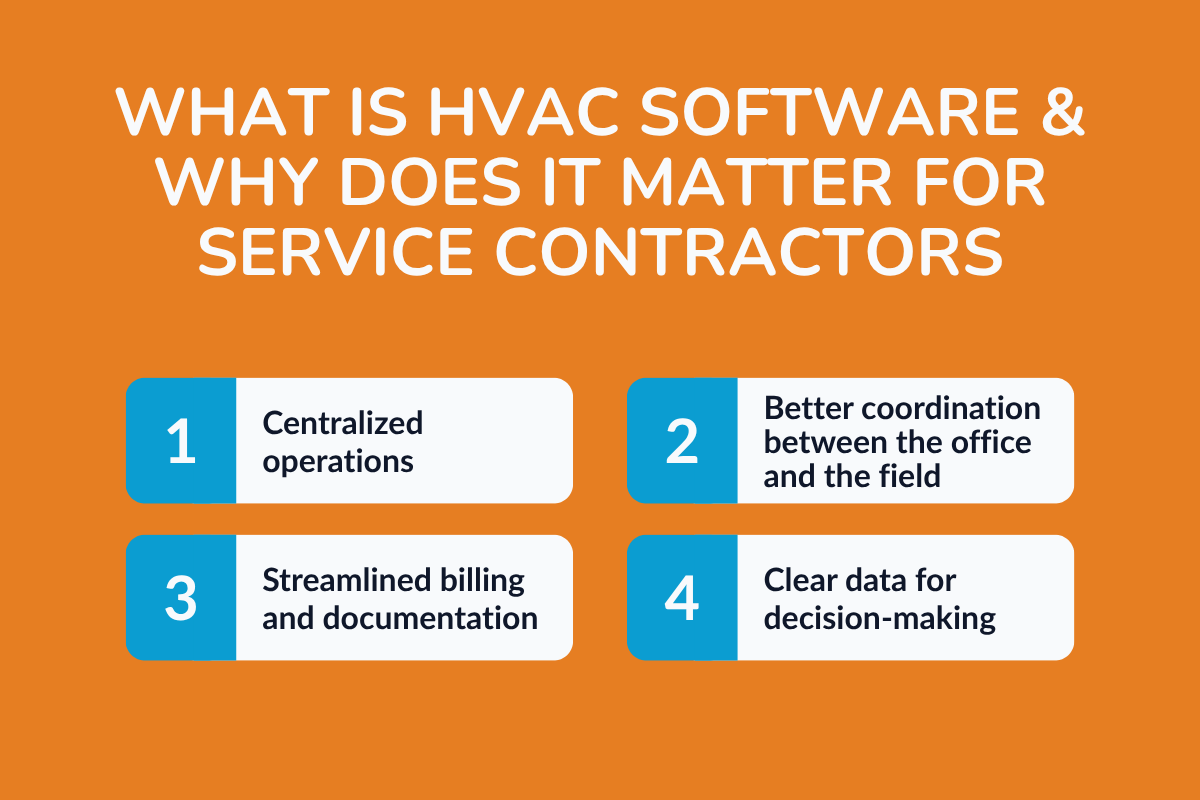
Before diving into automation and advanced features, it’s worth understanding what HVAC service software actually does, as it is the system that connects your office, field team, and customers. When it’s set up right, it becomes the backbone of your entire service operation.
1. Centralized operations
At its core, HVAC software acts as an operations hub. It lets you view job schedules, technician routes, and service requests in one dashboard. This reduces confusion between teams and helps the office track what’s happening in the field in real time.
2. Better coordination between the office and the field
Dispatchers can assign jobs and update technicians instantly. Techs can log job details, upload photos, and mark tasks as complete without calling back and forth. This keeps everyone working from the same information, improving accuracy and turnaround time.
3. Streamlined billing and documentation
Every completed job automatically links to its invoice, service notes, and payment history. Instead of using separate tools for estimates, invoices, and follow-ups, everything is documented under the same system. It’s easier to audit, train new staff, and maintain consistency.
4. Clear data for decision-making
Because every job, quote, and invoice passes through one system, patterns become easier to spot. You can track which services are most requested, where delays happen, and how each technician performs. These insights help plan schedules, improve service quality, and control costs.
Common Pain Points in Managing an HVAC Service Business
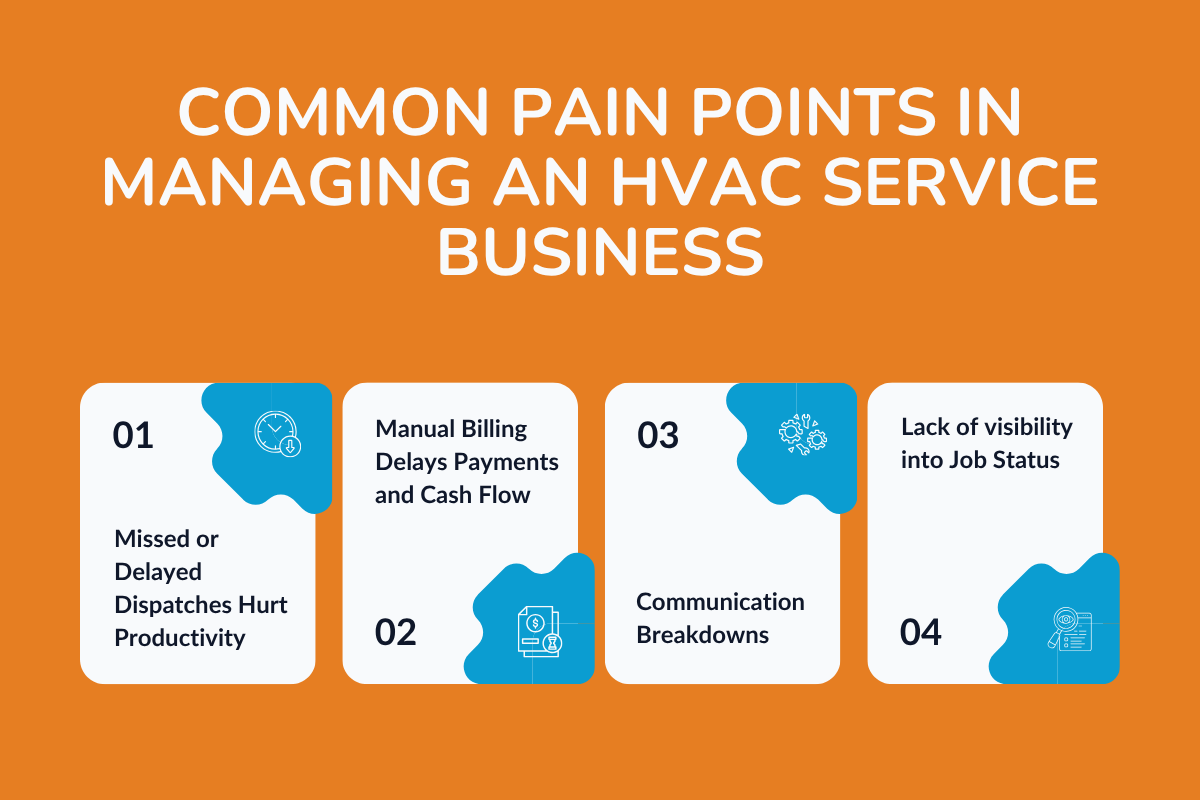
Often, the growing pains of HVAC businesses are not the workload but the coordination. There's only so much you can do manually without risking errors.
Let’s take a look at a few issues that slow down even the best teams, and how automation solves them.
1. Missed or Delayed Dispatches Hurt Productivity
Impact: When dispatch still relies on group chats, a job can become unassigned or delayed, and your customer may choose to go elsewhere.
Why this matters: Every 30-minute gap between job completion and the next start drains time, reduces billable visits, and inflates drive costs.
How time gaps are hurting your HVAC business:
- Lower utilization: Every 30-minute idle window is non-billable, reducing the proportion of time spent on revenue work. A typical target, around 75–85% is common in field service; excessive travel and idle time lessen this.
- More windshield time: Inefficient routing increases drive minutes between jobs, shrinking daily capacity and inflating fuel and vehicle costs.
- Cascading delays: Gaps amplify schedule slippage, which can trigger missed windows, overtime, and repeat visits if parts/skills aren’t aligned.
2. Manual Billing Delays Payments and Cash Flow
Impact: Manual invoicing or delayed billing means money spent has to wait for payment. Technicians commonly cite that one of the main pain point for them is that admin delays prevent jobs from converting into revenue quickly.
Why this matters: If your service cycle takes 3–5 days from job completion to invoice sent, that’s working capital tied up, which could limit your ability to buy parts, hire staff, or take on larger jobs.
3. Communication Breakdowns
Impact: If dispatch team might think a job is on schedule, techs might be stuck waiting for info or parts, and customers aren’t updated. A recent write-up on HVAC customer relations found that 76% of customers value clear communication and honesty.
Why this matters: Poor communication leads to poor customer relationship management, increases cancellations, damages reputation (reviews matter), and forces reactive fixes instead of proactive service.
4. Lack of visibility into Job Status
Impact: Without a unified view of job status, techs’ progress, inventory, and routes, operating in the dark. The lack of proper management is often cited as a major hurdle in HVAC business operations.
Why this matters: If you can’t see where bottlenecks are happening (tech wait time, route overlap, inventory delays), you can’t fix them, which caps growth and increases stress on your team.
These are the problems that silently slow down growth by wasting hours, lowering margins, and stretching already busy teams thinner.
> If these issues sound familiar, it’s a good time to see HVACBase in action to close these gaps for good!
How HVAC Service Software Streamlines Scheduling and Service Calls
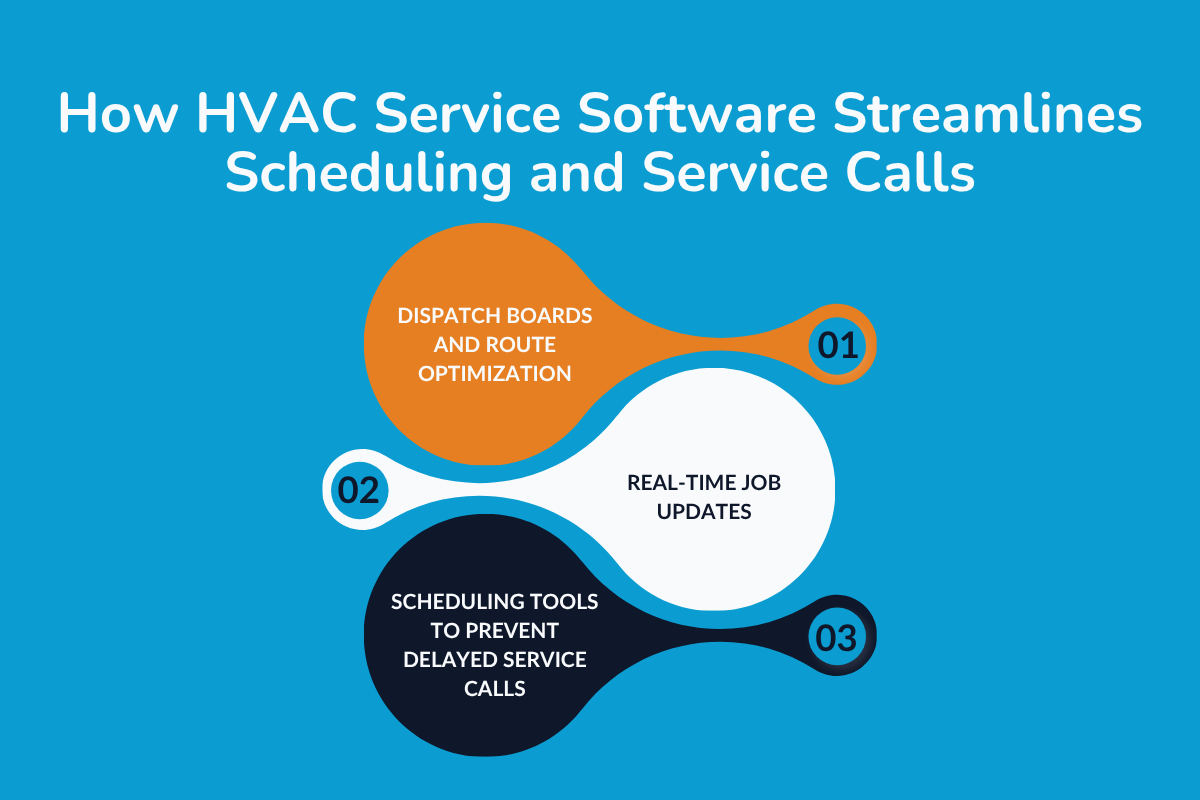
Efficient scheduling and routing are major parts of the difference between a decent HVAC business and a smooth-running one. Here are concrete ways smart systems help:
1. Dispatch Boards and Route Optimization
Manual HVAC scheduling requires you to manage multiple spreadsheets and calendars, resulting in HVAC techs waiting for their next jobs because nothing was reassigned.
Studies show that organizations using route optimization cut travel time by about 17% and increase productivity by roughly 24% in the first year.
In tangible terms: If a tech spends one extra hour driving each day across 20 workdays, you’ve just lost 20 tech-hours a month that could be billed.
2. Real-time Job Updates
Without a live update system, technicians finish a call, and the office might only learn about it hours later, but when HVAC professionals mark jobs complete or log issues on mobile apps, the office can plan the rest of the day better, minimizing idle time and reducing last-minute changes.
3. Scheduling Tools to Prevent Delayed Service Calls
If a customer books, your schedule says “assigned,” but techs weren’t updated, the job never happens. Using an HVAC service software helps you assign jobs by proximity, skill, and availability, helping you increase jobs completed per day.
Also read: HVAC Scheduling and Dispatch Programs: Top Picks
HVAC Invoicing Software: Automate Billing, Payments & Accounting
Billing is one of those things that everyone swears they’ll “get to later,” but it always ends up eating hours and slowing cash flow.
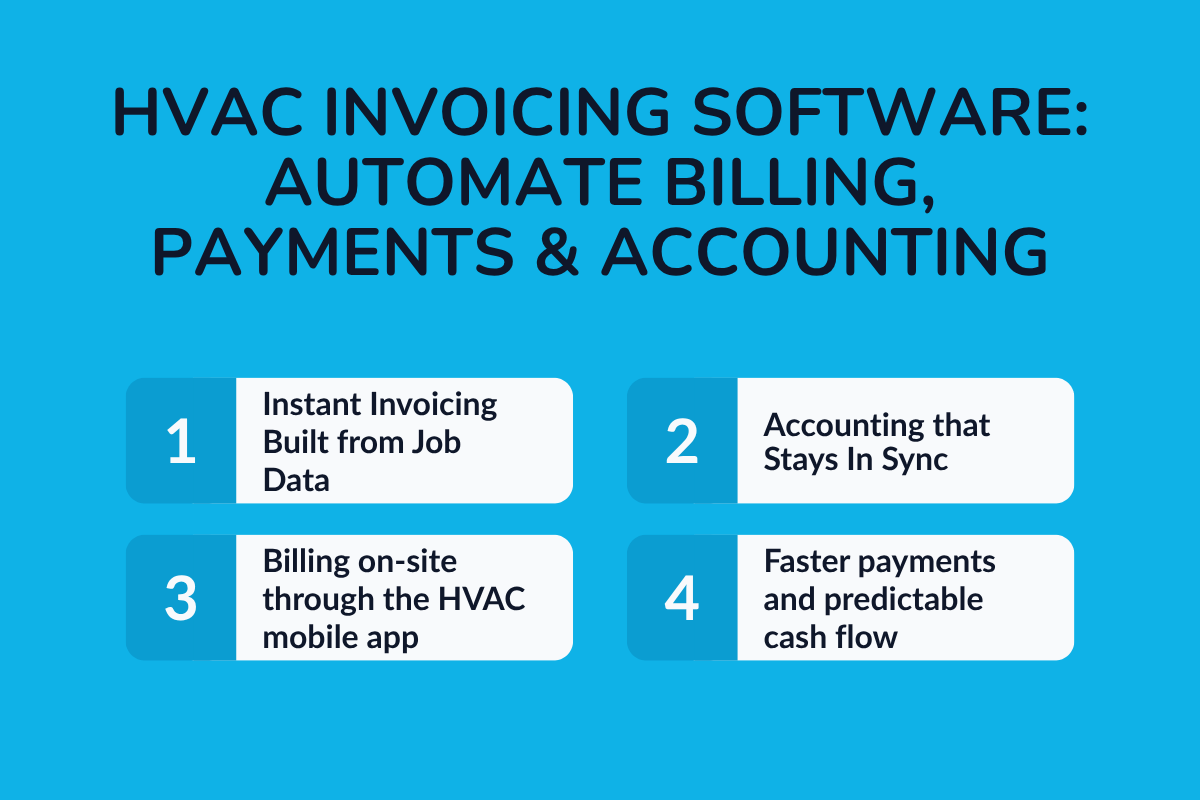
1. Instant Invoicing Built from Job Data
Every job generates data: time on-site, materials used, and labor costs. HVAC invoicing software automatically collects that information and builds a ready-to-send invoice once the technician marks the job as complete.
This means fewer missed items and no end-of-day double entry. For multi-job days or larger crews, the system ensures that each service visit is captured, billed, and recorded promptly.
2. Accounting that Stays In Sync
When invoices, expenses, and payments stay disconnected, minor errors turn into messy books by month’s end. That’s where QuickBooks integration and other linked systems come in, automatically syncing every invoice, tax entry, and payment record.
It’s the difference between reconciling accounts once a day versus once a week, and it keeps reporting clean for both the accountant and the owner.
3. Billing on-site through the HVAC mobile app
Many teams still wait until the end of the day to log invoices, which is why payments often get delayed.
With an HVAC mobile app, HVAC technicians can create and send invoices right after completing the job, while the details are still fresh. The customer signs on-screen, and the system syncs it back to the office in seconds.
This single workflow reduces missed invoices and forgotten line items.
4. Faster payments and predictable cash flow
When customers receive invoices immediately, they pay faster, especially with online and credit card payments built in.
Companies often see outstanding invoices drop soon after the adoption of digital billing. That steady cash flow is what allows owners to plan more effectively, rather than just reacting to what’s left in the bank at the end of the week.
Everything, from quotes to payments, is managed through a single dashboard in HVAC management software, making it easier to monitor what’s pending, what’s overdue, and who’s paid.
Experience Smart Automation Firsthand
If you'd like to see what that looks like in practice, you can book a quick demo to explore how automation fits into your workflow.
HVAC Accounting Software and Pricing: What It Costs to Automate Your Service
An accounting software for your HVAC business can do more than track revenue; it can also connect every financial detail to field activity.
> Typical Pricing Models
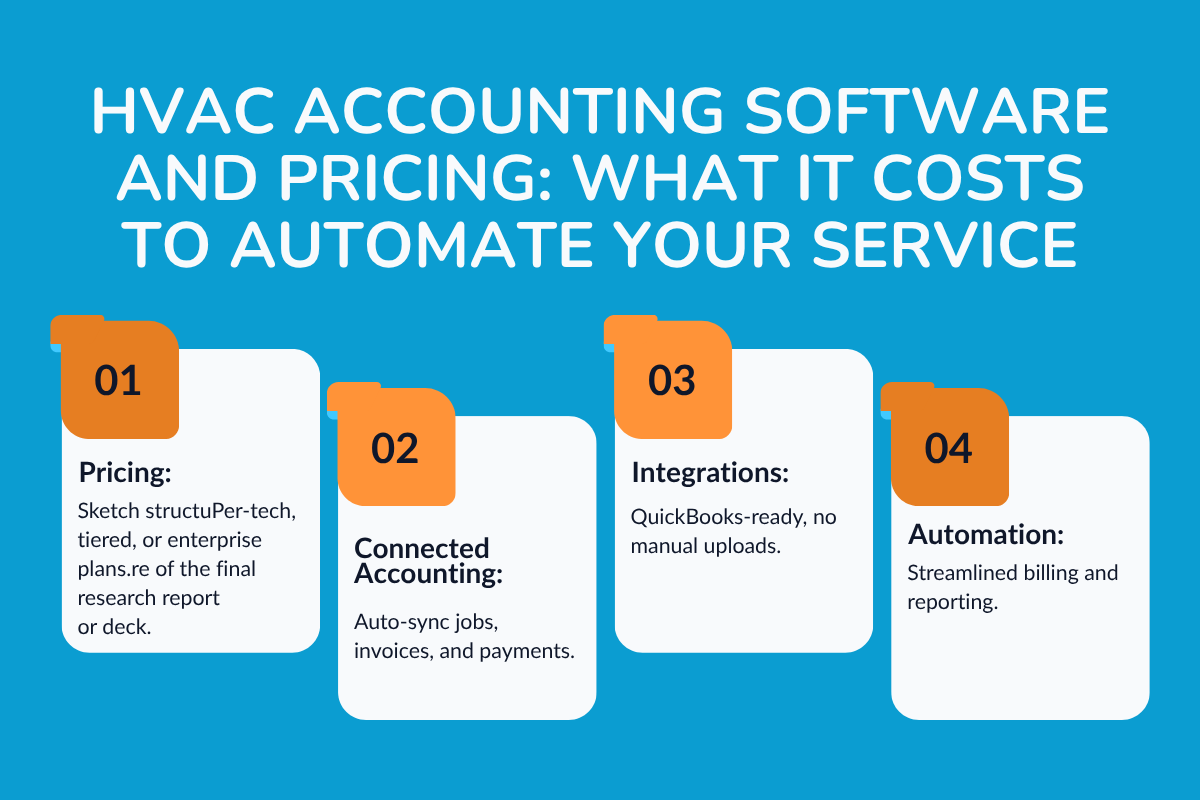
Most HVAC business management software platforms follow one of three pricing structures:
- Per-technician pricing: Charged monthly per active field user. Best for smaller teams who need flexibility to scale.
- Tiered packages: Fixed pricing based on company size or feature sets (e.g., dispatch + invoicing + accounting), suited for businesses with consistent workloads.
- Enterprise plans: Custom packages for larger firms managing multiple divisions or service types.
Full-suite HVAC software typically ranges from $25 to $75 per technician per month, depending on the level of integrations and support.
Larger enterprise tools can cost several hundred dollars per month, but they typically include advanced analytics, CRM, and reporting.
~ Prices may vary by vendor.
> How HVAC Accounting Software Connects Operations
Manual bookkeeping and job tracking are often run as two separate processes, one in the field and one in the office. This split creates errors, missed expenses, and inconsistent revenue recognition.
Modern accounting tools link job data directly to financial records. Every time you create invoices, record professional estimates, or update service agreements, those entries automatically feed into accounting.
That means the books reflect what’s happening on the ground, not what’s remembered later.
> Integrations That Eliminate Redundant Work
Many platforms integrate directly with QuickBooks Online, pushing invoices, expenses, and customer payments in real time. This eliminates the need for manual imports or spreadsheet uploads. It also simplifies tax prep.
For teams already using accounting software, integration is less about “adding” tools and more about removing manual processes that eat time and introduce risk.
> Where Automation Adds Value
Automated systems can:
- Streamline operations by consolidating scheduling, invoicing, and accounting in one view.
- Maximize efficiency through automatic expense categorization and live reporting.
- Maximize profits by identifying job-level profitability and flagging high-cost areas early.
Over time, ROI comes from reduced admin hours, better forecasting, and steadier cash flow.
> Estimating the Cost of Change
Transitioning from spreadsheets or legacy tools involves some setup, typically including data migration, system training, and integration with existing CRM systems or inventory management systems.
Most HVAC companies recover those costs quickly by saving staff hours on billing, dispatch, and reconciliation.
Businesses managing recurring HVAC systems maintenance contracts or annual service agreements see the fastest payback because automation removes repetitive admin work from renewals and reminders.
Customer Management Tools That Transform HVAC Businesses
For most HVAC teams, growth doesn’t stall because of a lack of new customers; it slows down because tracking the ones you already serve takes more effort than it should.
A connected customer management system within your HVAC software helps bring structure back to day-to-day operations, keeping every interaction, job record, and renewal in one place, so nothing slips through.
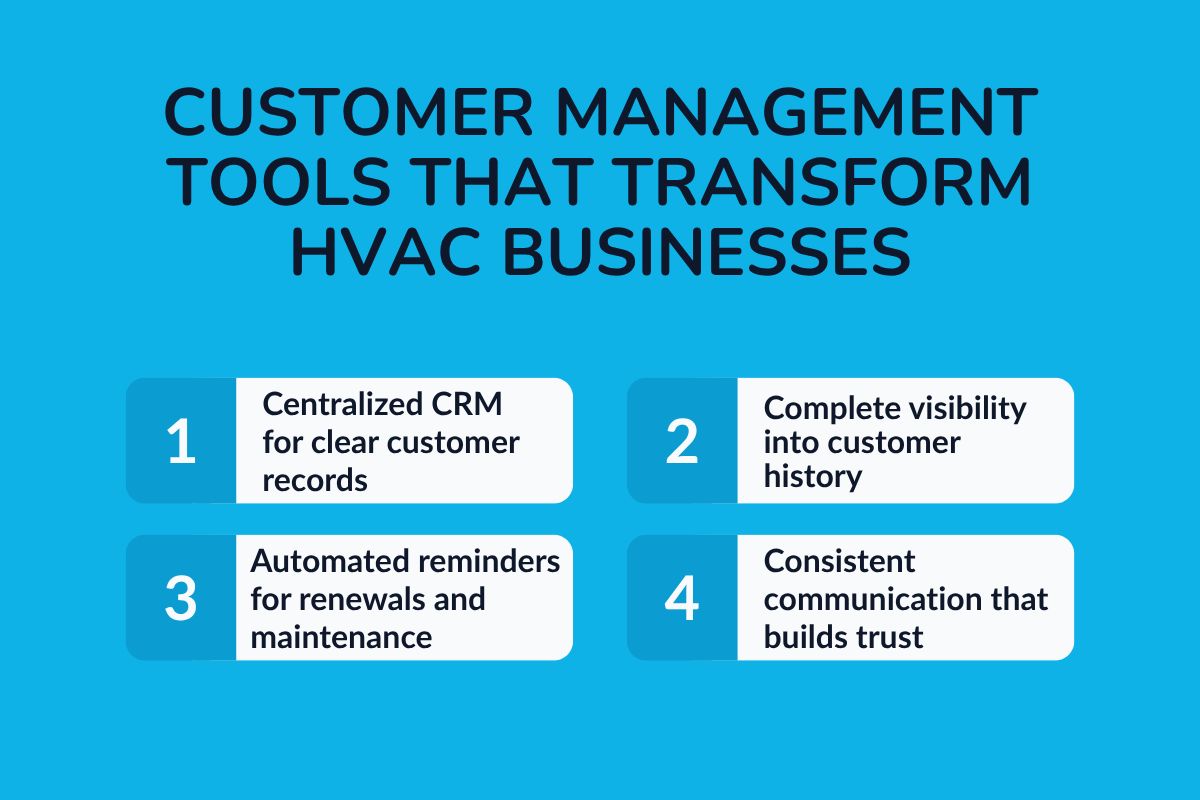
1. Centralized CRM for clear customer records
An HVAC service software keeps all customer information in one dashboard, from contact details and service notes to equipment models and warranties.
When a technician arrives at the job site, they already know the system's history and what has been done before. That context saves time and helps the visit get off to a good start.
2. Complete visibility into customer history
With a full log of customer history, teams can see patterns across jobs and equipment. If a unit has had three compressor repairs, it’s easier to recommend a replacement confidently instead of waiting for another failure.
3. Automated reminders for renewals and maintenance
Managing service agreements manually often leads to missed renewals and last-minute calls.
Automated reminders send customers a heads-up before their maintenance is due or a contract is about to expire. It keeps workloads predictable and ensures your schedule stays balanced year-round.
4. Consistent communication that builds trust
Every interaction matters, from customer calls to follow-up messages. A CRM built into your system supports seamless communication, recording all notes, updates, and responses in one thread.
5. Keeping customers informed in real time
When customers book online, they also want updates on arrival times, technician status, and job completion.
Automated notifications and text updates make that easy, improving customer experience without adding manual steps for your team. Consistent follow-ups and accurate data turn one-time fixes into ongoing relationships.
The HVAC companies that use connected systems to track and communicate with clients see higher retention and steadier revenue, proof that organized customer management is just as critical as skilled workmanship.
How HVAC Business Software Supports Growth and Efficiency
As teams take on more work, the spreadsheets and manual processes that once worked start showing cracks. That’s when structured tools make the difference between “busy” and “profitable.”
The main types of HVAC business software
Most HVAC software platforms fall into three practical categories:
- Operational tools for scheduling, dispatching, and job tracking are often delivered as HVAC field service software.
- Financial and reporting systems that manage billing, accounting, and cash flow visibility.
- Customer and contract management modules for renewals, estimates, and service follow-ups.
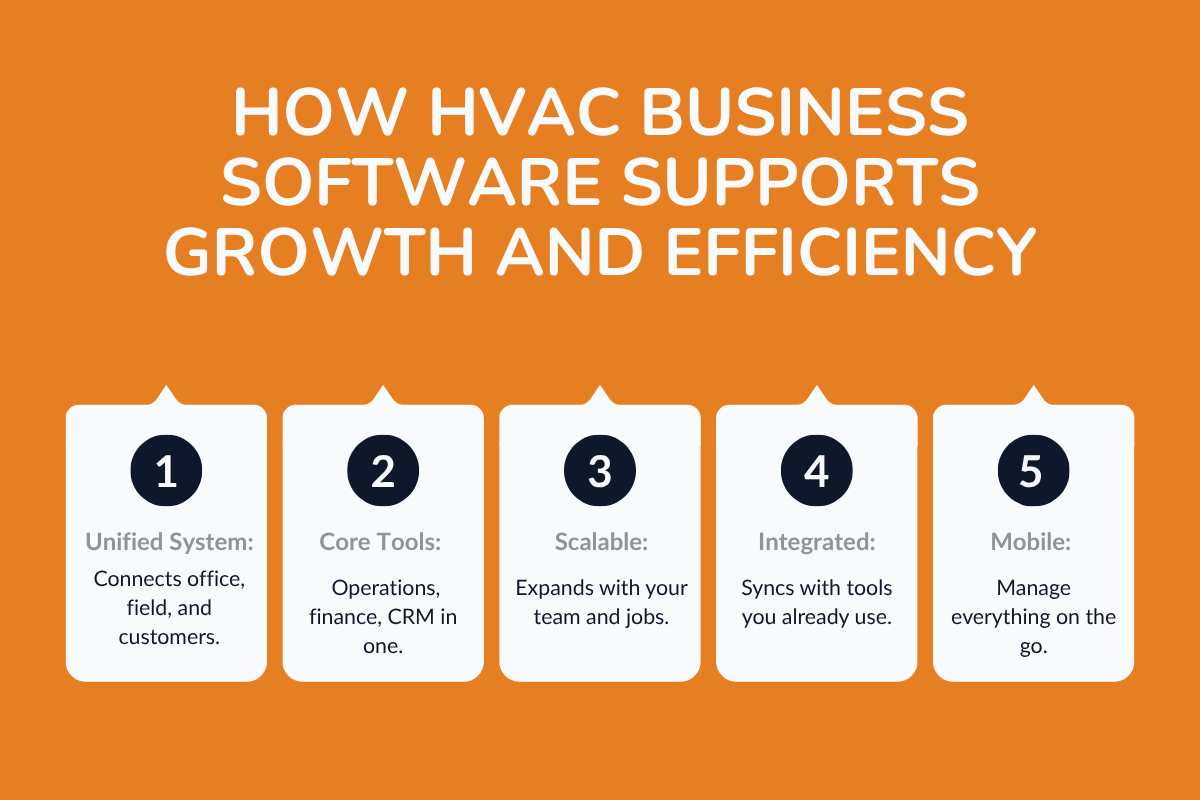
Together, these pieces function as a complete field service management software stack that links your office, technicians, and customers in real time.
Scalability and integrations that keep up
As the number of jobs and technicians grows, the system should expand with you. Look for platforms that integrate easily with accounting, inventory, and communication tools, rather than forcing you to rebuild processes from scratch.
Modern systems utilize open APIs, real-time syncing, and mobile dashboards, enabling owners to track work orders, parts, and performance from anywhere. For small teams, mobile access is what keeps the day moving when you’re on the road or between sites.
Top Features Every HVAC Company Needs in Its Software
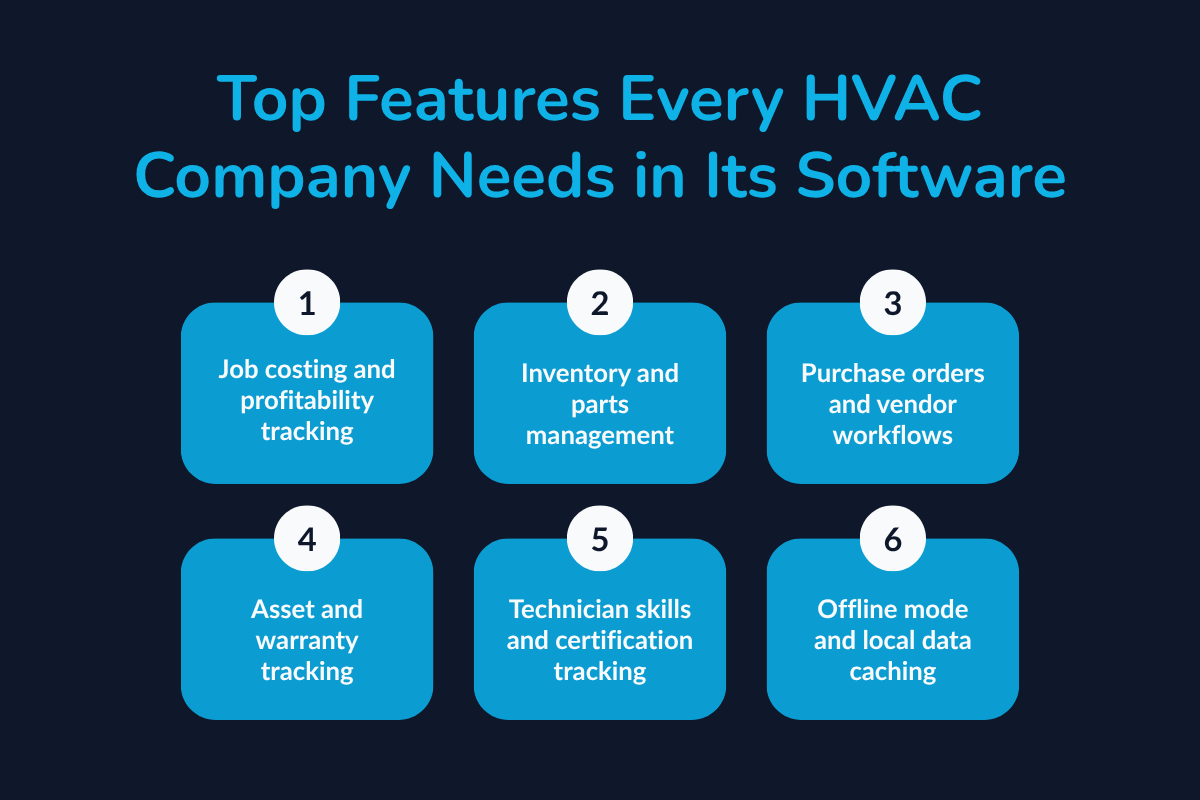
- Job costing and profitability tracking: Calculates labor, parts, travel time, and overhead for each job, identifying which calls or contracts are actually profitable and enabling owners to price and staff based on data, not assumptions.
- Inventory and parts management: Tracks parts used on every job, updates stock automatically, and flags reorder points to prevent stockouts, duplicate purchases, or repeat trips for missing materials.
- Purchase orders and vendor workflows: Generate purchase orders from low-stock alerts, track deliveries, and match orders to invoices for cleaner procurement and fewer mismatched entries.
- Asset and warranty tracking: Keeps a record of every installed system, including serial numbers, installation dates, warranty terms, and service history, simplifying warranty claims and future replacements.
- Technician skills and certification tracking: Tags technicians by skill set, licenses, and availability, ensuring the right person gets dispatched to the right job, reducing repeat visits and downtime.
- Offline mode and local data caching: Allows technicians to log job details and invoices even without mobile coverage, syncing updates automatically once they’re back online.
Check out: Must-Have Features of HVAC Business Software
Introducing HVACBase: One Platform, Full-Business Control
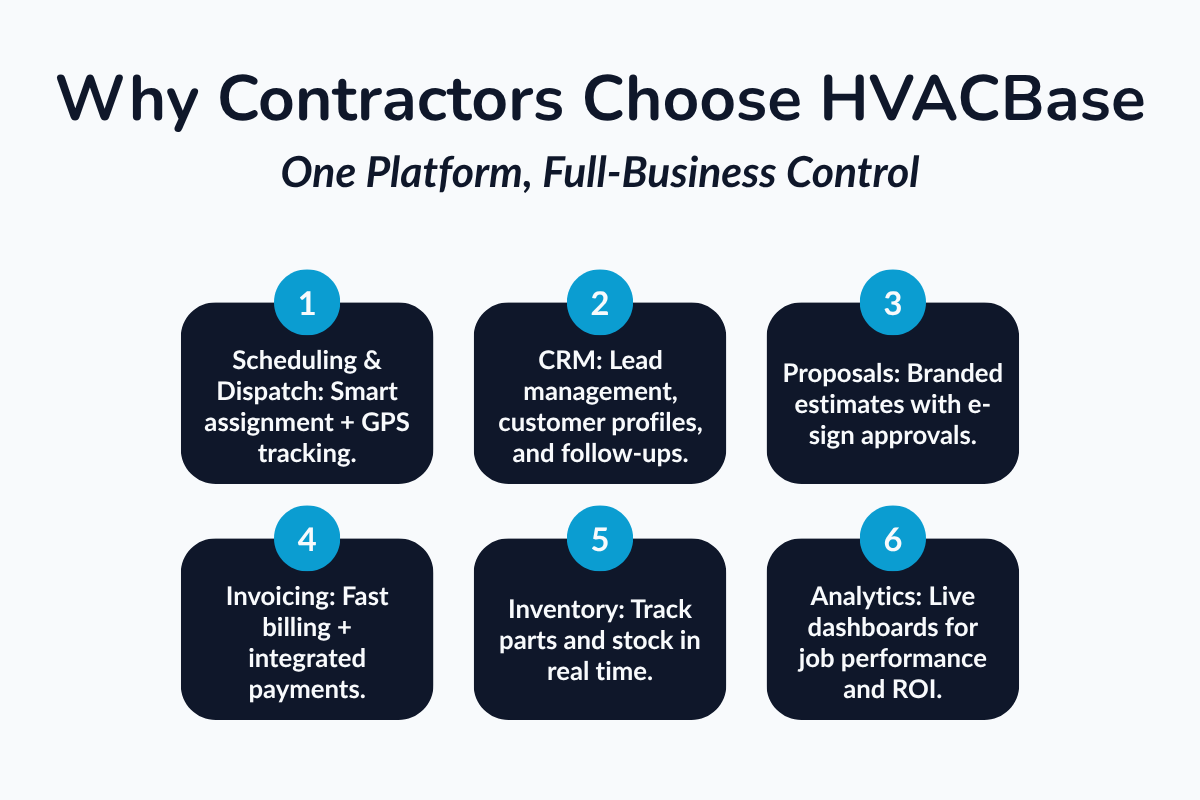
HVACBase is built to support every part of your HVAC business, not just one department. Here’s what it offers and how each feature supports smoother operations:
- Scheduling and Dispatching – A drag-and-drop board with live GPS tracking and automatic technician assignment based on skill and proximity.
- CRM and Customer Management – Centralized customer profiles with service history, lead tracking, and automated follow-ups.
- Proposals and Estimating – Create professional, branded estimates in minutes with built-in pricing templates and digital approvals.
- Invoicing, Billing, and Payments – Generate branded invoices instantly after job completion and accept ACH or credit card payments from the same dashboard.
- Inventory Management – Real-time tracking of parts across warehouses and trucks, with low-stock alerts and job-level assignment for full visibility.
- Business Reporting and Analytics – Live dashboards for job performance, technician productivity, revenue trends, and financial health.
Each module connects seamlessly, giving contractors one platform for daily operations, from the first customer call to the final invoice.
Conclusion: Why HVAC Software Is the Future of the HVAC Industry
The HVAC industry is moving beyond paper logs and manual updates. Businesses that once spent hours managing dispatch, billing, and calls are now running everything through one connected system, making it faster, cleaner, and with fewer mistakes.
Automation doesn’t replace people; it provides teams with the structure to focus on service rather than administrative work.
With the right software in place, you don’t just keep up with demand, you stay ahead of it.
See HVACBase In Action
You’ve seen how automation transforms dispatch, billing, and customer management. Now see it in real-time.
Book a 15-minute personalized demo and get a look at the same tools top HVAC contractors use to schedule faster, bill instantly, and keep every job on track.
FAQs
1. What’s the best HVAC software for field technicians?
The best HVAC software for field technicians is one that combines scheduling, dispatch, invoicing, and customer updates in one app. Tools like HVACBase stand out because techs can track jobs, create invoices, and collect payments directly from the field.
2. What’s the $5000 rule in the HVAC industry?
The $5000 rule is a common rule of thumb, often cited by contractors, that helps decide whether to repair or replace an HVAC system: multiply the system’s age by the repair cost. If the total exceeds $5000, replacement is usually the smarter choice.
3. Can HVAC contractors make $100,000 a year?
Yes. Experienced HVAC contractors and business owners often earn over $100,000 annually, especially if they manage multiple service teams or offer commercial contracts.
4. How much does HVAC business software cost?
HVAC business software typically costs $25–$75 per technician per month for small to mid-sized teams. Pricing varies based on features like accounting integration, mobile apps, and reporting tools.
Have questions or need personalized advice?
Talk to an Expert Today and let our construction specialists guide you to success.
Related Posts