HVAC Software for Service Businesses What Actually Improves Margins
March 1, 2026
On paper, many HVAC service businesses appear to be doing well. The phones are busy, the schedule stays full, and technicians are constantly moving from one job to the next. Yet behind the scenes, profits often tell a different story.
Margins feel tighter than they should, cash flow is unpredictable, and small issues quietly add up over time. Missed billable items, inefficient scheduling, delayed invoices, and inventory guesswork slowly drain revenue without anyone noticing right away.
This is where HVAC software stops being a “nice to have” and becomes essential. Not to add complexity, but to bring clarity, control, and consistency to the parts of the business that directly impact margins.
How HVAC Software Helps Service Businesses Improve Margins?
Talk to almost any HVAC company owner, and you will hear a familiar story. The phones are ringing nonstop, the schedule is packed, and technicians are heading from one job site to the next all day long. From the outside, it looks like business is booming, but scratch the surface, and things feel different.
Margins are thinner than expected, cash flow feels inconsistent, and everyone is working hard, yet the numbers at the end of the month do not quite add up. So, being busy is not the same as being profitable.
Most of the time, demand is not the issue. The real problem lies in the gaps between service calls, scheduling, invoicing, and payments. This leads to missed charges, idle time, late invoices, and inventory surprises quietly piling up.
Key Takeaways
- Where HVAC businesses silently lose money: Unbilled work, inefficient scheduling, delayed invoicing, and inventory blind spots slowly eat into margins without being obvious problems.
- How modern HVAC software plugs those gaps: By connecting fieldwork, scheduling, invoicing, and inventory in one system, it turns daily activities into accurate billing and faster cash flow.
- What profit-focused buyers should look for in a platform: Clear margin visibility, smooth field to office data flow, and tools that actually improve control, not just add features.
Stop Letting Margins Slip Through the Cracks
See how the right HVAC software helps you capture missed revenue, tighten operations, and turn busy days into profitable ones.
Book an HVACBase demo to see it in action.
The Hidden Margin Killers in HVAC Service Operations
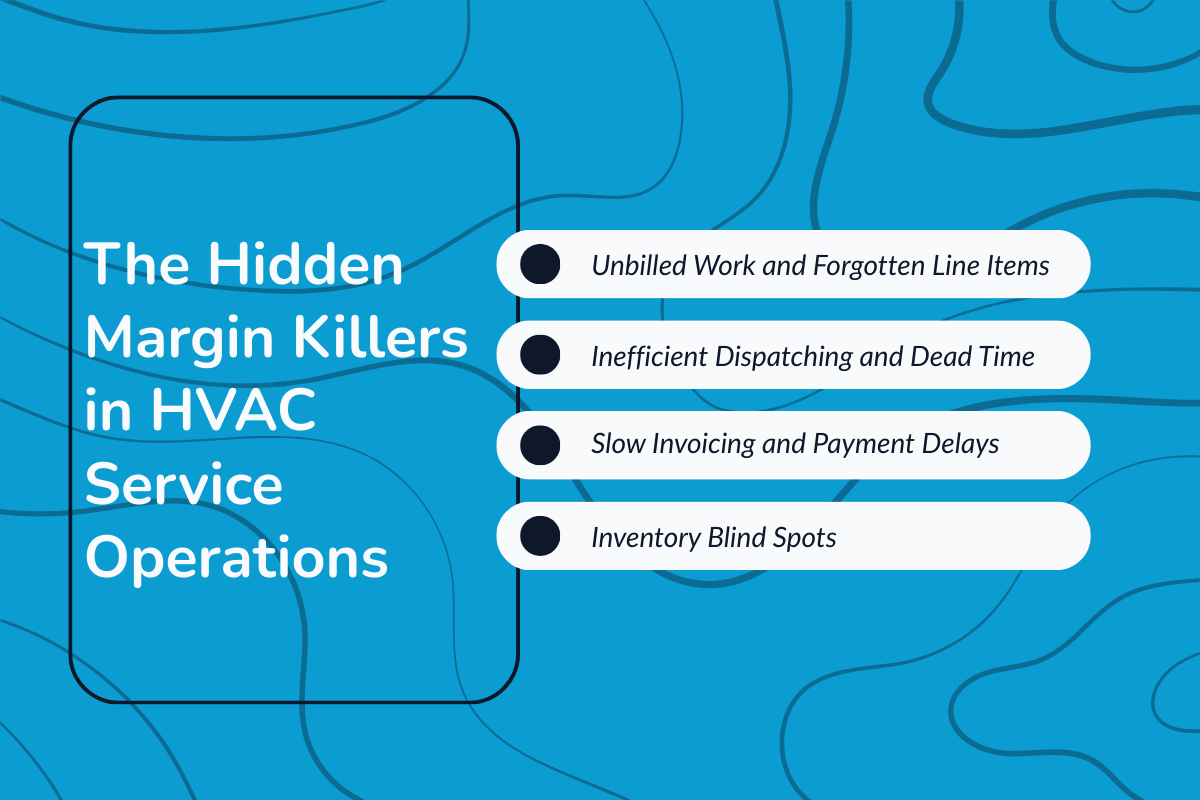
Before talking about software solutions, it helps to be honest about where money slips away today. These issues affect companies of all sizes, from small businesses to growing regional HVAC contractors.
1. Unbilled Work and Forgotten Line Items
Imagine a technician replaces a capacitor during a service visit. It takes ten minutes- the part comes off the truck, the customer is happy, but the line item never appears on the invoice.
This happens more often than most owners want to admit. Small materials, add-on tasks, extra labor time, and after-hours work often get missed when job details are tracked on paper or scattered across texts and phone calls.
Each missed item feels minor, but over hundreds of service calls, it adds up to serious lost revenue. Without consistent HVAC service software capturing job details in real time, fully billing every job becomes a guessing game.
2. Inefficient Dispatching and Dead Time
Every HVAC tech has felt it: A gap between jobs that is too short to go home and too long to ignore. Poor routing, last-minute cancellations, and emergency calls that throw the day off balance.
Inefficient HVAC scheduling and dispatch create dead time that goes un-invoiced. Over time, this lowers revenue per technician and increases stress across the entire business. HVAC dispatch software that is disconnected from real job progress makes it hard to fix this at scale.
3. Slow Invoicing and Payment Delays
Finishing work is only half the job. Getting paid is the other half. When HVAC invoicing software is manual or disconnected from field service workflows, invoices go out late, approvals take days, and customers forget details. As a result, disputes increase, and cash flow slows.
Delayed invoices not only impact cash flow but also create uncertainty. Owners hesitate to invest, and payroll planning becomes stressful. Growth stalls even when demand is strong.
4. Inventory Blind Spots
Inventory issues rarely feel like a big problem at first, but they quietly drain profit over time. Inventory management is one of the most overlooked margin killers in the HVAC industry.
Overstocking locks up cash that could be invested back into the business. Stockouts force you into last-minute purchases at higher prices. Techs arrive on-site without the right parts, leading to repeat visits and wasted hours.
In the end, it creates extra labor, more delays, unhappy customers, and margins that quietly shrink job after job. And without accurate inventory tracking tied to actual service usage, most decisions end up being based on guesswork rather than data.
How Does HVAC Software Directly Protect and Grow Your Margins?
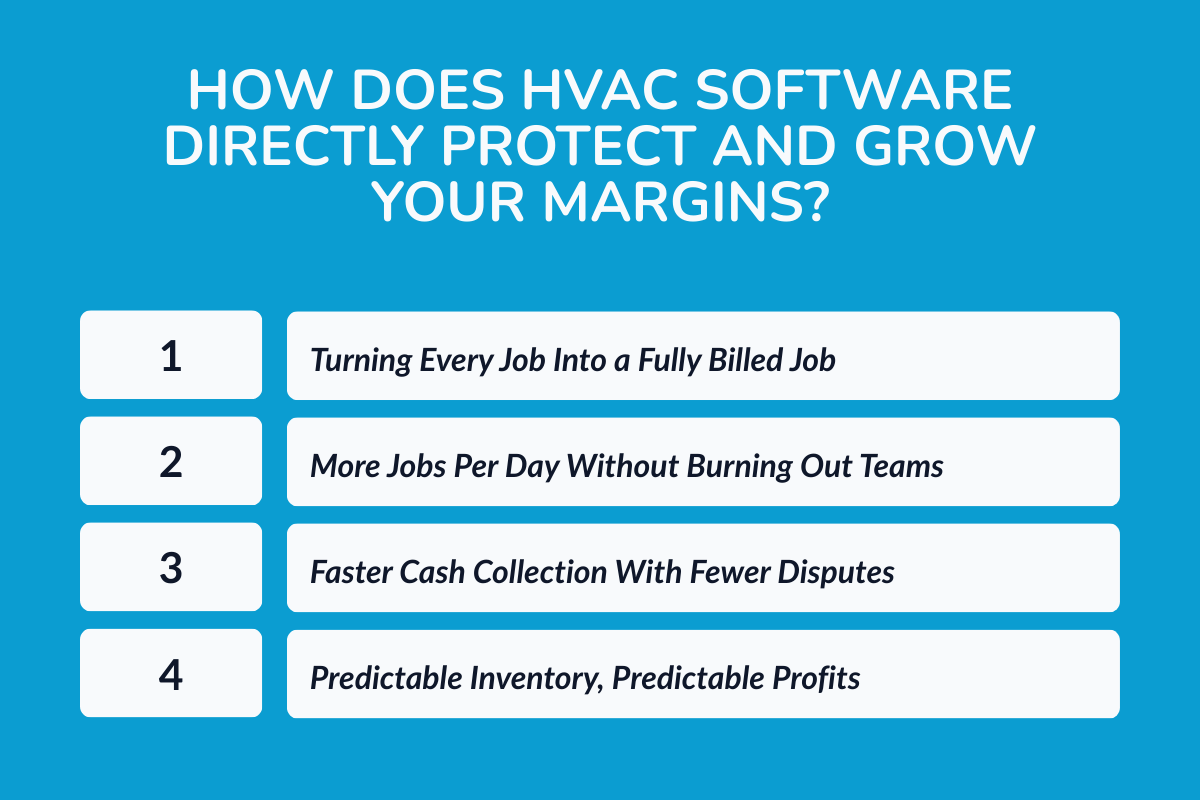
This is where HVAC software solutions shift from being a convenience to being a profit driver. When systems are connected, margins stop leaking and start compounding.
1. Turning Every Job Into a Fully Billed Job
The biggest win often comes from simply capturing everything that happens on a job site. With modern HVAC field service software, field technicians update job details as work happens.
Parts used, time spent, and additional services approved. Everything flows directly into HVAC invoicing software without relying on memory or handwritten notes.
Itemized invoices are automatically accurate, so nothing gets missed or left out. Fewer line items slip through the cracks, and you end up earning more per service call without needing to raise your prices.
2. More Jobs Per Day Without Burning Out Teams
Smart HVAC scheduling software changes the flow of the day.
Instead of relying on a static calendar, dispatchers get real-time visibility into job status. Routes can be updated instantly based on technician location and availability, and even urgent emergency calls can be slotted in smoothly without throwing the entire day off track.
This does not mean pushing HVAC techs harder; it means removing wasted time. When technicians spend more hours doing billable work and fewer hours waiting or driving inefficient routes, margins improve naturally.
3. Faster Cash Collection With Fewer Disputes
Digital invoices sent immediately after job completion change customer behavior. Details are fresh, Approvals are quick, which makes Payment processing frictionless.
Integrated payment processing allows customers to pay on the spot. Office staff can send invoices and collect payments without follow-ups dragging on for weeks. The result is simple: businesses get paid faster, cash flow stabilizes, and financial planning becomes easier.
3. Predictable Inventory, Predictable Profits
When inventory management is tied directly to job usage, patterns emerge. Owners see which parts move fast, which sit on shelves, and which drive emergency purchases. Purchasing becomes proactive instead of reactive.
Over time, waste drops, and stockouts decrease, and profit margins improve quietly but consistently.
Where Most HVAC Software Fails (And What To Avoid)?
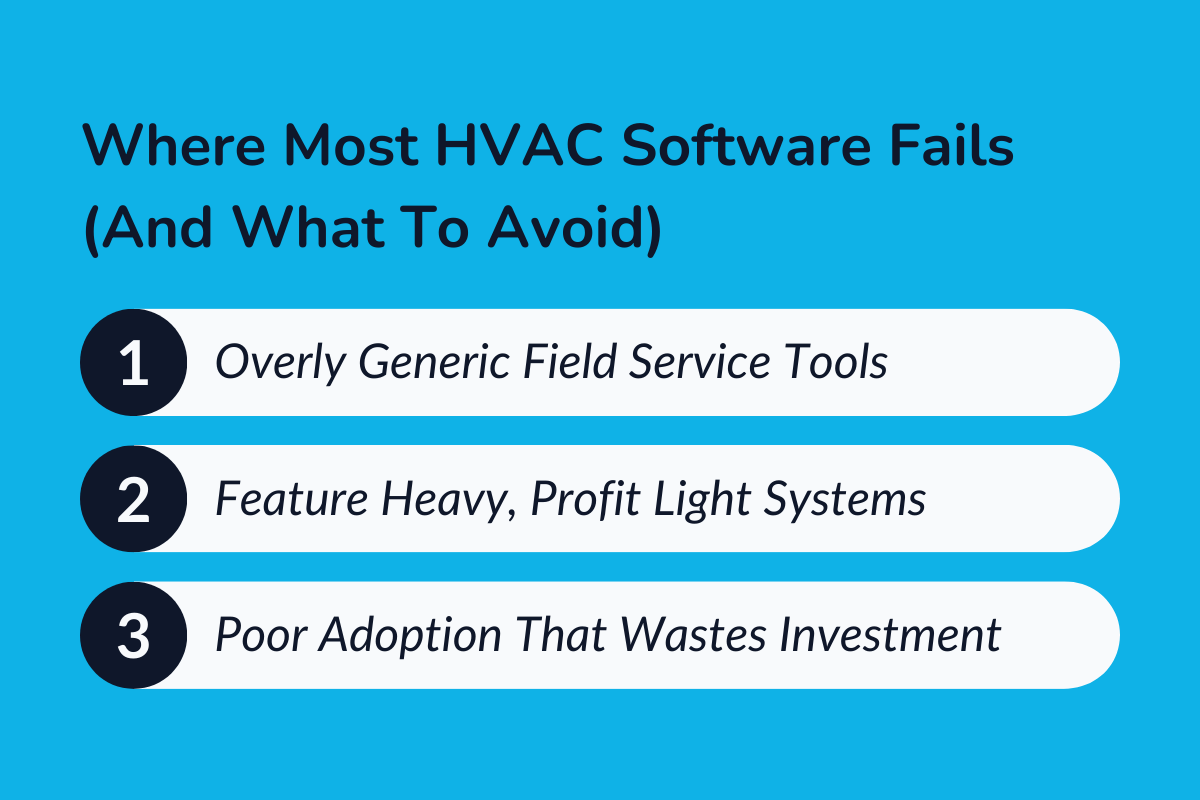
Not all field service management software delivers these benefits. Many systems fall short in ways that frustrate teams and waste investment.
1. Overly Generic Field Service Tools
Generic field service software often tries to serve every industry at once. The result is rigid workflows that do not match HVAC service realities.
HVAC businesses need tools built around service agreements, equipment histories, seasonal demand, and recurring maintenance. Without this focus, software adds steps instead of removing them.
2. Feature Heavy, Profit Light Systems
Some platforms look impressive in demos but fail to improve daily operations. Dozens of features mean little if job scheduling, invoicing, dispatch, and inventory are not tightly connected. Profit margins improve through alignment, not feature lists.
3. Poor Adoption That Wastes Investment
Even the best HVAC business software fails if teams do not use it. If field technicians find the mobile app confusing or office staff spend hours fixing data, adoption drops. Usability matters as much as functionality. Software should put everyone on the same page, not create new friction.
Top 4 HVAC Software Competitors to Consider
If you are comparing HVAC software options, here are four of the most trusted platforms in the market, along with their key features, ideal use cases, and pricing ranges.
1. HVACBase – All-in-One HVAC Business Management
What is it: HVACBase positions itself as a modern, operations-first platform built specifically for HVAC service businesses that want tighter control over margins and daily workflows. It is typically suited for contractors looking to unify their systems under one roof instead of layering multiple disconnected tools.
Features: It gives you everything in one place, from scheduling and dispatch to a built-in CRM, quotes, invoicing, load calculations, inventory tracking, mobile tools for technicians, and dashboards to keep your entire operation running smoothly.
Pricing: Pricing is subscription-based and available through demo and consultation.
2. ServiceTitan – Enterprise-Grade Field Service Software
What is it: ServiceTitan is widely recognized as a market leader in the enterprise HVAC software space. It is built for larger organizations with multi-location operations, layered management structures, and aggressive growth plans
Features: It covers pretty much everything a growing HVAC business needs, including scheduling and dispatch, a full CRM, advanced reporting, mobile estimates, inventory tracking, payroll tools, and even membership management for recurring service plans.
Pricing: Its pricing reflects its enterprise positioning and is commonly structured per technician. Per-technician models typically range from $250–$400+ per tech per month, depending on package and customization.
3. FieldEdge – HVAC-Focused Dispatch & Management Software
What is it: It focuses on trade-specific operational control, particularly for residential HVAC service companies. It is known for balancing structure with usability, making it suitable for established teams that want strong coordination without overwhelming customization. It's the best software for HVAC and trade businesses that value strong office-to-field connectivity
Features: It helps you stay connected with your team in the field through real-time technician tracking, smooth scheduling and dispatch, customer management, service agreement tools, QuickBooks integration, and a mobile app your techs can use on the job.
Pricing: Mid-range; often ~$100/month for office users and ~$125/month per tech (varies by plan and setup).
4. Housecall Pro – Easy, Scalable Field Service Tool
What is it: Housecall Pro targets smaller to mid-sized teams that value simplicity and fast onboarding. It is often chosen by growing contractors transitioning away from manual systems into their first structured software environment.
Features: It makes day-to-day operations easier with online booking, simple job scheduling, automated customer reminders, fast invoicing and payments, GPS tracking, and a mobile app that helps technicians stay organized in the field.
Pricing: Plans typically start around $59–$299/month, scaling higher with more advanced features and users.
What Profit-Focused HVAC Businesses Should Look For in Software?
Choosing HVAC software based on feature lists alone often leads to disappointment. Profit-focused businesses look deeper, prioritizing control, visibility, and systems that actually improve margins as the company grows.
1. Margin Visibility at Every Stage of a Job
Profit-focused HVAC businesses need to see how money moves through every job, not just the final invoice. Clear visibility helps owners spot issues early, rather than discovering margin problems after the job is closed.
- Track estimated vs actual labor and material costs in real time
- See job progress, overruns, and margins before they impact profits
- Understand which services and job types deliver the strongest returns
2. Seamless Field to Office Data Flow
When field technicians and office staff work from different systems, mistakes are inevitable. Smooth data flow keeps everyone aligned and eliminates revenue leaks caused by missing or delayed information.
- Automatic syncing of job details, customer information, and invoices
- No retyping notes, timesheets, or materials used on the job site
- Faster billing, fewer disputes, and cleaner handoffs between teams
3. Built for Scale Without Breaking Processes
Growth should not force HVAC businesses to rebuild their workflows every year. The right software supports more jobs, more technicians, and more contracts without adding complexity.
- Add technicians, locations, and service agreements without disruption
- Maintain consistent scheduling, invoicing, and reporting as volume grows
- Support long-term growth while keeping daily operations predictable and controlled
Is HVAC Software Worth It for Small and Mid-Sized Businesses?
For small and mid-sized HVAC businesses, every expense is scrutinized. The real question is not whether software costs money, but whether staying manual is quietly costing far more in missed revenue, wasted time, and stalled growth.
When Software Pays for Itself
For most small and mid-sized HVAC businesses, software does not take years to justify the cost. The return usually shows up quickly through tighter operations and faster cash flow.
- Invoices go out sooner, which means getting paid faster
- Fewer missed line items increase revenue without adding more jobs
Why Delaying Adoption Costs More Than Investing Early
Sticking with manual systems may feel cheaper, but it quietly limits growth and profitability. The longer inefficient processes remain in place, the harder and more costly they become to fix.
- Revenue leaks grow as job volume increases
- Disorganized data makes pricing and planning harder over time
How Is HVACBase Designed to Reduce Revenue Leaks in HVAC Operations?

HVACBase approaches HVAC software from a margin-first perspective. The goal is not just to digitize operations, but to protect profit at every step.
1. Purpose Built HVAC Workflows
HVACBase is designed around how HVAC service businesses actually operate. From service calls to commercial properties, workflows reflect real field conditions.
2. Profit Centric Scheduling and Dispatch
HVAC scheduling and HVAC dispatch software focus on maximizing technician utilization. Technician routes reduce dead time. Job scheduling adapts as work progresses.
3. Integrated Billing, Payments, and Job Costing
Everything connects. Job details flow into invoices. Payments update job records. HVAC accounting software integrations support accurate reporting and QuickBooks integration.
4. Inventory Intelligence That Reduces Waste
Inventory Intelligence That Reduces Waste means you always know what parts you have, what is being used most, and what is sitting untouched on the shelf.
Instead of over-ordering or running out at the worst time, your team can restock based on real usage patterns and upcoming jobs.
5. Actionable Profit Dashboards
Reporting tools go beyond static reports. Owners get insights they can act on daily to improve operations and run efficiency.
Bringing It All Together: Margins Are Built in the System, Not in Overtime
Putting in more hours rarely solves margin problems but better systems do. When HVAC software brings scheduling, billing, inventory, and field work into one clear workflow, waste disappears and control returns.
Teams stop chasing details, jobs get billed accurately, and decisions are based on real data. Margins grow not because people work harder, but because the business finally works the way it should.
What If Every Service Call Actually Paid What It Should?
See how HVACBase helps uncover hidden revenue, eliminate margin leaks, and turn everyday jobs into consistently profitable work.
If you want to see how HVACBase helps eliminate revenue leaks and maximize profits, book a demo with HVACBase and see the difference for yourself.
FAQs
1. What are the main benefits of HVAC software for service businesses?
The biggest benefits include improved profit margins, better cash flow, streamlined operations, and higher customer satisfaction.
2. Is HVAC software only for large companies?
No. Many small businesses see the biggest impact because software replaces manual processes early.
3. How does HVAC software improve customer experience?
Faster service, accurate invoices, automated reminders, and reliable service keep clients informed and confident.
4. Can HVAC software help with commercial properties and service agreements?
Yes. Modern platforms handle recurring maintenance, contracts, and complex job scheduling with ease.
5. Is it difficult for technicians to use HVAC software?
A well-designed HVAC mobile app makes it easy for field technicians to update job details and deliver exceptional service without added hassle.
Have questions or need personalized advice?
Talk to an Expert Today and let our construction specialists guide you to success.
Related Posts