HVAC Management Software Explained for Real-World Operations
March 1, 2026
Today at 6:45 a.m., the first service call arrives. By 7:30, schedules shift, technicians ask for details, and customers call for updates. The office struggles to keep up, not from failure, but because the system isn't built for today's HVAC pace.
Consider a morning where technicians see assignments on devices, updates are sent via HVAC software, and customers stay informed without calling the office.
The work stays the same, but the experience improves. HVAC management software connects field operations and office workflows.
Therefore, in this blog, we'll understand how HVAC businesses experience smoother, more controlled operations with a connected platform built specifically for HVAC companies.
How HVAC Management Software Supports Real-World HVAC Operations
HVAC management software simplifies a traditionally complex industry by integrating scheduling, dispatching, customer communication, inventory management, invoicing, and accounting software into a single system.
It provides real-time visibility into job progress, technician availability, and customer status, reducing friction between office staff and HVAC technicians.
Instead of multiple partial systems, HVAC software creates a single source of truth. Every job flows through one connected lifecycle:
Lead → Schedule → Dispatch → Field Execution → Completion → Invoice → Reporting
With mobile access and real-time syncing, technicians and office staff operate from shared data instead of repeated phone calls and manual reconciliation. Now that you understand how a connected system reshapes daily HVAC operations, let’s break down how this structure eliminates disconnected teams and strengthens execution in the real world.
Key Takeaways
- HVAC management software connects office staff and technicians in real time so everyone works from the same live information instead of relying on calls and manual updates.
- Real-time visibility reduces operational friction and customer confusion because job status, schedules, and technician progress are always clear.
- HVAC businesses of all sizes benefit from connected systems since complexity increases with service volume long before the team becomes large.
- Operations-first HVAC software improves execution during the workday by strengthening scheduling, dispatching, and field coordination rather than just generating reports.
- The right HVAC software improves efficiency and profitability by increasing technician utilization, reducing callbacks, and speeding up invoicing.
Ever Wonder Why Some HVAC Companies Run Smoothly While Others Feel Chaotic?
Some HVAC companies stay calm during busy days, while others feel overwhelmed with the same workload. The difference isn't team size or effort, it's how information moves through business systems.
When job scheduling, dispatch software, service software, and invoicing are handled in separate tools, even minor disruptions can confuse. High-performing HVAC contractors operate on one platform that connects scheduling, job details, technician locations, and customer communication in real time, reducing guesswork and missed handoffs.
Curious what changes when HVAC operations actually run on one connected system? Experience how HVACBase management software could support real-world HVAC teams.
Why Are HVAC Teams So Disconnected in Day-to-Day Operations?
HVAC teams are often disconnected because their tools are disconnected. Office staff may rely on accounting software, while HVAC technicians depend on texts, paper notes, or manual data entry.
Dispatchers manually track service calls, and inventory control updates are made after the job is complete. Each system holds partial information, but none provides a full picture of HVAC field service operations.
This fragmentation causes delays, errors, and unnecessary follow-ups. Whereas HVAC management software solves this problem by replacing scattered business systems with one centralized field service management software platform designed for HVAC businesses.
When dispatch, invoicing, customer management, and job progress live in sync, teams operate with clarity rather than constantly correcting mistakes.
What Is HVAC Management Software and What Should It Actually Do?
HVAC management software is designed to support the full service lifecycle from the moment a customer calls to the final payment.
The best HVAC management software fits your business needs, whether an all-in-one platform or have separate tools for dispatch, invoicing, and CRM. Considering these options ensures the software aligns with your workflow and goals.
It acts as the operational backbone of HVAC businesses by keeping scheduling, service calls, technician workflows, and customer relationship management aligned in real time.
Instead of reacting to problems after they happen, HVAC management software helps HVAC business owners stay ahead of issues through visibility, automation, and better coordination across service software and business systems.
1. HVAC software vs. general management software
General management software isn't built for HVAC service as HVAC businesses manage service agreements, recurring maintenance, equipment history, compliance records, and technician workflows tied to HVAC systems.
HVAC service software is designed around these realities, allowing HVAC technicians to access job details, customer history, and equipment data directly from mobile devices at the job site.
2. Operations-first vs. accounting-first tools
Accounting software focuses on reporting what has already happened whereas HVAC management software focuses on what's happening now across service calls and job management.
Operations-first tools prioritize scheduling and dispatching, technician productivity, and job progress, while seamlessly integrating with accounting tools such as QuickBooks.
This balance ensures accurate financials without slowing HVAC service operations, mainly when QuickBooks integration streamlines financial management and reduces manual data entry.
What Are The Core HVAC Management Software Features That Actually Matter?
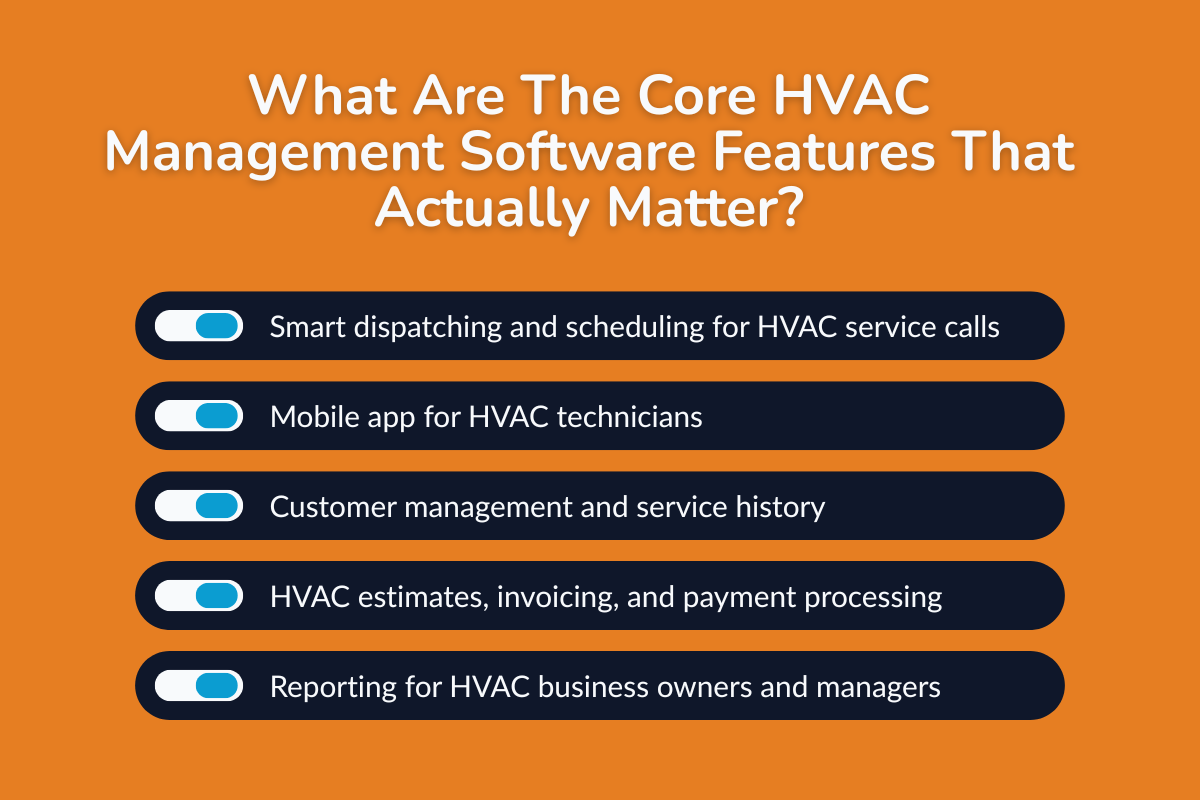
HVAC software tools often advertise long feature lists, but not every feature improves daily operations. What truly matters is how HVAC software reduces manual work, improves visibility, and supports both HVAC technicians and office staff throughout the service day.
The right features streamline operations instead of adding complexity. Now let's take a look at the features:
1. Smart dispatching and scheduling for HVAC service calls
Dispatching is where HVAC operations either stay organized or fall apart. Manual job scheduling forces office staff to constantly reshuffle calendars and field technician calls.
HVAC dispatch software assigns jobs based on technician skills, availability, location, and route optimization, reducing delays before work begins.
Also, with real-time updates and GPS tracking, HVAC companies complete more service calls per day while minimizing travel time and operational stress.
2. Mobile app for HVAC technicians
A mobile app is essential for HVAC field service software. HVAC technicians need access to job details, customer history, parts used, photos, videos, notes, and digital signatures directly from mobile devices.
Mobile field access eliminates manual data entry, improves accuracy, and ensures office staff can see job progress in real time rather than waiting for end-of-day updates.
3. Customer management and service history
Customer management tools centralize customer calls, service history, service agreements, and equipment details in a single location. This visibility improves customer satisfaction by allowing technicians to arrive prepared and informed.
Automated reminders also support service agreement renewals and proactive maintenance, strengthening long-term customer relationships.
4. HVAC estimates, invoicing, and payment processing
HVAC invoicing software accelerates billing by generating invoices immediately after job completion. Many HVAC management software solutions offer flat rate pricing, which simplifies quotes and increases transparency for customers.
Integrated payment processing allows technicians to collect payments in the field, shortening billing cycles and improving cash flow.
Invoicing features also allow for quick invoice creation, automated reminders, and flexible payment options. Automated reminders reduce missed invoices and manual follow-ups.
5. Reporting for HVAC business owners and managers
Reporting features provide insight into technician performance, job completion rate, first-time fix rate, job costing, and revenue trends.
These reports help HVAC business owners make data-driven decisions without relying on spreadsheets or manual analysis.
How HVAC Management Software Improves Technician Productivity?
Technician productivity directly impacts revenue, customer satisfaction, and scheduling efficiency for HVAC businesses. Without HVAC management software,
HVAC techs often lose time to unclear job details, repeated customer calls, and manual paperwork. A connected system gives HVAC technicians everything they need before arriving at the job site, including customer details and service history. Clear expectations reduce delays and help technicians complete more service calls per day.
Over time, productivity gains improve technician performance, increase capacity, and support long-term growth for HVAC businesses.
Is HVAC Management Software Only for Big HVAC Companies?
Many HVAC business owners assume management software is only necessary once a company reaches a specific size.
In reality, complexity grows long before headcount does. Even small HVAC businesses struggle with job scheduling, customer communication, and HVAC invoicing software as service volume increases.
Many HVAC management software providers offer a basic plan with essential features at an affordable price, making it accessible for small or new businesses.
HVAC management software supports solo HVAC contractors, small businesses, and large HVAC companies alike.
For small teams, it provides structure early. For growing teams, it prevents chaos. For larger operations, it enables scalability without losing operational control.
Signs Your HVAC Business Is Ready for Management Software
If your HVAC business relies on:
- Group chats to coordinate work
- Manually follows up with every technician
- Fields' constant customer calls asking for status updates
- Struggles to track unpaid invoices
These are all clear indicators. When workload visibility requires guesswork and manual tracking, management software becomes a necessity rather than a luxury.
These pain points directly align with the reasons HVAC professionals begin choosing HVAC business software built for field service operations.
How to Choose the Right HVAC Management Software Without Getting Overwhelmed?
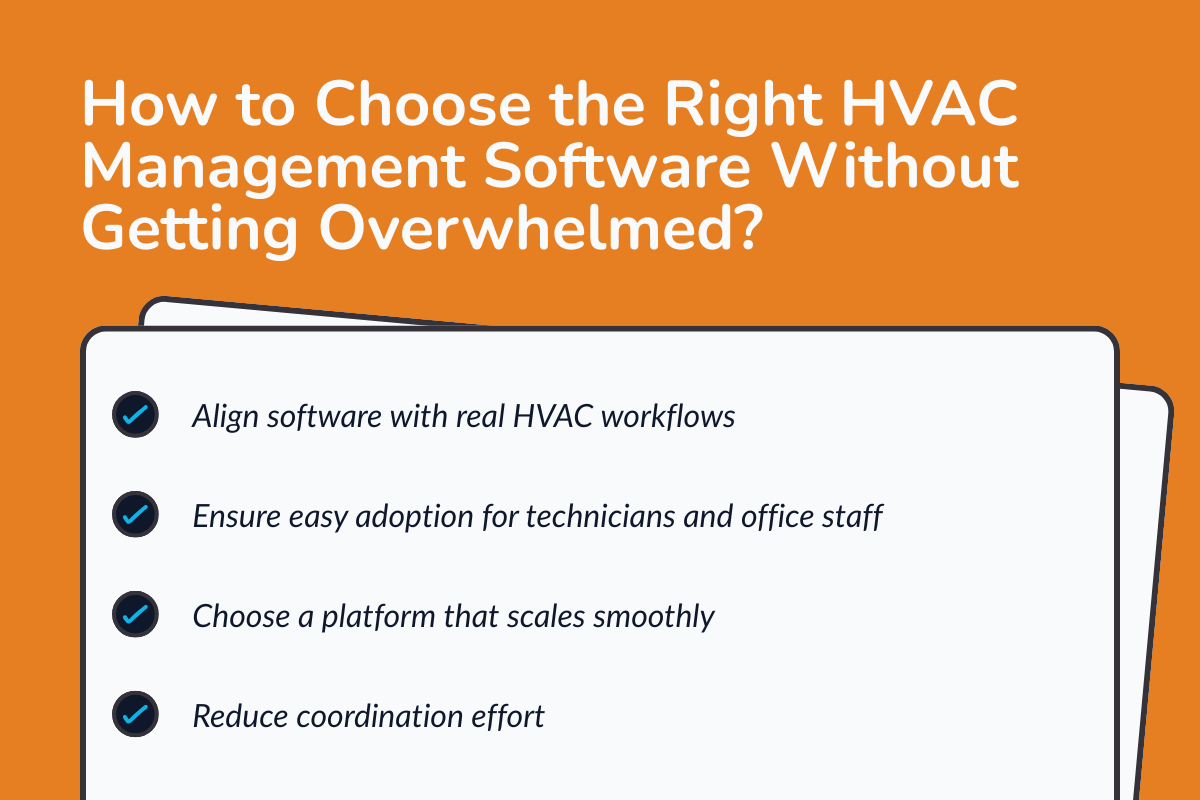
Choosing the right HVAC management software is less about comparing feature lists and more about understanding how the decision will impact long-term operations.
Many HVAC businesses run into problems when software is selected based on promises rather than on how well it fits real service workflows.
But before committing to any HVAC software, decision-makers should evaluate it using these practical criteria:
- The software should align with how the HVAC business operates today, including scheduling, service calls, and coordination between office staff and technicians
- Technicians and office teams should be able to adopt the system naturally without constant enforcement or repeated retraining
- The platform should scale smoothly as service volume, technician count, and customer demand increase
- The system should reduce coordination effort instead of shifting the same operational problems into a new tool
Making the right choice early helps HVAC businesses avoid costly software changes later and ensures the platform supports growth rather than slowing it down.
HVAC Management Software for Commercial HVAC vs Residential HVAC
| Area of Comparison | Commercial HVAC | Residential HVAC |
|---|---|---|
| Service Cycle Length | Longer service cycles with ongoing maintenance contracts, multi-phase projects, and layered approvals. | Shorter, high-frequency service calls focused on repairs, installations, and seasonal maintenance. |
| Compliance & Documentation | Requires detailed compliance tracking, asset history, inspection logs, and audit-ready documentation. | Typically lighter compliance needs, focused more on service records and customer communication. |
| Job Complexity | Complex job management involving multiple technicians, equipment assets, and extended timelines. | Faster job turnaround with single-tech visits and shorter completion windows. |
| Scheduling Priorities | Coordination across sites, contract-based scheduling, and long-term service agreements. | Speed, same-day dispatching, and efficient routing between multiple homes per day. |
| Customer Communication | Structured reporting for facility managers and commercial clients. | Automated reminders, real-time ETA updates, and quick invoice delivery. |
| Software Requirements | Needs asset tracking, service agreements, reporting, and multi-site visibility. | Needs fast dispatching, mobile workflows, and seamless billing integration. |
| Operational Flexibility | Requires scalable systems to manage complex portfolios. | Requires intuitive tools that keep field teams moving efficiently. |
How HVAC Management Software Strengthens Customer Communication?
Customer communication is one of the most common pain points for HVAC businesses. Missed calls, vague arrival windows, and delayed updates quickly lead to frustration.
HVAC management software automates customer communication through appointment confirmations, real-time updates, and automated reminders. Customers stay informed without needing to call the office repeatedly, improving customer experience.
Modern HVAC software also supports customer portals, allowing clients to view invoices, request service, and review their customer history online, thereby improving customer satisfaction and retention.
Which Operational Metrics Actually Matter in HVAC?
Most HVAC businesses track revenue. Fewer track the operational drivers behind that revenue. And that’s where the real control lives. If your teams feel busy but margins feel tight, the issue usually isn’t demand. It’s visibility into the metrics that actually shape performance day to day.
Here are the operational metrics that truly matter in HVAC- not vanity numbers, but indicators that directly affect profitability, technician efficiency, and customer retention.
1. Revenue Per Technician (RPT)
This metric tells you how productive each field tech really is. If revenue is rising but headcount is rising faster, you’re scaling inefficiency. High-performing HVAC companies monitor revenue per tech weekly to understand capacity, pricing effectiveness, and dispatch quality. It’s one of the clearest signals of operational health.
2. Technician Utilization Rate
Utilization measures how much of a technician’s available time is spent on billable work. Long drive times, poor routing, gaps between jobs, or unclear job details quietly reduce this number. Even a 10% improvement in utilization can significantly increase revenue without hiring more staff.
3. First-Time Fix Rate (FTFR)
This tracks how often technicians resolve issues on the first visit. Low first-time fix rates usually point to poor job documentation, missing parts visibility, or incomplete customer history. Every callback increases labor cost, fuel expense, and customer frustration. Improving this metric directly protects margins.
4. Callback Rate
Callbacks are expensive. They consume capacity that could be used for new revenue-generating work. If your callback rate is high, the problem is it’s incomplete diagnostics, rushed dispatching, or lack of systemized job tracking.
5. Average Ticket Size
This metric reveals how effectively your team communicates value. It’s influenced by technician training, service agreement positioning, and clarity of recommendations. Tracking this helps identify upsell consistency and pricing discipline across the team.
6. Invoice Cycle Time
How long does it take to generate and collect payment after job completion? Delayed invoicing slows cash flow and limits reinvestment in growth. Real-time job completion data should trigger invoicing immediately, not days later.
7. Service Agreement Retention Rate
Recurring revenue stabilizes HVAC businesses. Retention rate shows whether your maintenance agreements are actually delivering value. Low renewal rates often indicate inconsistent follow-ups or poor reminder systems.
8. Customer Response Time
The faster a customer receives confirmation, scheduling details, or arrival updates, the more professional your business appears. Slow responses erode trust before the technician even arrives.
How HVAC Software Helps Small HVAC Businesses Grow?
For small HVAC businesses, management software replaces manual processes that don't scale. It supports consistent operations, improves technician productivity, and allows HVAC business owners to focus on growth instead of constant firefighting.
By implementing better job scheduling, customer management, and HVAC invoicing software early, small HVAC businesses can grow revenue while maintaining control over daily operations.
Why Real-Time Visibility Matters in HVAC Operations?
Real-time visibility is what separates reactive HVAC businesses from proactive ones. Without it, managers rely on assumptions rather than accurate data.
HVAC management software provides a live view of technician locations, job progress, and workload distribution, improving scheduling and dispatching decisions. This visibility helps office staff resolve issues faster, reduce delays, and keep service calls on track.
How HVACBase Supports Real-World HVAC Operations?
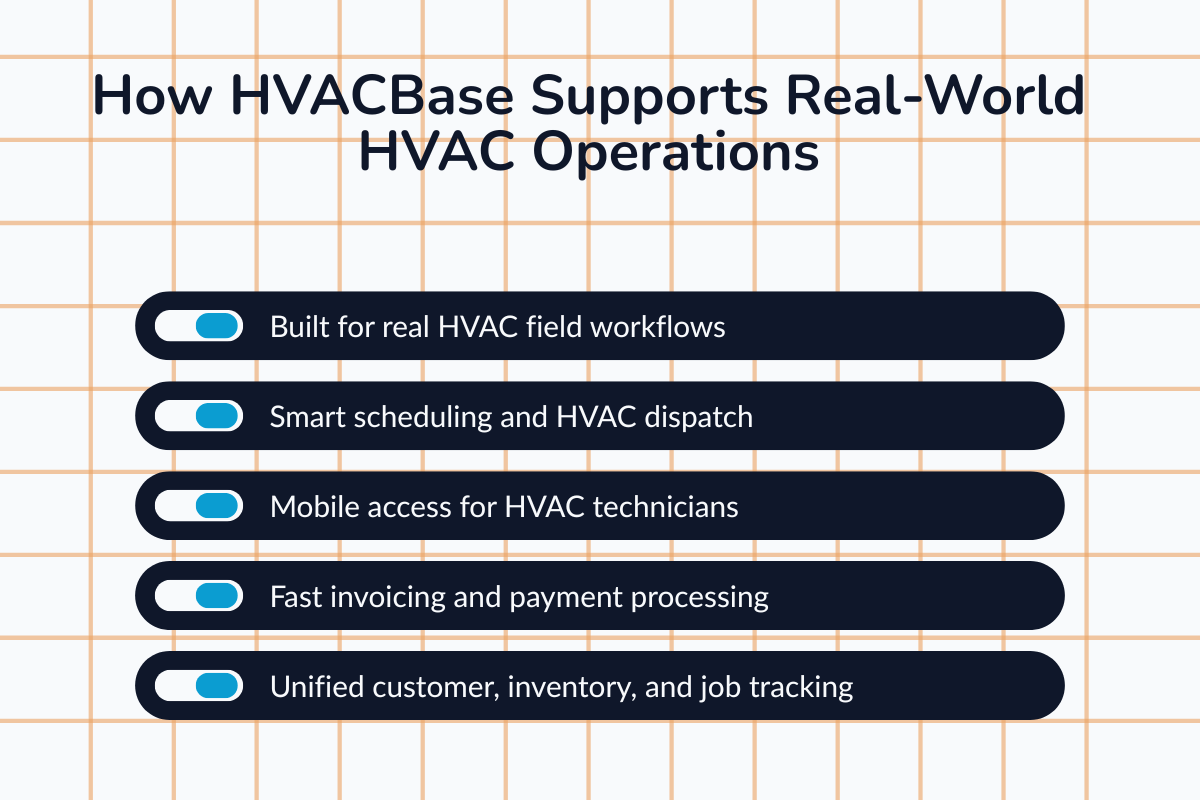
HVACBase supports HVAC field service realities, not abstract workflows. It focuses on how technicians, dispatchers, and staff interact with daily scheduling, invoicing, customer management, inventory, and job tracking within a single platform. This helps HVAC pros reduce friction and stay organized during peak seasons.
Core capabilities HVAC teams rely on daily include:
- Intelligent scheduling and HVAC dispatch software that keeps technicians assigned based on availability, location, and job priority
- Mobile access for HVAC technicians to view job details, update job progress, capture notes, and collect signatures from the field
- Built-in HVAC invoicing software and payment processing to shorten billing cycles and improve cash flow
- Customer management and service history tracking that helps teams deliver consistent, informed service.
- Inventory control and job costing toolsare integrated directly into daily workflows, not managed separately
In a Nutshell
When dispatch lives in one place, invoices in another, and technician updates in group chats, friction becomes part of the workday.
HVAC management software replaces chaos with clarity. By connecting scheduling, dispatching, field service, invoicing, inventory control, and customer management, HVAC businesses operate more efficiently.
Real-time visibility improves technician productivity, customer satisfaction, and long-term business performance. For HVAC business owners, the benefits of HVAC software extend beyond efficiency to better decision-making and scalable growth.
Why HVACBase?
HVACBase brings all the tools HVAC professionals need into one platform. It supports real-world operations, improves customer experience, and helps HVAC businesses grow without losing control.
By focusing on usability, accuracy, and field-ready workflows, HVACBase makes HVAC management software easy to adopt and easy to rely on. If you want to see how HVACBase works in real-world HVAC operations, explore and start your journey with HVACBase to see how it can streamline your scheduling, dispatching, and service workflows.
FAQs
1. What is HVAC management software used for?
HVAC management software helps HVAC businesses manage scheduling, dispatching, service calls, invoicing, inventory control, customer management, and technician workflows from one centralized platform, improving visibility and reducing manual work across operations.
2. Is HVAC management software suitable for small HVAC businesses?
Yes. HVAC management software is especially valuable for small HVAC businesses because it replaces manual processes, improves organization, and scales easily as the company grows and service volume increases.
3. Does HVAC management software integrate with accounting tools?
Most HVAC management software integrate with accounting tools like QuickBooks, streamlining invoicing, payment processing, and financial reporting while reducing duplicate data entry and errors.
4. How long does it take to implement HVAC management software?
Most HVAC management software can be set up in days to weeks, depending on the business size and data needs. Many companies begin with core features like scheduling, dispatching, and mobile access, then gradually adopt advanced tools such as reporting and inventory control.
Have questions or need personalized advice?
Talk to an Expert Today and let our construction specialists guide you to success.
Related Posts