HVAC Management Software: Why Operations Managers Are Making the Switch Now
December 24, 2025
The HVAC business involves a multitude of activities, such as juggling multiple service calls, managing inventory, ensuring regulatory compliance, and maintaining a sales pipeline that must stay in motion to keep revenue flowing consistently.
It is indeed a highly demanding work environment, and relying on outdated tools like spreadsheets, constant WhatsApp updates, and sticky notes can choke your HVAC workflows.
If you do not switch to automation, clinging to old-school methods can end up costing you far more than the HVAC software cost itself.
In this case, HVAC service software is the ultimate solution to restore efficiency and productivity across your operations and propel your business toward long-term success and scalability.
What is Driving the Rapid Adoption of HVAC Management Software Solutions?
To excel as an HVAC company and elevate customer satisfaction, you need a deep understanding of heating, ventilation, and air conditioning systems.
But technical skills and service quality alone are not enough. Smartness, swiftness, and streamlining your HVAC business activities are the keys to sustaining growth and maximizing efficiency.
HVAC field service software is the upgrade you need to tackle to achieve this. And it is not optional but a non-negotiable step to unlock profitability, turning every HVAC tech and every job into highly profitable endeavors.
Key Takeaways
- Operating without HVAC management software leads to job delays, wasted time, idle labor, slower payments, frustrated customers, and ultimately, loss of revenue and trust.
- The HVAC industry has evolved, and customers now expect fast, transparent, and high-quality service.
- Choosing the right HVAC business software is essential to improve efficiency, boost profitability, and build long-lasting customer relationships.
- Exploring a free demo can help you understand how the software works and make a confident decision.
Don’t Let Old Processes Slow Down a Modern HVAC Team
If spreadsheets, WhatsApp messages, and manual scheduling are holding you back, it’s time for an operational reset. Discover how HVAC software can streamline your day, boost revenue, and deliver the fast service customers now expect.
Take the first step: see how HVAC automation transforms your business.
The HVAC Industry Has Entered the “Instant Everything” Era
Customer expectations are evolving fast, and service businesses must adapt by delivering proactive updates, seamless communication, and prompt services.
Here, HVAC service software becomes the key to sustaining in an era where people expect instant actions at the click of a button, eliminating long wait times and patience. This software caters to the prominent sense of urgency among consumers. Here's how:
- Responsive Scheduling:
One-click booking, real-time appointment availability, and instant confirmation notifications ensure customers never have to wait for updates. - Proactive Communication:
Automated reminders, timely service alerts, and quick responses to customer queries, whether it is about scheduled visits, upcoming renewals, service follow-ups, or keeping customers informed at all times.
The Real Cost of Operating Without HVAC Management Software
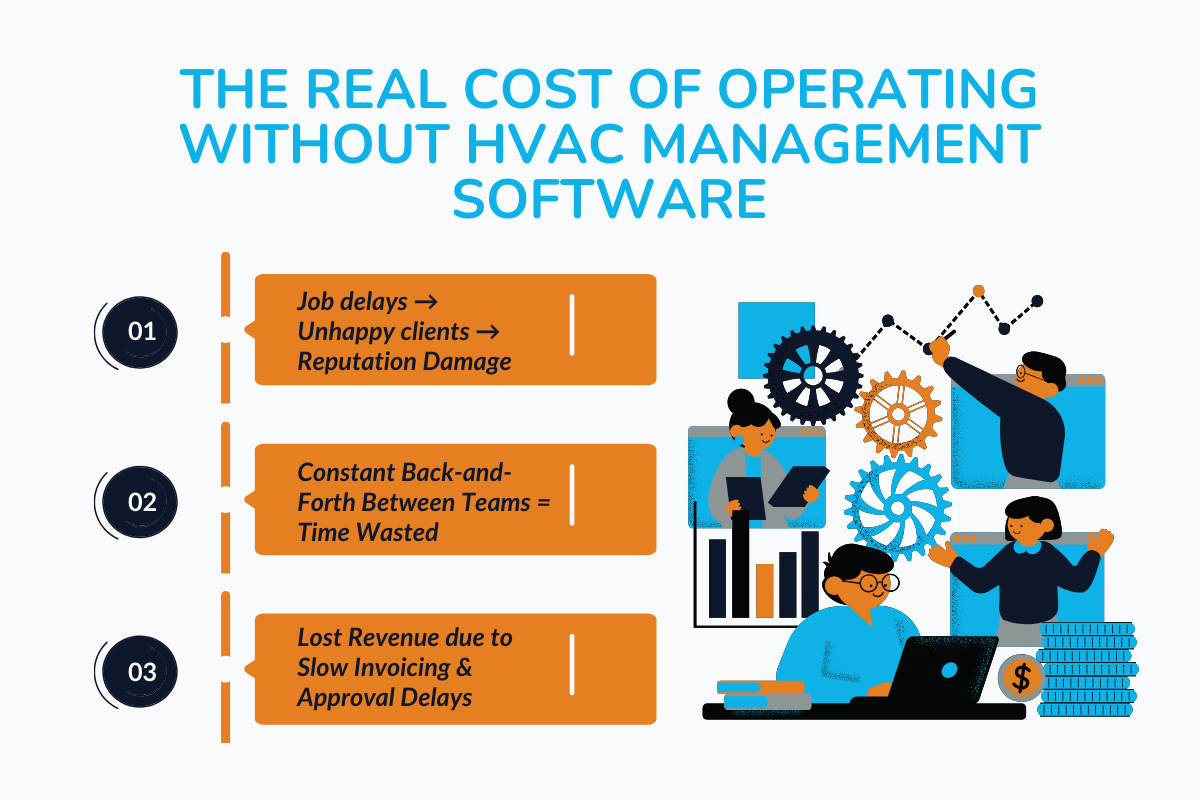
1. Job delays → Unhappy clients → Reputation Damage
Without reliable scheduling and dispatch, technicians run late, double-bookings cause confusion, customers face long waits, and your brand image takes a hit.
2. Constant Back-and-Forth Between Teams = Time Wasted
Managing jobs and inventory across multiple sites becomes overwhelming without clear updates and communication, causing confusion, return visits to complete the same job, and lost time, productivity, and travel costs.
3. Lost Revenue due to Slow Invoicing and Approval Delays
Manual quotes and invoices delay approvals and payments, disrupting cash flow and straining operational expenses.
Warning Signs You Have Outgrown The Spreadsheets Era
- Scheduling chaos: Relying on spreadsheets, sticky notes, or whiteboards, where schedulers manually send updates, gives way to overlapping routes, missed appointments, double bookings, and misplaced customer details. Ultimately, this frustrates customers and lowers service quality.
- Unproductive labor: Without real-time visibility into job progress, schedules quickly fall off track, leading to idle labor and wasted productivity hours when customers cancel appointments at the last minute or emergency jobs are missed, resulting in high earning potential.
- Inefficient inventory management: Technicians often arrive at job sites without essential parts due to stock-outs, causing double trips, further delays, and wasted productivity hours, ultimately lowering customer satisfaction.
Outdated tools are the #1 silent killer of HVAC productivity.
What Exactly is HVAC Management Software?
HVAC management software is a comprehensive solution that delivers powerful workflow automation, boosting operational efficiency by providing real-time job updates from the field to office teams, enabling faster customer response times.
Instead of relying on spreadsheets, phone calls, and disconnected tools, HVAC management software brings scheduling, dispatching, customer data, invoicing, and technician workflows into one platform. It gives office teams real-time visibility into jobs and gives field technicians mobile access to everything they need on-site.
If you want to understand more about HVAC Software, then read: What Is HVAC Software? A Complete Beginner’s Guide
What HVAC Management Software Actually Does For You?
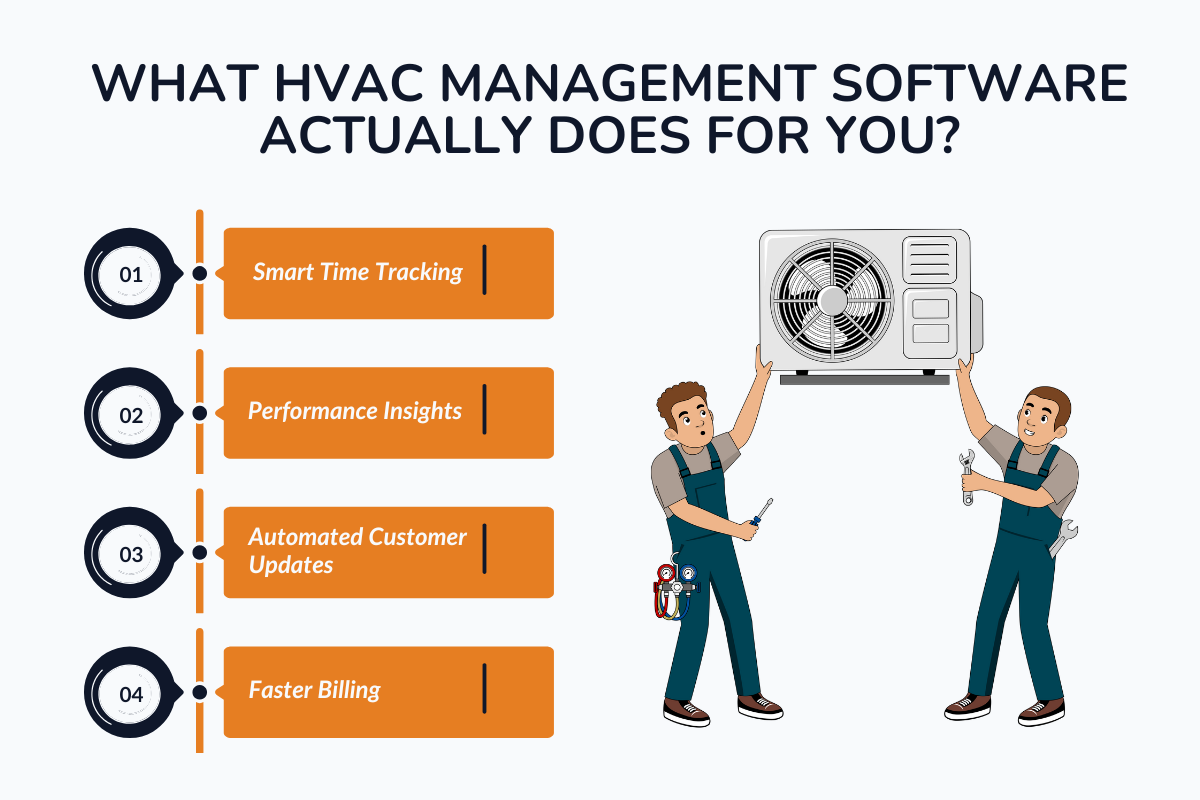
HVAC management software brings structure to the everyday operations of an HVAC business by connecting office workflows, field activities, and customer interactions into one coordinated system.
Efficiency Drives Your Revenue with smarter and faster operations. Let's see how HVAC service software delivers it for you!
1. Smart Time Tracking
HVAC scheduling software tracks the exact locations of field reps and completed jobs, optimizing routes and assigning nearby assignments based on availability, specialization, and workload.
2. Performance Insights
Data-driven insights help monitor project progress and performance KPIs through intuitive dashboards, enabling compliance reviews and identifying performance bottlenecks to implement better future strategies for better customer satisfaction.
3. Automated Customer Updates
Tracks customer history and past behavior to send personalized offers and timely service reminders that keep customers engaged and encourage repeat business.
Customer satisfaction is maintained when they receive instant updates without the need for constant follow-up calls, real-time estimated arrival times, job notes, and upcoming service reminders, keeping them informed and strengthening trust in your service quality.
4. Faster Billing
After every job completion, the HVAC invoicing software automatically updates the invoice and provides an online payment portal that supports debit and credit card payments, speeding up billing and payment processes while maintaining cash flow.
To understand how CRMs support renewals and ongoing service relationships, also read the Importance of HVAC CRM for Customer Retention
Why Switching Now = A Major Competitive Edge?
Time is not slowing down, and neither is the industry, and productivity is now your strongest competitive weapon. To escape operational chaos, you must make the switch to automation. Here’s why it truly matters:
Supports Peak Season Rush and Sustains Business in Off-Peak Periods
Peak HVAC seasons bring a whirlwind of activities for installations, work orders, and maintenance requests.
HVAC scheduling software uses live GPS tracking to dispatch technicians through the most optimized routes, reducing travel time and enabling your team to handle more job opportunities each day during busy seasons. It also provides real-time visibility into inventory levels, matching them with job requirements to ensure stock-outs never disrupt your operations.
Sending newsletters with energy-saving tips, limited-time offers, and referral rewards—along with automated service renewal reminders—keeps customers engaged and your brand top-of-mind even during off-seasons.
Noteworthy Stat: Companies that give personalized offers can gain more than 40% revenue.
Contractors who modernize TODAY would be able to:
- Serve more customers each day.
- Reduced reworks and job delays, translating to more five-star ratings
- Improve repeat business & referral rates.
- Higher Profit margins
- Efficient inventory management
How to Choose HVAC Management Software That Scales?
Let us explore the core functional features that the chosen HVAC service software must have to serve as the perfect digital assistant, as your business grows:
1. Cloud-Based & Mobile-First
It must be a cloud-based system with an open API, seamless integration with all tools, and advanced operational features to support the complexities of growing enterprises.
It should also include mobile app accessibility, enabling HVAC operations from anywhere, supporting remote work, and connecting technicians with office staff through real-time updates.
2. Integrations That Remove Double Entry
Your HVAC software should seamlessly integrate with essential third-party tools, including CRMs, Google Calendar, scheduling platforms, inventory management systems, and accounting software like QuickBooks Online.
This eliminates the need for manual data entry with an ecosystem that improves data flow and overall efficiency.
3. Customizable Workflows
The construction software should offer customizable workflows that adapt to your specific business needs, rather than relying on a generic one-size-fits-all approach that limits flexibility and efficiency.
4. Built-in Communication Tools
It must sync the field techs to the office teams with live GPS tracking and job updates to streamline HVAC scheduling, dispatch technicians to the right job at the right time, and cater to urgent needs as well.
The HVAC service software that you'll choose should also store customer details, service history, and agreements, enabling personalized communication and automated maintenance reminders for both technicians and customers.
5. Inventory & Parts Management at Scale
As job volume increases, inventory mismanagement becomes expensive. HVAC software should offer real-time inventory tracking, low-stock alerts, and usage reports tied directly to work orders.
This prevents overstocking, reduces emergency part purchases, and supports multi-warehouse or multi-vehicle inventory visibility as operations expand.
A Quick ROI Breakdown: What Can You Expect?
| Operational Win | Time Saved | Revenue & Business Impact |
|---|---|---|
| Automated scheduling & dispatch | 2–3 hours saved daily by eliminating manual planning and calls | More jobs per technician, less idle time, higher daily service revenue |
| Faster quoting & invoicing | Estimates and invoices created in hours instead of days | Faster approvals, quicker payments, improved cash flow |
| Reduced callbacks & rework | 20–30% fewer errors with accurate job details | Lower rework costs, better margins, higher customer satisfaction |
| Higher technician productivity | Less time calling the office or searching for info | More jobs completed per shift without adding headcount |
| Improved repeat & referral business | Automated reminders and follow-ups run continuously | Higher renewals, more service agreements, predictable revenue |
| Better inventory & route planning | Fewer emergency runs and duplicate visits | Lower fuel costs, optimized parts usage, higher profit per job |
Time-saving operations translate into revenue generation. Modern HVAC Business Management Software can be your key to boosting profits by saving every minute while increasing your revenue capacity.
How Is HVACBase Built for the Way HVAC Teams Actually Work?
1. Built specially for HVAC Contractors:
It is a specialized field service software with in-built tools tailored for the workflow and operational demands of HVAC operators.
2. Intuitive User-Interface with customizable workflow:
It offers workflow customization to fit your business operations and a highly user-friendly interface with core features that are easy to use, even with zero technical expertise.
3. Mobile App support for iOS and Android devices:
An HVAC mobile app with instant job updates and performance metrics accessible anytime, anywhere, that seamlessly supports both iOS and Android devices.
The mobile app sends instant alerts and push notifications, reminding customers of upcoming appointments and notifying field reps and managers about new leads and service bookings.
4. HVAC Design Software for accurate system layout and Proposal Generation
An editable and real-time tool for automated heating and cooling system sizing, duct layouts, and code-compliance auditing. It uses the automated design parameters and real-time pricing to generate professional proposals with accurate quotes.
5. Optimized scheduling with live route tracking:
A simple drag-and-drop feature for HVAC scheduling to maximize job outputs within each workday.
It tracks job site status to assign, reassign, or reshuffle job allocations based on technician expertise and availability, maximizing outreach while saving time and fuel.
6. Real-time job details to manage jobs, customers, and field teams:
Live tracking of every rep’s whereabouts in the field helps dispatch managers assign emergency tasks to the right technician in the right territory, which reduces customer wait times and elevates satisfaction levels.
7. Automated Invoicing and Integrated Payment Processing:
Each technician's job completion is automatically updated and synced with your accounting system, such as QuickBooks, enabling instant invoice generation and a built-in instant payment portal for faster payments.
8. Centralised and secured document storage:
HVACBase offers a central repository for important documents such as inspection reports, service records, and permits that are securely stored and accessible anytime.
9. Reliable Support and Training after Software Onboarding:
A dedicated support team provides personalized guidance on every core functionality to minimize errors and maximize benefits. All features work together here with zero hassles.
Step-by-Step Transition Plan for Operations Managers
HVAC service software needs every operational manager to take some important steps before the transition to an automated workflow:
1. Assess the Current Key Performance metrics
You need to understand your current performance before implementing HVAC business software so you can compare your improvement in measurable terms. Start by establishing a baseline through accurate data collection and performance analysis.
Key metrics to review include:
- Job Time: Measure the average time from job acceptance to completion to understand your current turnaround time.
- Close Rate: Determine the percentage of service quotes that successfully convert into signed contracts.
- Callbacks: Track how often jobs require follow-up visits to assess service quality and team efficiency.
2. Pick a future-proof tool with the best HVAC software
The HVAC service software you choose must resolve current operational bottlenecks while also offering scalability to keep up with a dynamically evolving HVAC industry, with seamless integration to other essential tools.
3. Train Field and Office staff with the Simple Onboarding Process
Both field and office teams should receive a simple onboarding experience through a structured program or mentor-driven training that delivers practical and hands-on guidance to ensure they can fully maximize the software’s potential.
Final Verdict
Running an HVAC business today is no longer just about technical expertise or service quality. It is about how efficiently your operations support that work behind the scenes. Scheduling accuracy, technician coordination, inventory availability, customer communication, and billing speed now directly determine profitability and reputation.
Stop giving in to pressure and fix workflow inefficiencies before they lead to complete burnout.
Protect your brand reputation, elevate client experience, and boost profits with a transformative HVAC business software solution built not only for large enterprises but also priced affordably for small businesses.
Put your operations to the test before peak season hits
HVACBase is designed around how HVAC teams actually work in the field and in the office. As job volume increases, HVACBase helps teams stay organized without adding overhead. Schedules stay clean, technicians remain informed, and managers stay in control with real-time visibility across jobs, inventory, and payments.
So, schedule a demo with our experts and see how the right tools can reduce stress in your daily operations and keep your business thriving.
FAQs
1. Can HVAC management software reduce paperwork?
Yes, HVAC management software can significantly save time and effort involving paperwork by digitizing work orders, centralizing customer records, and automating invoices and compliance documents.
2. How does the HVAC software improve accountability?
HVAC service software centralizes and automates data-driven performance insights for operations, sales, and field teams by tracking, monitoring, and reporting real-time actions and performance metrics, making every team member accountable for their activities.
3. Is HVAC business software scalable as my business grows?
Yes, HVAC service software is built to support growing businesses. It lets you add more users, manage multiple projects, and incorporate multiple locations into customized workflows seamlessly. It is suitable for both small businesses and large enterprises as well.
4. How fast can an HVAC company implement the software?
The deployment of HVAC business software is rapid, and full implementation, including training and data migration, takes 1 to 2 weeks, and business operations can benefit from it instantly.
Have questions or need personalized advice?
Talk to an Expert Today and let our construction specialists guide you to success.
Related Posts