HVAC Estimating Software: Ensuring Accuracy, Reducing Mistakes, Increasing Margins
December 29, 2025
Top-performing HVAC contractors pay close attention to their estimating process, creating detailed and accurate estimates that directly support strong profit margins.
However, many HVAC professionals still rely on manual calculations and spreadsheets to build estimates. While this approach may seem precise, manual estimating is inherently prone to human error and introduces significant risk.
Even small inaccuracies in labor hours, material costs, or sheet metal charges can quickly compound, resulting in underpriced jobs and reduced profitability.
To avoid these risks, contractors need purpose-built HVAC estimating software that supports labor cost calculations, residential and commercial jobs, Trimble-based estimation, and the creation of accurate material lists and professional-grade estimates.
Accurate Estimates Drive Faster Wins and Higher Margins With HVAC Estimating Software
An accurate HVAC-specific pricing catalog helps the HVAC company scale faster.
The best HVAC estimating software helps us calculate detailed estimates, which include HVAC equipment, labor rates, and material costs for each HVAC job, and saves valuable time through digital plans.
In this blog, we will see how estimating software attracts more projects in less time with less manual effort. Also, we will discuss how it helps technicians to prepare invoices accurately and streamline HVAC assembly.
Key Takeaways:
- The manual estimating process creates hurdles, including inconsistent pricing, incorrect calculations, and the loss of potential users.
- Automated estimating tool provides accurate and precise estimates with real-time tracking and high profit margins.
- Teams that shift from manual methods to automated tools achieve faster conversions and higher client retention.
- With HVACBase, you get precise estimates and branded proposals in just a few clicks.
A Small Workflow Shift That Frees Up Hours Every Week
HVAC estimators lose an average of 4–6 hours per week correcting estimate mistakes, revisions, and pricing inconsistencies. That’s not a people problem—it’s a process problem.
When estimating is automated and standardized, mistakes drop, revisions slow down, and margins stabilize. See how HVACBase helps teams reduce estimating errors and reclaim that lost time.
Why is the Manual HVAC Estimating Process Causing Your Margin Loss?
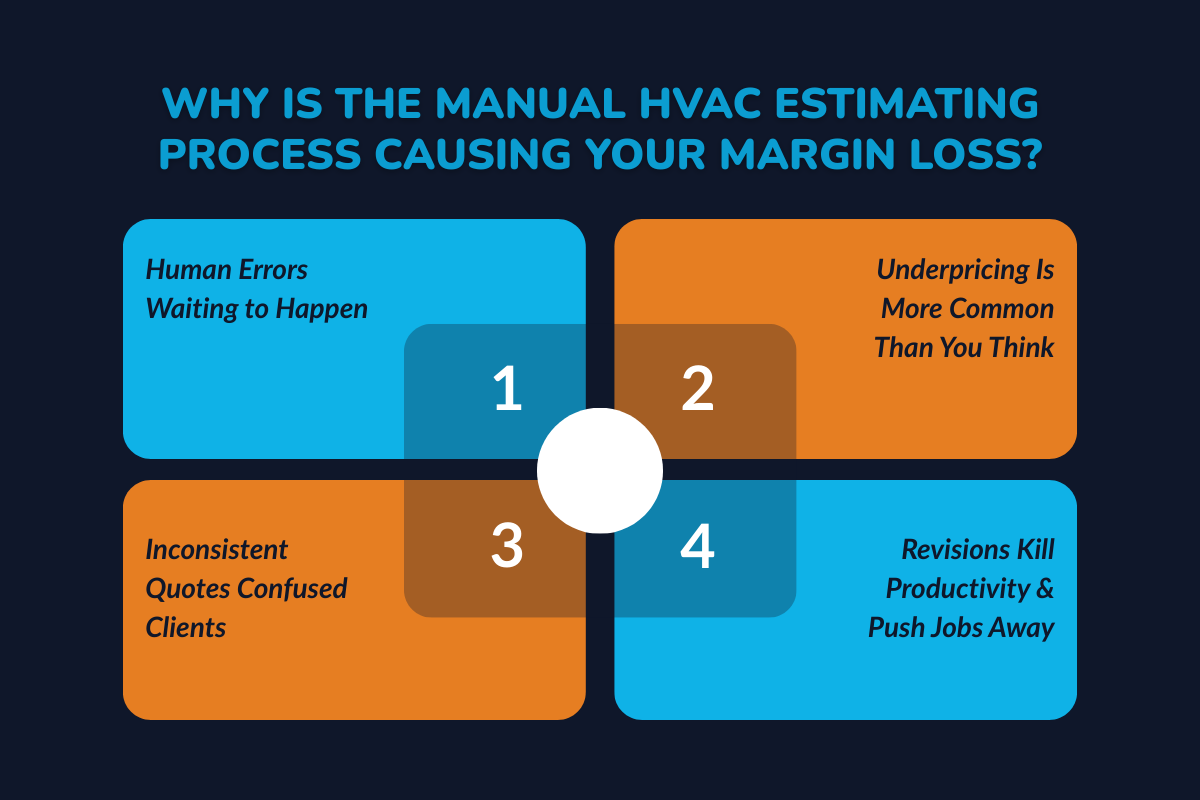
A. Human Errors Waiting to Happen
HVAC or ductwork contractors using manual methods for calculations or spreadsheets in the HVAC market face a major setback, as there is a high risk of incorrect estimates due to inaccurate measurements of fittings or overhead costs.
B. Underpricing Is More Common Than You Think
Many HVAC contractors underprice jobs while rushing to send quick proposals in an effort to win more work. In the process, critical details are often overlooked, such as accurate labor calculations, material costs, or additional charges related to plumbing and fittings.
These small omissions compound quickly, resulting in undervalued estimates that erode profit margins before the job even begins.
C. Inconsistent Quotes Confuse Clients
When two clients receive different prices for the same product or service, it immediately raises questions and creates confusion. Inconsistent quoting makes it difficult for clients to understand what is included in the estimate and undermines confidence in your pricing.
D. Revisions Kill Productivity & Push Jobs Away
Every revision or estimating mistake requires additional time to correct, pulling teams back into rework instead of moving deals forward. As revisions stack up, the sales workflow slows, creating bottlenecks in the estimating process.
Did you know? From $1.15 billion in 2024 to $3.27 billion by 2033, the total value of the worldwide HVAC estimating software industry will grow from $1.15 billion in 2024 to $3.27 billion in 2033
What HVAC Estimating Software Actually Solves and Who Needs It?
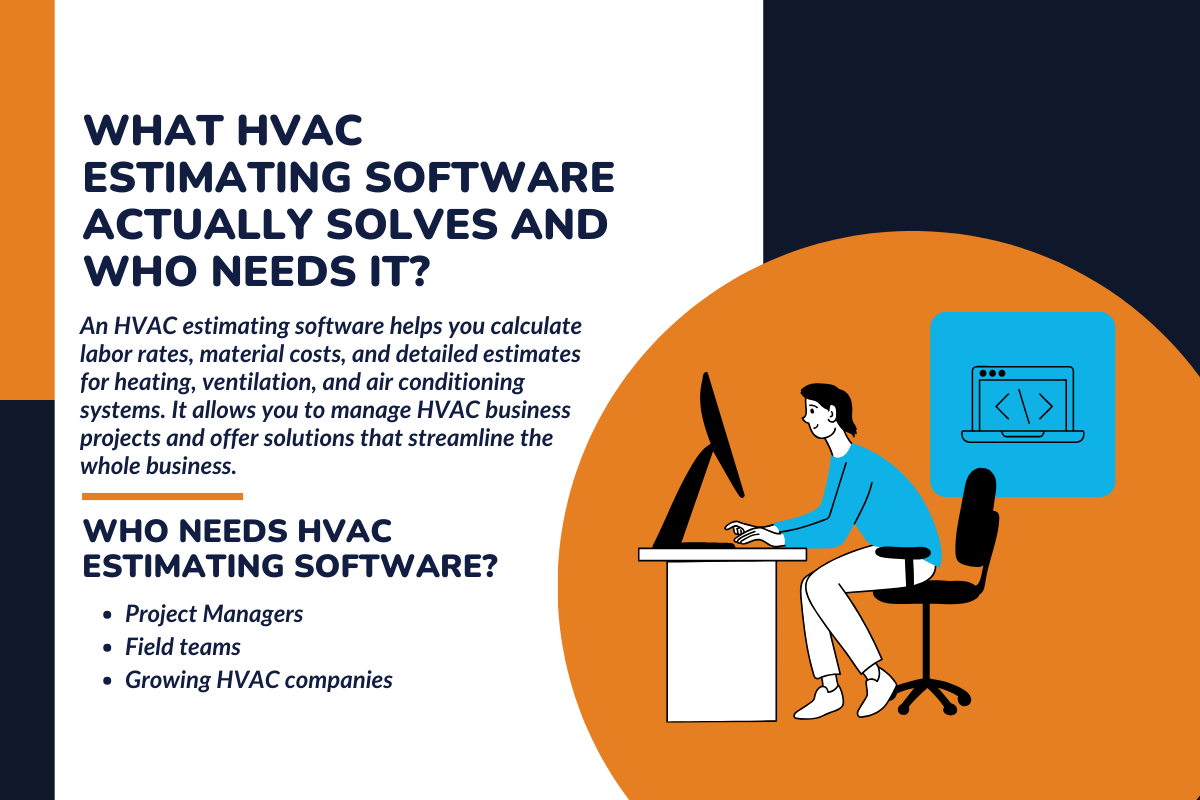
An HVAC estimating software helps you calculate labor rates, material costs, and detailed estimates for heating, ventilation, and air conditioning systems. It allows you to manage HVAC business projects and offer solutions that streamline the whole business.
Who needs HVAC estimating software?
- Project Managers: It provides real-time visibility into your reps' activity, and with branded templates, you can close more deals quickly.
- Field teams: Field team members need precise estimates to keep project deliverables on track with quick insights.
- Growing HVAC companies: With increasing HVAC jobs, they need accuracy and precision.
What Makes a Modern HVAC Estimator Different?
Modern HVAC estimators no longer rely on manual methods that slow down the estimating process, as they require a considerable amount of time for manual calculations and bid preparation formulas.
A modern HVAC estimator replaces these inefficiencies with digital tools designed for accuracy, speed, and scalability. It delivers consistent, data-backed estimates that protect profit margins while saving valuable time. Instead of reworking calculations, teams can focus on winning and executing jobs more efficiently.
Let us talk about other features of HVAC estimating software:
Core features tied to your angle:
- CRM Integration for Fast, Connected Quoting: With CRM integration and other integration software, such as accounting software or QuickBooks, you can quote faster.
- AI-Driven Labor and Material Calculations: AI helps you identify pricing gaps and build linear takeoffs with accurate estimates.
Why Integrated Estimating Tools Boost ROI in 2026?
Integrated estimating tools help you reduce human error and accurately calculate your HVAC business's financial performance. Let's talk about some ROI:
I. Faster Quotes Attract More Jobs
Speed matters when you are dealing in the competitive market of HVAC businesses. Customers often expect faster bidding or quoting while maintaining accurate measurements and calculations.
With estimating software, you get accurate calculations and quicker quotes with a lower probability of human errors in just a few clicks.
II. Pricing Consistency Builds Client Trust
Inconsistency in pricing across quotes for the same clients is a significant issue that can lead to missed conversion opportunities.
When users receive proposals with consistent pricing for the same HVAC projects, their trust and the HVAC business's credibility increase.
III. Smart Automation Flags Low-Margin Bids
The estimating tools help you focus on bid quality and reconsider the amounts before bid submissions in less time.
On the other hand, automation helps you reconsider the estimated details, such as low bid value or overpriced material costs, before sending the final bid invites.
Check out Manual Estimating vs AI-Powered Estimators:
| Feature | Manual Estimating | AI-Powered HVAC Estimator |
|---|---|---|
| Accuracy | Relies on manual data entry, outdated formulas, and copy-paste workflows, increasing the risk of calculation and measurement errors. | Automates labor, material, and equipment calculations using real-time data for accurate, consistent estimates. |
| Speed | Quotes require juggling spreadsheets, price books, emails, and revisions often taking hours or days. | Generates professional quotes instantly using synced job details and pre-built templates. |
| Consistent Pricing | Pricing varies by estimator and version of price sheets, leading to inconsistent customer quotes. | Centralized pricing updates ensure standardized, up-to-date rates across the entire team. |
| Data & Workflow | Job details are scattered across notes, emails, and files, limiting visibility and control for managers. | All job data, history, and analytics live in one connected system with CRM integration. |
| Profit Margins | High risk of underpricing due to missed line items, miscalculations, and delayed revisions. | Built-in margin safeguards flag low-profit bids and protect margins before quotes are sent. |
Learn what the difference is between a manual estimator and a digital estimator through this: HVAC Software vs Manual Estimation: Pros & Cons.
How the HVAC Business Evolves From Spreadsheets to Smarter Dashboards?
- Track the metrics: It helps you track metrics such as quote turnaround ratio, margin accuracy, bid to win ratio, etc.
- Gives complete visibility to managers: Managers can see which tasks are working, which reps need more jobs, etc.
- Dashboards turn raw data into valuable insights: Live dashboards help you make better decisions in real time.
Curious to know where your HVAC estimates are going wrong? Read in depth: HVAC Estimate Mistakes to Avoid
Comparing Best HVAC Estimating Software for Modern Contractors
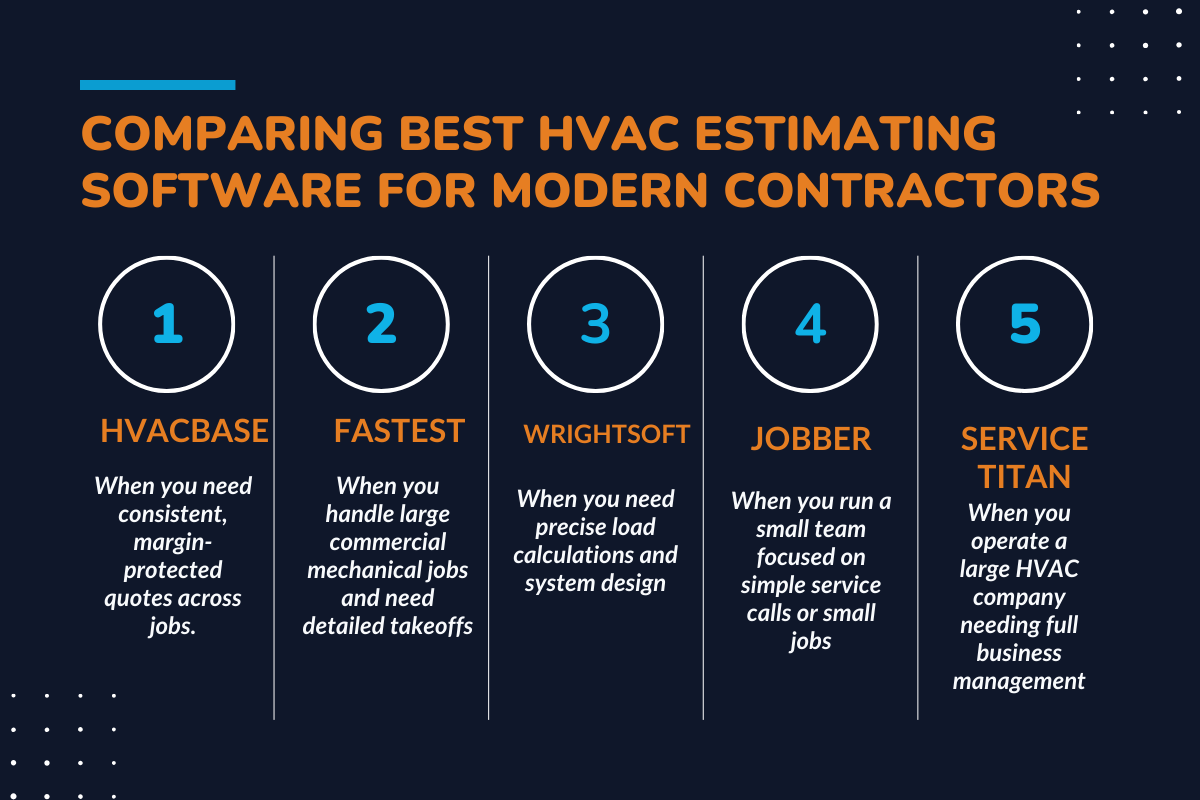
1. HVACBase: When you need consistent, margin-protected quotes across jobs.
It offers you a centralized platform for precise measurement and quick estimates. It integrates with CRM and other software with ease and delivers real-time visibility through live dashboards.
Core features of HVACBase:
- Customizable proposal templates: You can add line items and data according to personal requirements in ready-made templates for faster bids.
- Quick Estimate Builder: You can instantly convert bids into estimates and assign them to reps in just a few clicks.
- Automated Material Takeoffs & Equipment Lists: Once you input project scope or system specs, HVACBase generates material takeoff lists and equipment requirements automatically — reducing manual errors and saving time.
- Revision & Change Order Support: Easily update estimates when scope changes — the system recalculates labor, materials, and updated totals automatically, ensuring consistency and minimizing rework.
Best for: Growing HVAC companies or mid-sized teams that want a single, centralized system for lead capture through the final bid calculator.
Pricing: HVACBase pricing is “quote-based,” implying the cost depends on business size, number of users, modules selected, or other factors.
2. FastEST: When you handle large commercial mechanical jobs and need detailed takeoffs
It offers specialized estimating software for construction, HVAC, mechanical, and plumbing services. It provides comprehensive reporting features along with project management tools.
Core features of it:
- FastPIPE: It offers takeoff and reporting tools for estimating plumbing, HVAC, and related systems.
- FastDUCT: It can manage HVAC jobs based on requirements for standard ducts or purchased ducts.
- FastWRAP: It helps you quote insulation jobs and estimation with digitizer takeoffs.
Best for: HVAC contractors working on large mechanical projects that require detailed takeoffs.
Pricing: FastEST offers three pricing models.
- Purchase Option: First Application $4,995 one time, Additional Application $2,495 one time.
- Lease Option: First Application $250 per month, Additional Application $105 per month.
- Maintenance Option: First Application $1,250 per year, Additional Application $250 per year.
3. WrightSoft: When you need precise load calculations and system design
It offers cloud and mobile-based solutions for HVAC projects, whether residential or commercial. It offers complete design features for HVAC projects and helps you elevate your business.
Core features of it:
- System designs: It offers you system designs for residential or commercial duct, geothermal loop systems, etc.
- Load Calculations: Help you calculate loads and system sizes for precise takeoff lists.
- Labor Cost Estimation: It supports labor calculations tied to scope and system complexity, helping contractors build accurate job cost estimates.
Best for: Residential or light commercial HVAC teams who need system design and load calculations before quoting.
Pricing:
- Residential Core: $500
- Residential Advanced: $900
- Residential Premium: $1,100
- Commercial Only: $800
4. Jobber: When you run a small team focused on simple service calls or small jobs
It is a digital toolbox for daily tasks such as scheduling jobs, processing payments from customers, etc. It also offers features such as helping you send estimates, handle installations, service calls, etc.
Core estimating features of it:
- Professional Estimates: It offers customized proposals with branding and line items according to your business.
- Client Approval & Online Acceptance: After sending a quote, clients can review and accept estimates online via Jobber’s client hub, speeding up approvals and reducing back-and-forth.
- Job History & Customer Record Integration (CRM): Jobber links quotes and estimates to customer records, past jobs, and service history, enabling you to reference past pricing, repeat jobs, and use historical data for more accurate future estimates
Best for: Small teams or service-focused contractors who require basic estimates and scheduling jobs.
Pricing:
- Core: $29/month: basic plan for solo or small teams.
- Connect: $129/month: includes 5 users and collaboration tools.
- Grow: $249/month: for growing teams needing sales features.
- Plus: $449/month: up to 15 users with advanced automation.
5. ServiceTitan: When you operate a large HVAC company needing full business management
It helps you boost the overall efficiency of your HVAC business through real-time insights, team tracking, analyzing performance, etc. It offers proposal estimates and branded templates for faster sales conversion.
Core estimating features of it:
- Proposals: It offers customizable branded proposals for quick bid invitations.
- Service Agreements: You can easily manage your recurring HVAC services and convert them into contracts.
- Mobile Estimates & On-Site Quoting: Technicians can generate estimates directly on the job site using the ServiceTitan mobile app (Android or iOS). This enables field crews to build quotes in real time.
Best for: Large-scale enterprise that requires full coverage from operations, sales, dispatch, and till service contracts.
Pricing: The prices are not publicly listed. You can schedule a demo with them.
Signs Your HVAC Business Has Outgrown Manual Estimating
Manual estimating might work when jobs are few and simple. But as your HVAC business grows, cracks start to appear, and they usually show up before you realize what’s causing them.
If any of the signs below sound familiar, it’s a strong indicator that spreadsheets and hand calculations are holding you back.
1. Quotes Take Too Long to Send
If it takes hours—or days—to prepare an estimate, you’re already losing opportunities. Customers expect quick responses, and slow quotes often mean lost jobs, even if your pricing is fair.
When estimating starts delaying sales, it’s a sign your process can’t keep up with demand.
2. You Can’t See Your Margins Until It’s Too Late
If you only understand how profitable a job was after it’s completed, estimating has already failed its purpose. Growing HVAC businesses need visibility into margins before sending the quote, not after absorbing the loss.
3. Growth Is Increasing Stress Instead of Profits
If more jobs mean more pressure, more rework, and tighter margins, manual estimating is no longer supporting your business; it’s limiting it. At this stage, automation isn’t a “nice to have.” It’s necessary.
How to Choose the Right HVAC Estimator for your business?
Step 1: Check Real-Time Pricing & Accuracy
Choose a tool that drives accurate and precise calculations that removes the chances of human errors, along with real-time pricing.
Step 2: Look for CRM-Connected Workflows
Check whether your chosen tool directly syncs with CRM for an easy flow of project details, contacts, and customer information.
Step 3: Evaluate Proposal Quality and Branding
Pick a tool that drives accurate pricing in estimates and breaks down the forecast into clear parts for better visibility with branded proposals.
Step 4: Confirm Margin Protection Features
Select a platform that helps you identify low-margin bids and protect your margin ratio by keeping all clients and estimators aligned with the business goals.
Which HVAC Businesses Benefiting Most From Estimating Software
| HVAC Business | Key Advantages of Estimating Software | Why It Matters |
|---|---|---|
| Residential HVAC Installers | ✔ Faster quote turnaround ✔ Consistent pricing across installers ✔ Accurate load sizing + system matching | Better close rates during peak seasons because homeowners choose the team that quotes first with confidence. |
| Commercial HVAC Contractors | ✔ Detailed takeoffs ✔ Accurate material and labor cost modeling ✔ Margin protection on large bids | Big projects rely on precision. One mispriced line item impacts total profitability. |
| Service & Maintenance Providers | ✔ Standardized service pricing ✔ Quick add-on estimates during visits ✔ Integrated invoicing + CRM | Technicians convert more on-site opportunities when pricing stays consistent and instantly accessible. |
| Mechanical Contractors | ✔ Complex mechanical takeoffs ✔ Strong equipment databases ✔ Multi-stage project quoting | Mechanical projects require depth and accuracy. Estimating software reduces human error on major system builds. |
| Multi-location HVAC Companies | ✔ Unified pricing across branches ✔ Central dashboards for quote monitoring ✔ Margin control at scale | Multi-branch teams gain visibility and consistency. Leaders track performance across every location. |
Conclusion: Accuracy, Consistency, and Margin Protection in One System
The manual estimating process leads to inconsistent pricing, human errors, lost potential clients, and reduced profit margins. However, HVAC estimating software changes this scenario with automated calculations and precise estimates.
It gives you accurate and branded estimates that help you close deals faster. Client trusts the transparency through the estimate breakdown, which builds credibility for your HVAC business.
Beyond estimating, a modern digital platform provides centralized scheduling, accurate labor and material calculations, professional proposals, and streamlined workflows, all from one system.
Choose HVACBase
If you value pricing consistency, want to reduce human error, and are ready to scale your HVAC business with accurate, reliable estimates, then you are in the right place.
Tap here to book your demo and start building precise estimates with HVACBase today.
FAQs
1. How to estimate HVAC projects?
The best way to estimate all HVAC projects is to collect all job information, calculate your system load, identify all required materials and equipment, and, if using workers, use your labor hours and current market rates. Many companies now utilize HVAC estimating software to streamline the estimating process.
2. Which is the best estimating software?
An excellent HVAC estimating program will provide accuracy, automation, up-to-date pricing, and the ability to manage margins. There are several options available, such as HVACBase, FastEST, WrightSoft, Jobber, and ServiceTitan.
3. What is the 2-foot rule in HVAC?
The 2-foot rule refers to the minimum distance that must be kept clear around HVAC equipment to allow sufficient airflow, provide access for safe servicing, and ensure optimal unit performance.
4. What are the four types of estimation?
There are four main types of HVAC and construction estimations:
1) Preliminary Estimation
2) Detailed Estimations
3) Quantity Takeoff Estimations
4) Bid/Proposal Estimation.
5. What is the rule of thumb for HVAC calculation?
The general guideline for HVAC calculations is to use 1 ton of air conditioning for every 400-600 square feet of home. Professional load calc (e.g., Manual J, AI estimators, or software tools) will provide much more precise results.
Have questions or need personalized advice?
Talk to an Expert Today and let our construction specialists guide you to success.
Related Posts