HVAC Management Software Running Operations from Scheduling to Payment
January 22, 2026
HVAC businesses rely heavily on 5-star ratings to build a strong reputation, generate referrals, and increase revenue.
If you wait until the end of the day to process payments, follow up with customers, update inventory, or schedule your lead pipeline, you are already falling behind. At the same time, your competitors have closed the deals.
The right digital tool can empower you to streamline every step, from scheduling and payment processing to inventory management, customer follow-ups, and lead management that helps you focus on what matters most: growing your business and delighting your customers.
Manage Your HVAC Business Operations with the Right HVAC Management Software
HVAC management software reduces the need for multiple tools by providing an all-in-one solution for residential and commercial HVAC contractors.
The best HVAC business management software automates job operations through a mobile app with built-in features for smart scheduling and dispatching, predictive dispatch, automated reminders, data-driven insights, automated marketing campaigns, invoice creation, and payment processing.
This blog explains how HVAC management software helps contractors run their entire business from scheduling to payment without relying on disconnected tools or manual processes. It'll walk you through the real operational challenges HVAC businesses face today.
By the end, you'll gain a clear, practical understanding of how modern HVAC management software replaces chaos with structure and helps HVAC businesses scale confidently while delivering consistent, high-quality service.
Key Takeaways
- Save Time and Streamline Operations: HVAC management software helps businesses save time, streamline operations, and deliver maximum customer satisfaction that drives sustainable growth.
- Automate Critical Tasks: By automating scheduling, lead management, dispatching, invoicing, and inventory management, HVAC software reduces manual effort and operational errors.
- Avoid Revenue Loss from Disconnected Systems: Disconnected systems slow down HVAC operations and increase mistakes that drain revenue. A unified platform brings visibility, control, and efficiency, which are essential for long-term success.
- Experience the Software Firsthand: Exploring a free demo is a smart way to see the software in action and make an informed decision before adoption.
- Choose Budget-Friendly Solutions: Rather than paying for multiple unused features, opting for a solution focused on real operational needs delivers better results.
- HVACBase is the best fit: HVACBase offers all the core features designed specifically to streamline HVAC operations, making it a reliable and sustainable choice for long-term growth.
Move beyond manual processes and disconnected tools to upgrade your business systems and maximize profits. Explore the HVAC Field Service Software Solutions specially engineered for HVAC teams to streamline operations.
Why HVAC Companies Struggle with Disconnected Systems?
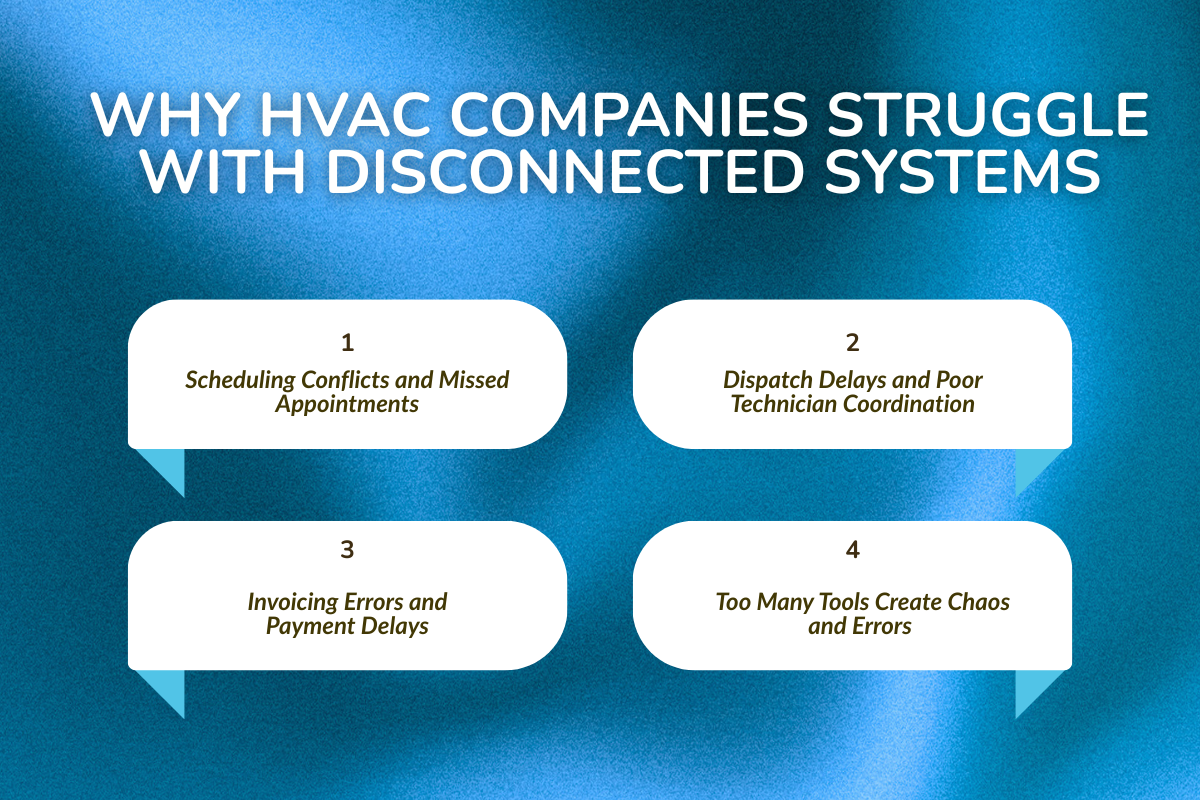
Running an HVAC business without a unified tool is like sailing an uncharted sea, where navigation becomes difficult and hidden obstacles can slow progress.
Let us explore their implications on HVAC project management:
1. Scheduling Conflicts and Missed Appointments
When technician scheduling and dispatching are not done right, it becomes the perfect recipe for missed jobs, double bookings, wasted hours, and technician burnout.
Unclear schedules and a lack of real-time updates often lead to lost leads, frustrated customers, and disengaged employees.
2. Dispatch Delays and Poor Technician Coordination
Creating job schedules and maintaining constant communication with technicians during peak seasons while switching between multiple tabs can quickly turn into chaos for HVAC professionals.
Errors multiply when jobs are scheduled at the wrong address, technicians arrive late, or valuable time is wasted on updates instead of fulfilling urgent requests.
While these mistakes may seem minor, their impact is significant, resulting in lost revenue and missed opportunities.
3. Invoicing Errors and Payment Delays
Most HVAC businesses do not lose money because they do bad work; they lose it because of bad accounting. Manual invoicing leads to mistakes and delays, especially during peak seasons.
Invoices get buried under documents, no automated payment reminders are created, creating a long queue of overdues, and payments get pushed back, which takes a hit on cash flow.
4. Too Many Tools Create Chaos and Errors
As Mark Twain once said, “Too much of anything is bad.”
That is exactly what happens when HVAC businesses juggle multiple tools for scheduling, communication, billing, marketing, and inventory management.
Instead of automation making life easier, teams end up hopping between tabs all day. Admin work piles up, confusion sets in, and small mistakes start slipping through the cracks. Ultimately, managing the tools becomes harder than running the business itself.
What HVAC Management Software Actually Does (Beyond “Just Software”)?
HVAC software is not just a tool; it is the backbone of a more organized, efficient, and growth-ready HVAC business.
What Exactly is the HVAC Management Software?
HVAC management software is a cloud-based, user-friendly single platform designed to streamline day-to-day operations.
It automates routine workflows like job assignment, appointment reminders, and invoicing, while giving office teams and field technicians real-time visibility into job progress and schedules.
It also enables seamless communication, supports compliance and audit checks, sends automated reminders, and integrates with accounting systems for invoice generation, payment processing, and payroll management.
Explore More: HVAC Management Software: Why Operations Managers Are Making the Switch Now.
How HVAC Management Software Centralizes Operations?
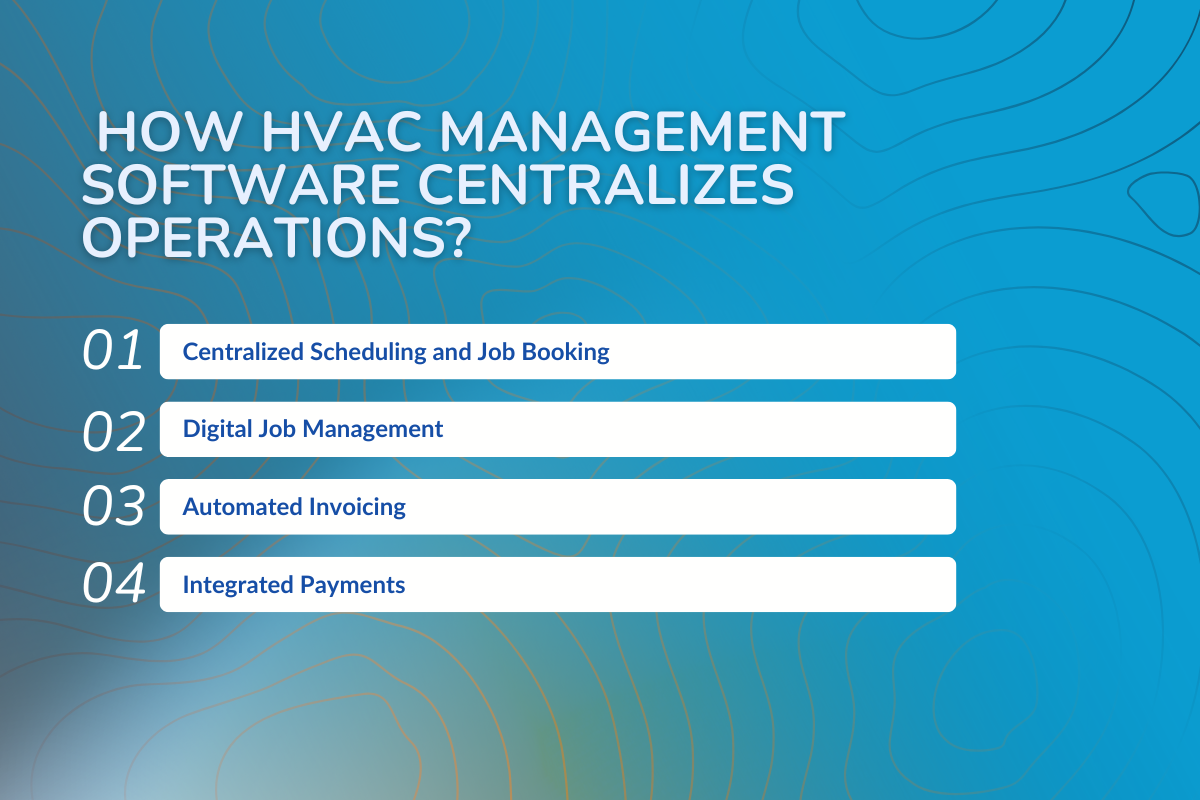
HVAC software tools integrate several key functions into one unified platform, centralizing and streamlining business operations. Let us explore how:
1. Centralized Scheduling and Job Booking
The HVAC scheduling feature provides a seamless single-calendar view to assess projects and deadlines, allocate jobs accordingly, and ensure the right person is on the right job, balancing workload, specialized skill sets, and technician availability. It helps to improve customer satisfaction and reduce no-shows.
2. Digital Job Management
HVAC service software is designed with an intuitive and offline-enabled mobile app that gives office and field teams instant access to job and customer details, real-time job status updates, and photo uploads.
It also enables teams to share proposals with clients instantly and capture digital signatures for service agreement renewals and new contracts, helping to close jobs on the spot without delays.
3. Automated Invoicing
HVAC software seamlessly integrates with accounting systems to generate invoices instantly after job completion.
The software has built-in flat-rate pricing to boost technician productivity. All this allows quotes to be created in seconds, while standardized pricing across multiple HVAC services builds customer trust and helps teams close more jobs faster.
4. Integrated Payments
HVAC technicians to generate invoices directly from their mobile devices immediately after job completion and collect payment on the spot using online pay links, ACH, or card terminals.
HVAC mobile app keeps teams and clients alert with automated notifications for upcoming payments and overdues to keep the business cash flow healthy.
Where HVAC Management Software Creates the Biggest Impact?
HVAC business owners can benefit from the software across multiple areas of operations. Let us take a closer look:
1. In the Office
HVAC management software reduces administrative stress by centralizing core HVAC operations, saving time, minimizing errors, and boosting revenue through greater efficiency.
2. In the Field
Intelligent dispatching leverages real-time GPS tracking and skill-based routing to ensure the right technicians are assigned to the right jobs and equips managers to reschedule to handle urgent bookings. Techs can instantly update job status on the go, without a daily office visit.
3. In Customer Experience
HVAC management software impacts customer experience by automating communication and maintaining consistent service records.
Automated confirmations, reminders, and clear communication reduce uncertainty, while accurate service records and professional invoices build trust. This consistency improves satisfaction and increases the likelihood of repeat business and referrals.
4. In Cash Flow
In financial operations, HVAC management software accelerates billing cycles through instant invoice creation, automated payment reminders, and integrated payment processing. These capabilities reduce payment delays, improve invoice accuracy, and support healthier cash flow management.
Before evaluating tools or features, it helps to understand the basics—this overview explains it well: HVAC Management Software: What Every Contractor Should Know.
How to Choose the Best Software for an HVAC Business?
Software is the backbone of efficient operations, but feature overload can be misleading. The presence of countless tools in one platform should not be the deciding factor. What truly matters is adopting software that fits your business needs, simplifies processes, and supports long-term growth.
Here are must-have features to help turn your HVAC business into a high-performing operation:
1. Integration with Accounting & CRM Systems
The software must integrate seamlessly with accounting to automate payment processing that drives higher customer satisfaction and stronger financial health.
On the other hand, customer relationship management (CRM) features are important in HVAC software to manage client information and service history.
2. Mobile Access for Field Teams
The software must work wherever the HVAC job is done. The solution you choose should include a mobile app that allows technicians to access job details, update job status in real time, and continue working with offline functionality even when connectivity is limited.
3. Customer Support System
Even the best software fails if teams don’t know how to use it properly. Ongoing customer support and practical training play a major role in successful implementation and long-term adoption.
Look for vendors that offer responsive support, clear onboarding, and real-world guidance. This ensures your team actually uses the software as intended and gets value from it over time.
4. Automated Invoicing and Payment Processing
Billing delays directly affect cash flow. HVAC software should automatically convert completed jobs into invoices and support multiple payment methods, including online payments.
Automated invoicing reduces manual errors, speeds up collections, and ensures consistent pricing. Payment reminders and integrations with accounting systems help maintain predictable cash flow, especially during busy seasons.
5. Real-Time Job Visibility and Status Tracking
Managers and office teams need live visibility into what’s happening in the field. HVAC software should provide real-time job status updates so teams can track progress, respond to delays, and communicate accurate information to customers.
Without real-time visibility, decisions are based on assumptions instead of data, leading to miscommunication, scheduling errors, and customer dissatisfaction.
What makes HVACBase the Smart Choice for Efficient HVAC Operations?
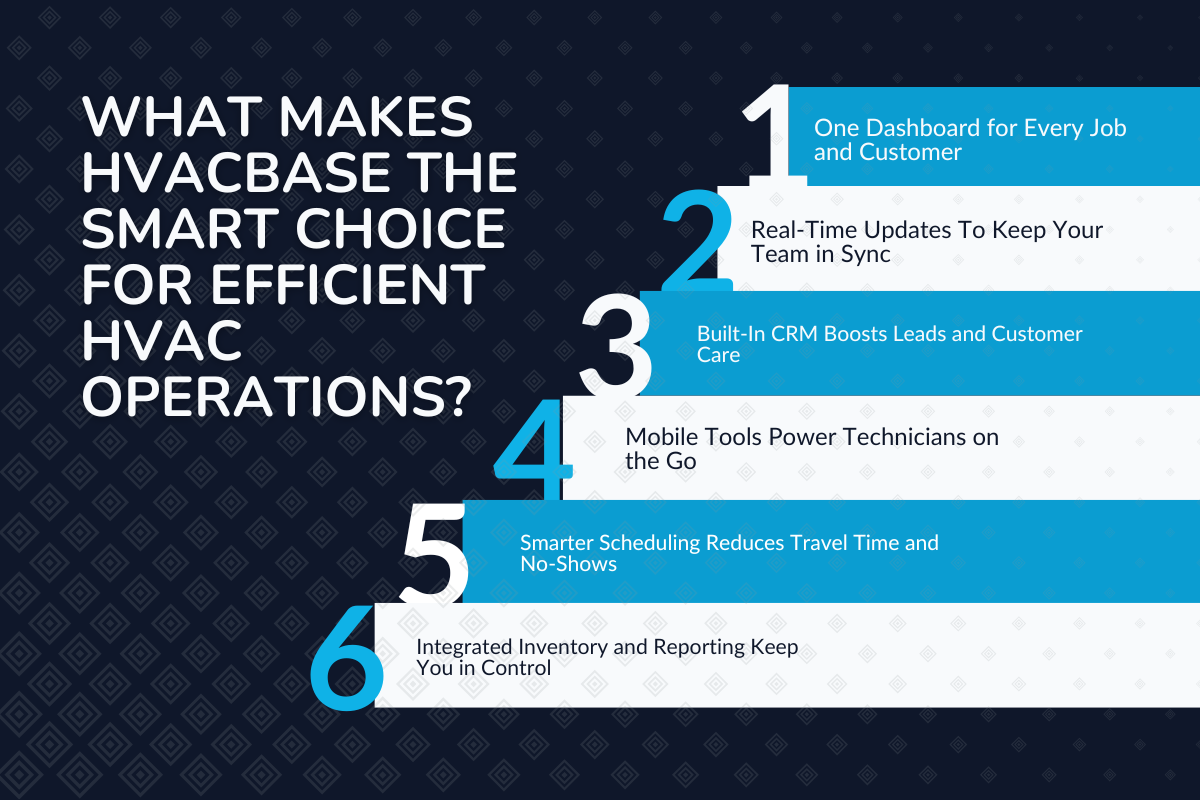
The HVAC industry needs the best software to automate every task that turns into a win for your business. Let us unlock the features that make HVACBase the right solution:
1. One Dashboard for Every Job and Customer
HVAC service software offers a unified platform that streamlines a multitude of activities like marketing, scheduling, dispatch, invoicing, payments, inventory management, communication, and CRM with real-time insights.
It eliminates the need to switch between multiple tabs and offers API integrations for seamless scalability. Automating routine tasks in HVAC companies can be cost-effective, as it will handle a larger volume of jobs without increasing staff.
2. Real‑Time Updates to Keep Your Team in Sync
Real-time updates from the field to the office and vice versa keep every team member in sync. This feature eliminates delays and improves response times for urgent service orders to keep the teams moving efficiently.
3. Built‑In CRM Boosts Leads and Customer Care
HVAC Management Software stores all customer data in a centralized repository and provides a real-time communication platform to keep office and field teams connected.
Automated reminders and follow-ups ensure every lead in the pipeline stays active, increasing lead capture and engagement rate, while built-in client communication keeps customers updated on upcoming appointments and service agreement renewals.
4. Mobile Tools Power Technicians on the Go
A user-friendly mobile app that works offline lets technicians access important information such as customer information, job details, schedules, optimized directions, and service agreements from anywhere at any time.
Field techs no longer need to return to the office for manual data entry; they can upload job updates, photos, videos, and documents on the go, ensuring nothing gets missed through the cracks.
Did you know? Mobile access reduces administrative tasks by nearly 30%.
5. Smarter Scheduling Reduces Travel Time and No‑Shows
Automated dispatch matches jobs to technicians based on skill, availability, and live location, which maximizes coverage in every workday.
Technicians' schedules are based on real-time weather and traffic conditions, optimizing the shortest routes to reduce drive time and increase job completion rates.
6. Integrated Inventory and Reporting Keep You in Control
The software equips office staff to manage inventory with precision and accuracy. It automates stock monitoring, sends alerts for low levels, and streamlines procurement, which saves costs and reduces errors.
HVACBase software provides data-driven insights that reveal what’s working and what’s not, helping HVAC businesses eliminate inefficiencies by making informed decisions.
Preparing Your HVAC Business for the Future with Centralized Technology
The demand for U.S. HVAC service management software is growing rapidly, driven by technological advancements. This shift is powered by cloud-based solutions, IoT, and AI, which are transforming operational efficiency. Let’s explore what HVAC contractors need to stay equipped for this new wave of technology:
1. IoT-Enabled Systems
IoT sensors send alerts when problems are detected, enabling contractors to prioritize calls to maximize service efficiency, boost customer satisfaction, and unlock new revenue streams.
2. AI & Machine Learning
AI-powered predictive maintenance enables smarter inventory management and service planning, identifying potential equipment failures to prevent costly breakdowns.
3. Smart Home & Building Integrations
Modern HVAC operations increasingly interact with smart buildings and home automation systems. Integration with these platforms enables remote monitoring, energy optimization, and faster diagnostics.
Leading HVAC software providers are already incorporating these capabilities to support connected environments without adding operational complexity.
4. Sustainable HVAC Solutions
Sustainability is no longer optional. Centralized software helps contractors monitor energy usage, track system performance, and support energy-efficient service recommendations.
These insights benefit both customers and businesses by reducing operating costs while aligning with environmental standards.
Smart Reminder: Energy Optimization reduces energy consumption by 47% by adjusting settings based on occupancy and real-time energy pricing.
Conclusion: One Platform to Run Your Entire HVAC Operation
If your workflow depends on juggling multiple tabs, you are inviting chaos and costly mistakes.
HVAC service software solutions provide a unified platform that brings every department under one umbrella, enabling teams to work on the same real-time data with intelligent automation designed to improve operational efficiency.
Before the peak season hits, you need the best HVAC software to stay organized to keep schedules clear, track every job update in real time, and give managers full control over payments and inventory.
Caution: Do not skip the free demo of the all-in-one HVACBase Software that can prove to be a game-changer for your HVAC operations.
Get in Touch with HVACBase experts to guide you through software solutions built to run every HVAC business smoothly without the chaos and stress.
FAQs
1. Is HVAC Business Software Worth it for Small HVAC Businesses?
Yes, absolutely! HVAC service software solutions are highly beneficial for small businesses, transforming chaotic tasks into an organized and streamlined digital workflow. This boosts efficiency, reduces errors, and enhances customer satisfaction, enabling smoother and faster business growth.
2. How Much Does HVAC Management Software Typically Cost?
HVAC business software typically ranges from $40 to $300 + per month for basic plans, with pricing varying based on subscription features, company size, and the number of users.
3. Can HVAC Management Software Integrate with Accounting and Payment Tools?
Yes! HVAC invoicing software typically integrates with accounting solutions, such as QuickBooks Integration, providing seamless data synchronization, automated invoice creation, and automated reminders for timely payments. It also offers online payment portals, enabling faster processing and healthier cash flow for your business.
4. How Does Centralized HVAC Software Improve Profitability?
HVAC software solutions streamline service operations, boosting overall productivity and business efficiency. This enhances customer satisfaction and enables your team to attract, engage, and convert new leads for higher revenue growth that maximizes profits.
Have questions or need personalized advice?
Talk to an Expert Today and let our construction specialists guide you to success.
Related Posts