HVAC Computer Software That Brings Office, Dispatch & Field Together
January 13, 2026
Running an HVAC business today is different from five years ago. Jobs are faster, customers expect instant updates, and teams work across various locations.
Many companies still rely on disconnected systems for calls, billing, and scheduling, while technicians have partial job info on their phones.
These gaps cause delays, confusion, and extra costs. Modern software unifies workflows into one system, making it essential for protecting margins, enhancing customer satisfaction, and scaling effectively.
What was once optional is now a strategic necessity, changing how HVAC businesses operate.
How HVAC Computer Software Connects Office, Dispatch, and Field Teams
HVAC software serves as a shared system, giving live data and visibility across teams. Office staff can monitor job progress without disturbing technicians.
Dispatchers assign and modify jobs based on real-time availability and location. Technicians arrive well-equipped with job details, customer history, and equipment info.
This shared access cuts unnecessary calls, enhances scheduling, and allows proactive updates. Over time, HVAC firms see smoother workflows, fewer errors, and easier peak season management.
Key Takeaways
- Modern HVAC software connects office, dispatch, and field teams in real time, eliminating communication gaps.
- Automated scheduling and route optimization reduce downtime and improve daily job capacity.
- Technicians access job history, customer info, service agreements, and pricing on mobile devices, boosting first-time-fix rates.
- Estimates, work orders, invoicing, and payments flow seamlessly in one platform, saving time and reducing errors.
- Performance tracking and reporting provide actionable insights for coaching, operational improvements, and business scaling.
Curious How Connected HVAC Workflows Actually Work?
When office teams, dispatchers, and field technicians work from the same system, everyday HVAC operations become faster, clearer, and more reliable.
Get a closer look at how connected HVAC workflows reduce errors and improve service delivery. See It In Action.
The Communication Gap Holding HVAC Businesses Back
Most HVAC businesses don’t struggle because of demand or technical expertise; they struggle because information doesn’t move smoothly between teams.
When scheduling, dispatch, billing, and field updates live in different systems, small gaps turn into missed updates, delayed invoices, and frustrated customers. As HVAC companies grow, this fragmentation becomes more complicated to manage.
Modern HVAC service software centralizes communication and job updates, ensuring office teams, dispatchers, and technicians stay aligned, especially during busy seasons when accuracy matters most.
1. Office Teams Lack Real-Time Job Visibility
Office employees often hear customer frustrations first, but are last to know field updates. Without real-time progress, service windows become estimates, follow-ups turn into apologies, and invoicing suffers from poor visibility.
Without centralized HVAC software, office staff depend on technicians for updates, which is inefficient and inconsistent.
Modern HVAC management software solves this by automatically synchronizing job status, enabling proactive communication and timely invoicing.
2. Dispatchers Overloaded with Manual Coordination
Dispatchers frequently act as human connectors between multiple systems. Schedule changes handled through calls and texts increase errors and stress.
Without accurate time tracking or GPS data, dispatch decisions rely on assumptions instead of facts. As job volume grows, this approach doesn’t scale.
Advanced HVAC service software replaces guesswork with real-time data. Dispatchers assign jobs based on technician availability, proximity, and skill set, while route optimization reduces travel time. This transforms dispatching into a strategic workforce management function.
3. Field Technicians Working with Incomplete Information
HVAC technicians often arrive at job sites without a full context. Missing job history, unclear job details, or a lack of material cost visibility lead to longer diagnostics and rework.
Technicians waste time calling the office instead of providing service. HVAC techs gain real-time access to material costs, aiding expense management and billing.
Mobile HVAC software lets technicians arrive prepared with customer history, service agreements, flat-rate pricing, and equipment details, boosting first-time-fix rates and customer satisfaction.
What HVAC Computer Software Really Means Today
HVAC software was once focused primarily on scheduling and invoicing. Today, it runs the entire business from a single connected platform.
Modern HVAC software tools support everything from field service management to automation and record-keeping, helping companies streamline operations, retain customers, and improve accountability.
This evolution reflects a broader industry shift toward efficiency, transparency, and better customer experiences.
1. More Than Scheduling-Connected Operating System
Modern HVAC business software combines customer relationship management, scheduling and dispatching, inventory management, and financial tools into one system.
Many HVAC software solutions offer seamless QuickBooks integration, which helps streamline invoicing and reduce manual data entry.
By eliminating redundant tools, HVAC business management software improves adoption and reduces training overhead. Office staff, dispatchers, and technicians all work within one system.
2. One Platform, One Workflow
Jobs move digitally from the first customer call to completion without manual handoffs.
Estimates convert into work orders, which then become invoices with automated payment processing and accounting integration.
This unified workflow is especially valuable for HVAC contractors managing service agreements or complex commercial projects, ensuring complete job histories, accountability, and repeat business.
3. Real-Time Sync Across Office and Field
When technicians update job progress, the office sees it instantly.
Photos, notes, time tracking, and signatures are captured on-site, improving communication and reducing paperwork.
This real-time synchronization also supports compliance, reduces disputes, and strengthens customer trust through accurate documentation.
Want to know more about how this actually works? Go through: A Complete Beginner’s Guide: What Is HVAC Software.
What Are the Key Features That Keep HVAC Office, Dispatch & Field in Sync?
The best HVAC software solutions eliminate friction instead of adding complexity.
Features like automated appointment reminders and online booking that can be completed in just a few clicks improve customer trust and convenience by streamlining communication and scheduling.
HVAC software can also automate appointment reminders and provide accurate service windows, further enhancing reliability and user experience. Comprehensive feature coverage ensures that every stage of the HVAC service lifecycle is managed within a single system.
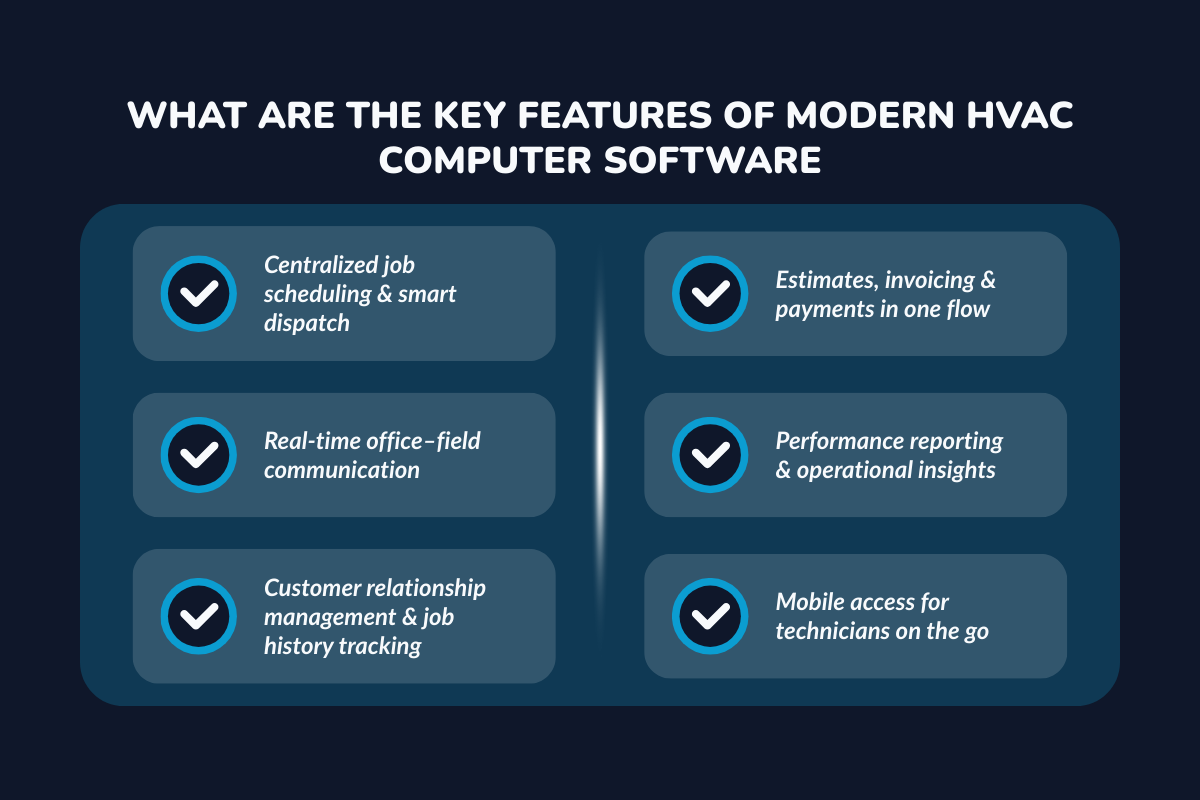
1. Centralized Job Scheduling & Smart Dispatch
Scheduling tools use technician availability, skills, and location to assign jobs efficiently.
Dispatchers assign jobs in a few clicks while balancing workload and optimizing routes. This reduces downtime and improves daily capacity.
AI-enhanced dispatching further improves efficiency by predicting delays and dynamically adjusting schedules.
2. Field–Office Communication in Real Time
Built-in communication tools replace scattered calls and texts.
When technicians update job status, office employees and dispatchers see it immediately. This clarity improves customer communication and reduces internal follow-ups.
Managers gain visibility without micromanaging, and technicians stay instantly informed of changes.
3. Customer Relationship Management & Job History Tracking
Customer management tools keep comprehensive interaction records, enabling HVAC contractors to access service history, equipment info, and invoices in one place.
This facilitates personalized service and quicker issue resolution.
For instance, HVACBase offers robust features that enhance technician performance and customer satisfaction. Detailed history fosters repeat business and long-term relationships.
4. Estimates, Invoicing & Payments in One Flow
HVAC invoicing software connects estimates, invoices, and payment processing into one seamless workflow.
Technicians collect payments at job completion, reducing delays. Accounting integrations minimize reconciliation work and improve financial accuracy.
This unified flow improves cash flow and reduces billing disputes.
5. Performance Reporting & Operational Insights
Performance metrics show how the business is really operating.
Managers track job costs, completion times, and technician productivity. These insights support smarter pricing, better workforce planning, and improved profitability.
Historical reporting also identifies training needs and operational bottlenecks.
6. Mobile Access for Technicians on the Go
A strong mobile app is essential for modern HVAC operations.
Technicians access job details, customer history, flat-rate pricing, and service agreements directly from the field. They update progress, capture photos, and process payments without returning to the office.
Mobile-first platforms reduce paperwork, shorten job cycles, and improve service quality.
Eager to explore the top HVAC field service apps transforming technician workflows? Read the blog Mobile Apps for HVAC Technicians: The Modern Toolbox.
How to Choose the Right HVAC Computer Software
Choosing HVAC computer software isn’t about chasing features. It’s about finding a solution that matches how your business actually runs.
HVAC software cost typically ranges from $40 to $300+ per user per month, depending on features and scale. Many vendors require demos or trials before sharing pricing details.
1. Understanding Your Operational Complexity
Residential HVAC companies, commercial contractors, and mixed-service businesses operate differently.
Software should support your job volume, technician count, and service types without forcing workarounds. Overbuilt systems slow teams down, while underpowered tools limit growth.
2. Integration with Accounting and CRM Tools
Seamless integration reduces manual data entry and financial errors.
When job costs, invoices, and payments sync automatically, financial data stays accurate. HVAC business owners often prioritize software that integrates smoothly with accounting tools.
3. Automation and Intelligence Capabilities
Automation handles repetitive tasks like appointment reminders and work order creation.
Nowadays, many HVAC platforms will also use predictive insights to flag scheduling conflicts or potential delays, helping managers stay proactive rather than reactive.
4. Ease of Onboarding for Office and Field Teams
User-friendliness directly affects adoption.
Field technicians need intuitive mobile access that works in real job-site conditions. Successful onboarding includes real-world scenarios, not just tutorials.
When software fits daily workflows, adoption improves naturally.
Implementation Blueprint for HVAC Teams
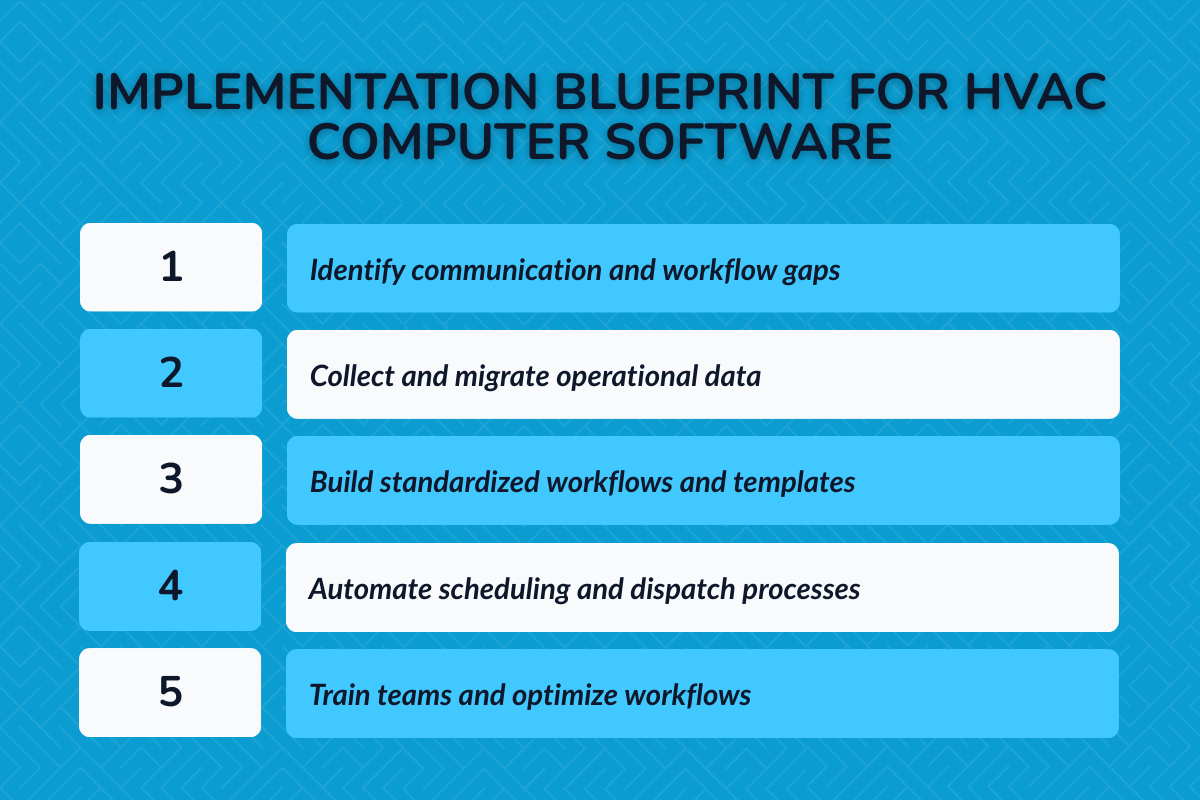
Day-to-day HVAC operations often break down when teams rely on disconnected tools that don’t share real-time information.
- Disconnected systems slow operations: Separate tools for scheduling, dispatch, invoicing, and field updates fragment data and create avoidable errors.
- One connected workflow for all teams: HVACBase unifies office employees, dispatchers, and field technicians in a single HVAC software platform with real-time access to job details, customer information, and technician availability.
- Streamlined operations at scale: By centralizing scheduling, customer management, field service management, and financial tracking, HVACBase reduces manual data entry and maintains accuracy as job volume increases.
Curious how HVACBase removes guesswork from daily operations? Explore HVAC Computer Software built for growing HVAC businesses.
In a Nutshell
HVAC software brings clarity to complex operations by replacing fragmented communication with shared visibility.
Office employees, dispatchers, and HVAC technicians work from the same system, improving coordination, job completion speed, and accountability.
As HVAC companies scale, connected HVAC management software becomes essential for maintaining consistency, customer satisfaction, and operational efficiency.
Why HVACBase?
HVACBase is explicitly designed for HVAC business owners who need more than basic scheduling tools. It combines HVAC service software, customer relationship management, workforce management, and HVAC invoicing into one unified platform.
HVACBase streamlines real-world HVAC workflows, enabling teams to quickly and confidently handle daily tasks such as assigning jobs, tracking progress, managing service agreements, and managing financial data. Book your demo now!
FAQs
1. What is HVAC computer software, and how does it help HVAC businesses operate efficiently?
HVAC computer software is a centralized HVAC business management solution that helps HVAC companies manage scheduling and dispatching, customer management, invoicing, field service operations, and workforce coordination from one system, reducing errors and improving efficiency.
2. How does HVAC business software improve customer management and customer satisfaction?
HVAC business software improves customer management by maintaining detailed records of job history, service agreements, communication, and payments, allowing HVAC contractors to deliver personalized service, timely updates, and a better overall customer experience.
3. Is HVAC software suitable for small HVAC businesses and growing HVAC companies?
Yes, modern HVAC software solutions are built for small businesses and scaling HVAC companies, offering tools for scheduling, dispatch, invoicing, and workforce management that grow alongside the business without requiring multiple systems.
4. How does HVAC service software support HVAC technicians in the field?
HVAC service software provides field technicians with mobile access to job details, customer information, material costs, time tracking, and job progress updates, helping HVAC techs complete jobs efficiently at every job site.
5. Can HVAC invoicing software reduce manual data entry and improve financial tracking?
Yes, HVAC invoicing software automates estimates, invoices, payment processing, and accounting integration, reducing manual data entry while improving visibility into job costs, financial data, and overall business performance.
6. Why is HVAC business management software essential in today’s HVAC industry?
HVAC business management software is essential because it helps HVAC professionals streamline operations, coordinate office and field teams, improve customer communication, and meet rising expectations for fast, high-quality HVAC service.
Have questions or need personalized advice?
Talk to an Expert Today and let our construction specialists guide you to success.
Related Posts